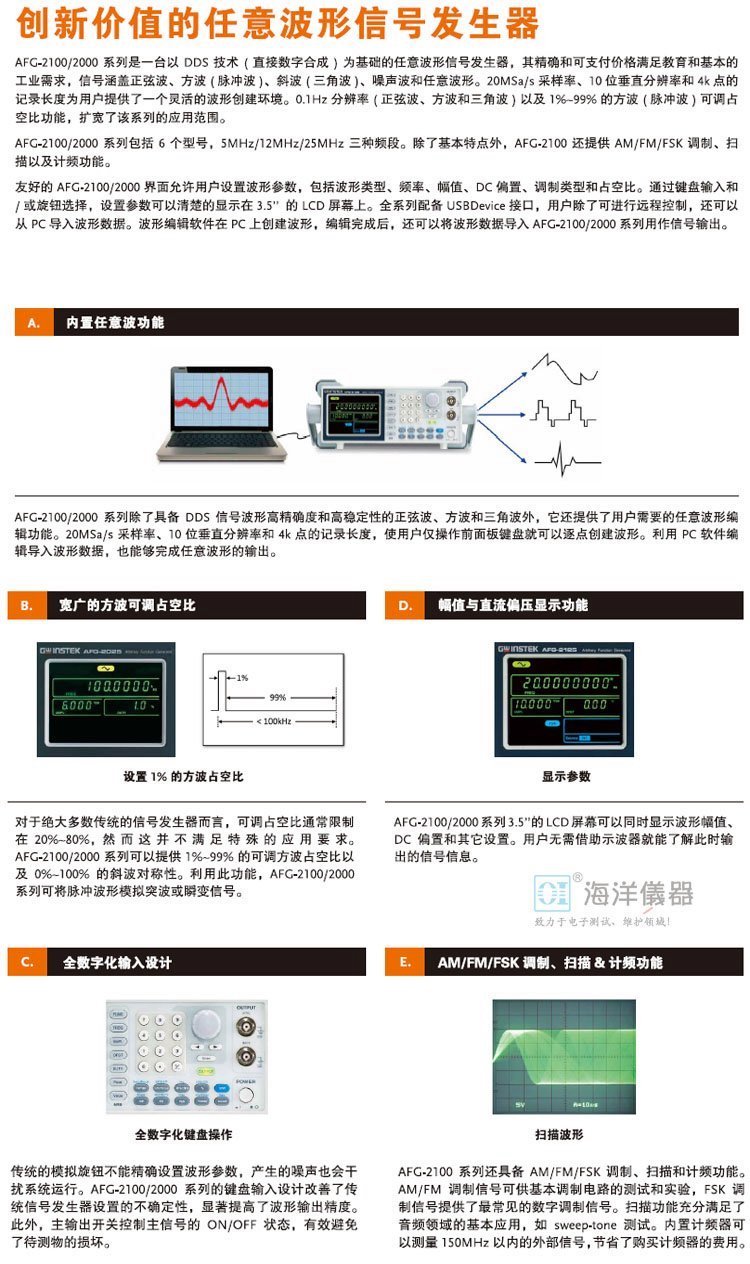
The afg-2100/2000 wave-shaped signal generator is an arbitrary waveform based on the dds technology, covering the sine wave, square wave, triangle wave, noise wave and 20msa/s sampling rate. The resolution of 0. 1hz and 1 ~99% of the apogee (pulse waves) can be adjusted to space ratio functions, greatly expanding its application。
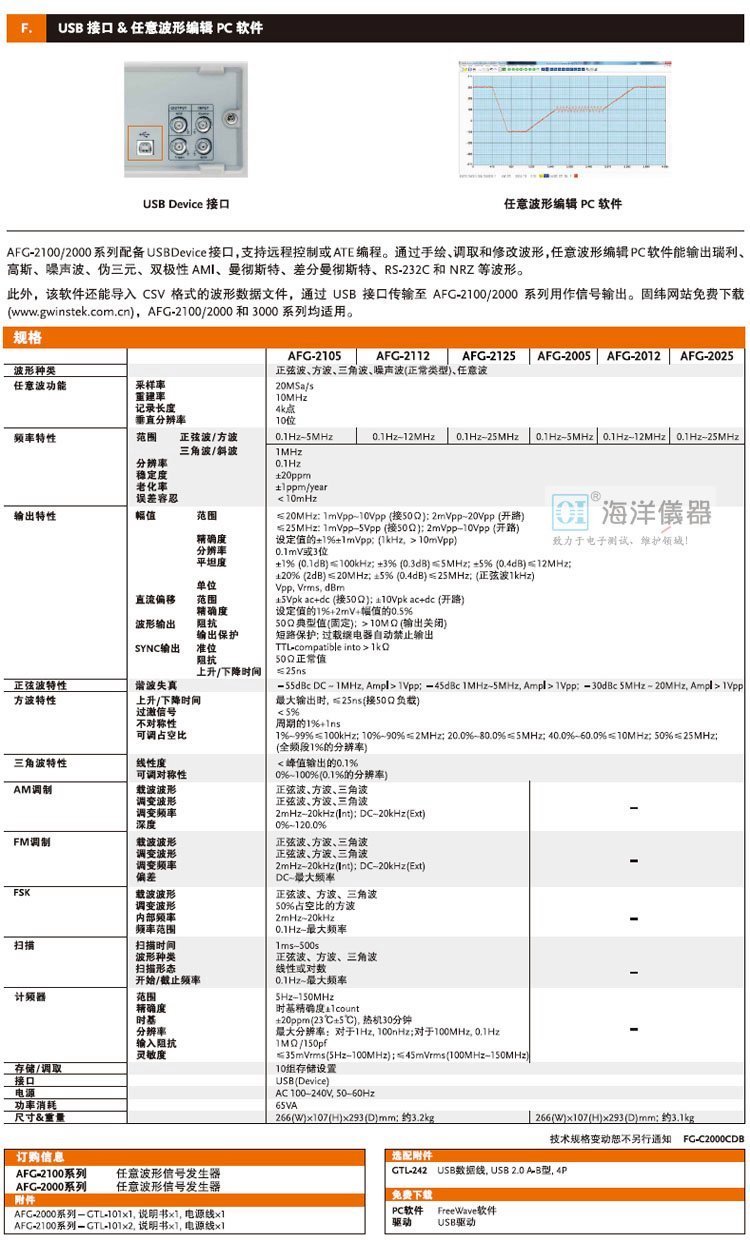
The afg-2100/2000 series consists of 6 models and 5 mhz/12 mhz/25 mhz frequency bands. In addition, the afg-2100 series provides am/fm/fsk modems, scanning and frequency functions. Using a fully digitized operational design for parameter settings, the three coloured lcds of 3. 5 ' are displayed and the parameters of the settings are clearly displayed. A full series of usb data interfaces will allow users to import wave-shaped data from the pc in addition to remote control。
Inline any wave function
The afg-2100/2000 series provides a random wave editing function for 20msa/s sampling, 10 vertical resolution and 4k log length. Users can edit random waves by setting up panels or using exclusive wave-based editing software。
Display function for band values and straight current bias
In addition to setting parameters, afg-2100/2000 also displays the pressure bands, direct flow bias readings on the lcd screen. Three bands of vpp, vrms and dbm are available for user selection and replacement。
Large square waves can be adjusted to space ratio
The fpg-2100/2000 series provides a space ratio of 1% to 99%. Using this function, pulsed waveforms can simulate a sudden wave or a transient signal。
Am/fm/fsk, sweep, counter functionality (afg-2100 series only)
The afg-2100 series incorporates three variants of am/fm/fsk, waveform scanning and frequency functions. The frequency counting function of 150 mhz resulted in savings in the purchase of additional counters。
Full digital key design
The full-digitized key design of the afg-2100/2000 series has improved the uncertainty of traditional signal generator settings and significantly increased the accuracy of wave output. 3. 5's lcd screen, which allows users to observe changes in parameters during the adjustment。