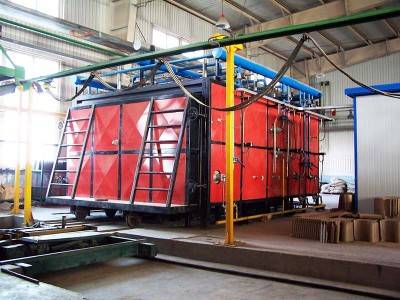



A shuttle kilnIt's a modern intermittent kiln. Its structure is similar to that of a tunnel kiln. It consists of both the kiln room and the kiln car. The pile is placed on the kiln scaffolding, which is pushed into the kiln room. The kiln car and its products are pulled out of the kiln room when they are cooled. In the out-of-cooking, the kiln car moves like a shuttle on a knitter, so it's called a shuttle kiln。
A shuttle kiln is similar to a tunnel kiln and is performed outside the kiln. The shuttle kiln is adaptable to the burning of products and can burn into products of different sizes, shapes and materials。
It can be used not only as the main burning equipment for production, especially for small quantities and varieties, to meet the diversified needs of the market, but also as auxiliary burning equipment, such as reburning of products, testing of new products, etc. It should be an indispensable burning device for the ceramic industry。
In addition, the shuttle kiln is structured in such a way as to cover a small area, so that the investment in large shuttle kilns is lower than in small and medium-sized tunnel kilns with equivalent output。
The heat consumption of the shuttle kiln is higher than that of the tunnel kiln and the tunnel kiln. As a result of the development of light-quality fire-resistant bricks, especially fire-resistant fibres, combustion technology, residual heat-use technology and the design level of kilns have improved, the shuttle kiln is moving towards energy-saving, large-scaleization, with thermal consumption decreasing, better than some tunnel kilns. Therefore, efficient and energy-efficient shuttle kilns should be of a reasonable type for small and medium mass ceramic production. The shuttle kiln has grown rapidly in western developed countries and has been widely used in europe and the united states in recent years。
A shuttle kiln combustion system: placed on both sides of the kiln wall. Depending on the fuel used, the structure and layout of the combustion room are different。
When burning oil or gas, one or more burners may be set at the height of the kiln. After entering the flame shuttle kiln, heated from the top down。
01) the high-temperature thermal flue gas generated by combustion of the burner flows from the gap between the two sides of the kiln to the top of the kiln, and then downwards through the cracks between the scavenging materials of the kiln car, which, in the process, transmits the heat to the kiln car and makes it a product。
(02) thermal smoke from the flue gas itself becomes waste gas, draining from the flue system and chimneys into the atmosphere. Since thermal flue flow from top to bottom is consistent with the hydrodynamic “dispersible vertical flow law”, the temperature in the shuttle kiln is more even and does not appear to be a tunnel kiln-like phenomenon, which is a major advantage of the shuttle kiln。
From http://www. Sdaixier. Com
