In order to provide you with a full and systematic understanding of the core dimensions of the cold, the underlying concepts, working principles, cold classification, and application values and models。
I. What is cold? (basic concepts)
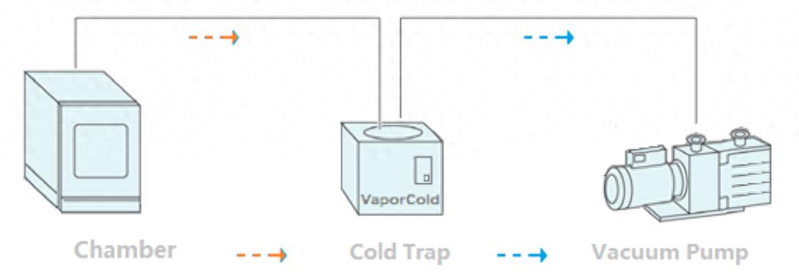
Cold trip, in short, is a cryogenic trap between a vacuum container and a vacuum pump。
Ii. Rationale
The working principles of the cold are based on the mechanisms of transformation in physics:
When gas molecules move and come into contact with cold walls at temperatures well below their condensing or boiling points, molecules quickly lose their kinetic energy, with variations - from gas to liquid (cooled) or directly to solid (ice/frost). In this way, gas molecules are “captured” on cold walls and no longer participate in gas circulation in vacuum systems。
Iii. Classification of cold air
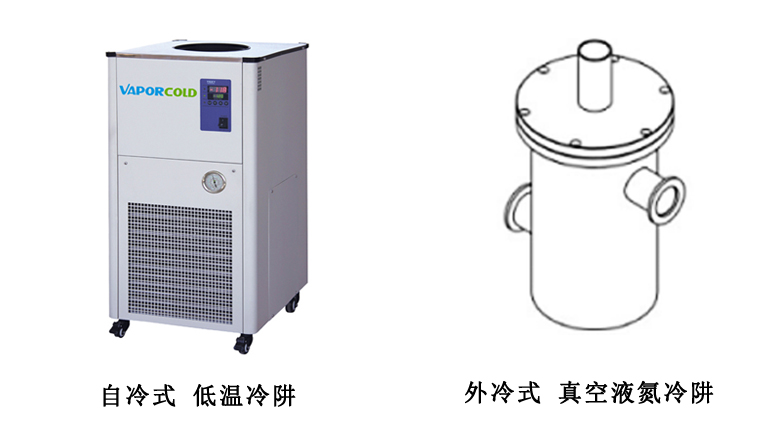
Depending on the mode of cooling, cold beams are divided into two main categories: self-cooling and external cooling。
Self-cooled cold
2. Outer cold cold
Iv. Core values of cooling in vacuum operations
1. Index levels to increase vacuum efficiency
Residual gases in vacuum rooms are mainly water and gas. In the case of water, for example, 1g ice expands to about 10,000 l water vapours in a vacuum of 0. 1 torr. It is extremely inefficient to remove these huge gases from vacuum pumps alone. The cooling acoustics condensate water vapours instantaneously through low temperatures, significantly reducing the volume of gases and significantly increasing pumping efficiency. This is why dry tanks, centrifuges, must be equipped with cold beams。
Interrupting corrosive gases and extending the life of the pump body
Many chemical experiments produce acid or corrosive gases. Direct entry into a vacuum pump can corrosive the metal parts and degrade the pump oil. Refrigeration as a “barrier” collects corrosive gases before they enter the pump, thereby effectively protecting the vacuum pump and extending its useful life。
3. Environmental protection and recycling
Recovering hazardous solvents through cooling and preventing direct discharge into the atmosphere through vacuum pump vents reduces environmental pollution and also achieves solvent recycling。
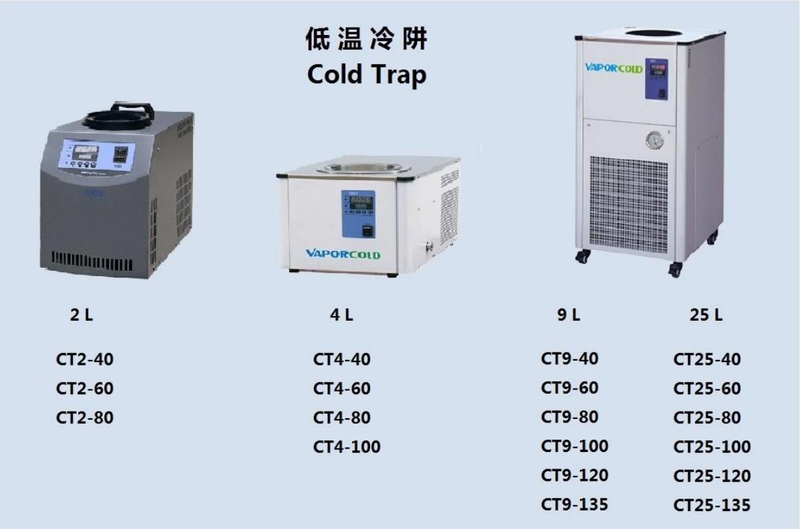
V. Introduction to typical products: the vapoorcold series
Vaporcold is a typical high performance self-cooling cold cold, designed to meet modern laboratory and industrial needs。
Vi. Summary
Vapour generation is inevitable in vacuum drying and pressure-retarding processes. The installation of cryogenic chills on vacuum pipe roads is not only a necessary means of protecting equipment but also a key to improving process efficiency. Long-flow instruments with low-temperature chills can significantly reduce drying and distillation time by using their powerful suction effect (cryopumping) and are indispensable “accelerators” and “protecting gods” in vacuum systems。