Core perception: the trade-off logic of keyword accuracy & flow size
To promote keywords, the essence is the choice of words: all keywords cannot escape two core dimensions — “precision” and “flow volume” — without absolutely perfect words, only words suitable for their own shop。
Using the whole of the warmer cup, for example, we'll take you to the bottom of the line:
1. Magnificent words: cups
The volume of traffic is extremely high, covering the users of the web-wide search cups, but with very low accuracy. All kinds of products, including glass glasses, tons of barrels, tea cups, thermostats, etc., have a plethora of user requirements, a high amount of waste after dropping, a high pc (click unit price), a very poor transformation, and new hands, small traders have given up。
2. Industry core word: a warm cup
It is a generic word, with sufficient traffic and better precision than a generic word, but it remains broad. Covers all types of cups such as classics, outdoors, children's, women's, brands, etc., with high percentages of non-precision demand users, high competitions, high single-click costs and limited funding not recommended。
3. Disaggregated precision: children's warmth cups
The precision has increased significantly, with direct targeting of users with children's water cups, and the demand of the population is clear, with a stronger intent to convert, and is the core term for small and medium-sized businesses. The volume of traffic is moderate, taking into account accuracy and exposure, and the tolerance rate is extremely high。
4. Ultra-precision long end words: children's hot cup cartoons/children's hot cups picachu
The precision is full, matching the exact user of an ip combination, the cartoon cup, and the will to convert is strong。
But fatal shortboards: the volume of traffic is extremely small, there are few single-day exposures and few hits, and single-handedly such words cannot afford the flow of shops and can only be cast as a batch of supporting words。
The golden rule of the new word
1. Non-blind pursuit of words: large flow of words, poor precision, fast burning of money, new stores unable to compete
2. Not limited to super-precisions: word flows are too small and must be multiple-worded
3. The main thrust is to break down the second-stage precision with a few long-tail precisions to balance flow and transformation。
Keyword vs population outreach: product fit core distinction
Many vendors argue about whether the opening words of their products should be popularized by the population, bearing in mind the core finding that there is a precise breakdown of adjectives, a well-defined product, and priority keyword promotion。
Products suitable for the promotion of keywords (predominant)
The product has clear generic and subdivided attribute terms, and users proactively search for precision needs:
- temperature cups, valves, household electricity, hardware, mother-child breakdown, etc.
Users search with clear targets, the accuracy of keywords directly determines the quality of the flow and corresponds to a search for competitive models。
Products more suitable for popularization (non-targeting)
There are no uniform criteria for the broad term, the subdivisions, and the user is passive and rarely accurate:
- women's dress, dress with flowers, dress with small styles, etc
There are tens of millions of products of the same type, with no fixed precision adjectives, which can lock a precise population through keywords, and rely on crowd packs, labels and grass for better results。
Note: there is no absolute fit, only a probability priority, and newcomers follow this pattern first, and then fine-tune at a later stage based on data。
Iii. Promotion of the four main marketing goals in the background of keywords (newers only understand the basis)
New keyword projects will include search cards, trend stars, flow cards, and a self-defined roll-out of four models, with newers not having to look at all, focusing on the most commonly used and practical "search card slots"。
1. Search for card slots (novice)
Core: locked search for advertising posts, self-selected words, autonomous cards, most manageable and best suited for new hands。
The system provides four types of high-quality word selection channels with a zero base of direct reference:
- core card words: product core precision, preferred
- shop-specific words: branding, shop lines, precise flow of elderly customers
- prescripted words: subtitling thermal search words, subtitling product categories
- industry hot/trend opportunity words: a recent search for new and rising words suitable for incremental traffic。
It also supports the search for synonym expansion, input into product cores, automatic system transfer of derivatives and initial screening and placement testing of beginners。
2. The other three models are simple recognition
- trend stars: the main hit industry surges, suitable for hot spot payments
- flow gold card: high-level flow magnification tool, not to touch new hands
- self-defined promotion: high-level fine fine-tuning, zero base need not operate。
Iv. Three matching models: broad/centre/precision
The selection of words must be accompanied by a matching method that directly determines flow accuracy and volume, and the underlying logic must be understood:
1. Precision matching
Users must search for identical keywords before advertising。
Characteristics: very small flow, highest accuracy, stable transformation, suitable for high precision long end words。
2. Broad matching
Users search for relevant derivatives, synonyms, associated words, all trigger advertising。
Characteristics: very high flow, lowest accuracy, easy to run waste flow, carefully used。
3. Centre matching
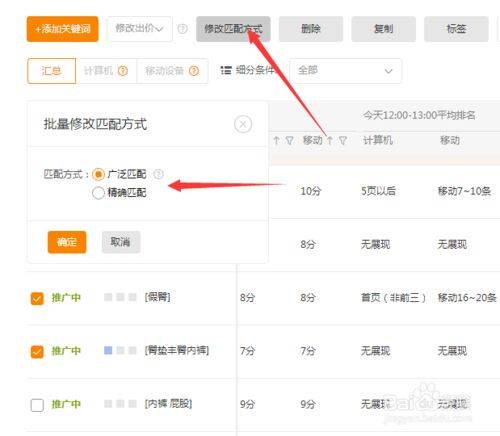
In between, balancing flow and accuracy is a universal compromise for new hands。
The next step is not to be remembered: the first priority for the starter is "centre matching + precision" , steady data, less pedals, and then flexible transitions after the end。
V. Flow wisdom: the advantages and disadvantages of the word selection (new hands to avoid pits)
Flow info = the system will automatically help you find words, expand traffic, match crowds。
- advantages: no manual choice of words is necessary to dig into artificially neglected cold words
- disadvantages: extremely random, easy to match irrelevant generic terms (e. G. Valves to electrician terms), producing inefficient consumption。
Newcomers suggest
The pre-manual choice of words is the main one, the cut-off flow is the manual precision first; the base data are available, the flow logic is understood, then the scaling is activated as appropriate。
Vi. Detailed card pattern: first article/first three/first page
Searching for three locations at the core of the card, the more forward, the better traffic, and the more expensive the pc, the newbies will choose as needed:
1. First article
The search page is number one, with the largest traffic, the highest quality of users, suitable for the impulsive consumer category, the male demand category (mouse, hardware, utensils)。
Disadvantages: very high unit cost of hits, high consumption rate, no preferred choice recommended by newcomers。
2. Top three (first best option)
The ranking is stable at the top of the search for advertising, with sufficient traffic and high accuracy, with the pc being lower than the first, with the highest value for money, 90 per cent suitable for new handshops and amortization of the main push。