China news agency (ccps) quest 15 june: visiting the quantified winter worm and herbs trading market: "the bargaining price" and new developments
Author li gangning
At 10 a. M., the multi-county mooring square, 4,000 metres above sea level, became noisy. Dong chou and his father found a prominent location, opened the folding bed and laid out the acquired winter worm and summer grass, and many came up immediately。
The qinghai winter worm summer grass (hereinafter referred to as `soft gold') is known to be “soft gold”, which accounts for about 60 per cent of china's output, while the qundo county of yubuki county in qinghai province, which is at the origin of the river, is known as china's “winter worm summer grass first county” for its good quality. Each year, between may and early july, multi-county counties enter the mooring season and the mooring square in the county cities becomes a trading market。
Dong chou and his father have been negotiating with their customers, and from time to time they have used the ancient “stand-off” — the buyers and sellers have reached out to each other, negotiating according to the changes in their fingers, and the whole process has been blocked from outsiders。
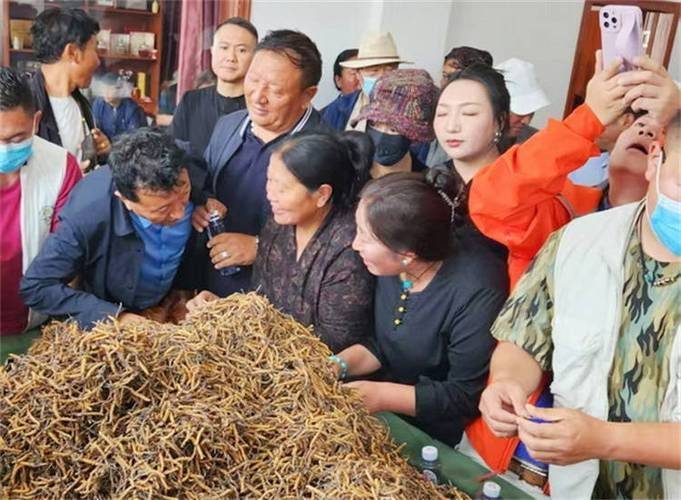
Dong chou is a member of the cheong county of yukju county in qinghai province and has been engaged in the acquisition and sale of weeds。
"we just came here to collect the weeds dug by the local pastoralists and sell them here." east week told the news agency, “so far, i have collected one or two pounds of weed, or about 1,000 yuan per pound.”
Dong-joon said that their acquisition was like a bet, and if the grass received was dry and colored, the sale price was not high。
In addition to face-to-face transactions, the worm and grass business in east week has a modern way of doing so. "it was only yesterday that guangdong guests were given a vacuum package delivery." the mobile phone was swayed to the east and said that it was now very fast and that customers thousands of kilometres away could eat fresh weeds。
Unlike middlemen such as dongjo, nima, a pastoralist in the village of ado, in kato county, has been insisting on “self-financing”。
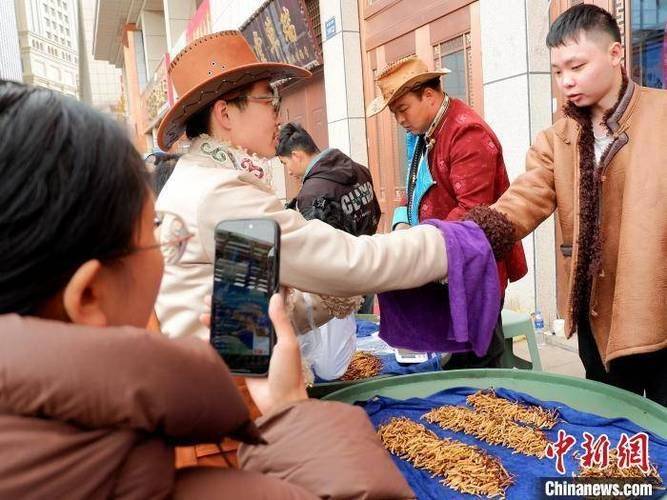
Nirma told the news reporter of the china news agency that this year a dozen of their family members went up to the mountains to dig for weed, and he sold it to the market. “this year, because of the rain, weeds are not as good as last year. In the last month, a man could dig up to 2,000 or more, and this year he could dig up to 7,800.” nima said。
According to journalists, the average price of each fresh weed in the market is between $30 and $50, and the price of dried weed is about 20 per cent higher。
"the price of the better-quality weed is not floating very much. The price of root is around $100, the price of medium-quality grass is slightly larger at 1,200 to 1,300 pounds, and the price of weed is almost 60,000 pounds, which is higher than last year's because it is not as good as it is。
Throughout the square, other “works” have been extended in addition to the traders who buy and sell weed。
Wang xiu-hwa, a “brusher” from galmu, 1,000 kilometres away. Every year, when we're digging for weeds, she comes to brush, which is her 18th year。
Wang xiuhua put a weed on his apron, with a brush in his right hand, picks up a weed in his left hand, rubs the dirt off the weed and puts it aside for less than 10 seconds. "because it's fresh grass, it's easy to break if it's too hard, it's not worth it." wang soo-hwa said to the press。
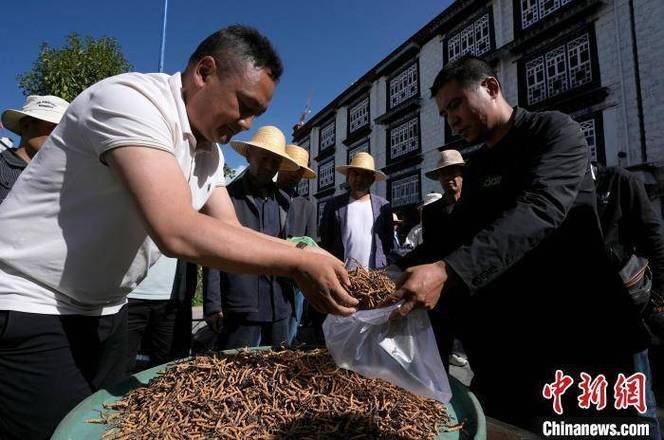
Journalists have learned that there are currently more than a dozen scrawlers in the entire polyferage square, who travel back and forth with folding stools and work immediately when they encounter a business in need. Their income is determined by the number of weeds that can be painted three or four thousand a day by a skilled brusher like wang su-hwa. "the dry grass, the wet grass, the wet grass, can make $4,500 a day." wang xiuhua said。
It is understood that weeders who come to a number of counties each year work almost two months, and when weed is traded in large quantities, they earn about $7,000 a month。
In addition to wang soo-hwa, who earns money from his strength, there is also the stone-store, who earns money from his brain。
The booths of the quartz are for small items such as brushes, heads, calculators, small electron scales and straw hats. “a brush of three dollars, a worm initials 80 dollars, as long as i have everything to do with the trade. It's always raining these days, and i sell umbrellas, and i make $3,400 a day。
As the peak of the trade in weeds approaches, whether east week, nima or wang suhua, isolaryan looks forward to it, “it is too important for us to have a good year's income that depends on two months.” (concluded)