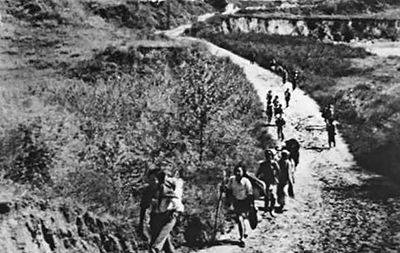
Young patriots from all over the country traveled to yanan。
The period of janan was an important one in the history of the chinese revolution and an example of the successful intellectual work of the communist party of china. During this period, the party's intellectuals worked mainly through the solidarity-based attraction phase, the absorption-based training-replacement phase and the agro-industrial transformation-based education phase。
Attractive
As early as the waqf fort conference, the communist party of china gradually began to correct some of the past abuses against intellectuals. Following the outbreak of the total resistance, the party issued a series of instructions for a large number of intellectuals to develop their work, such as the instructions on the mass absorption of intellectuals and the development of new personnel, and the documents on the mass absorption of intellectuals. At the same time, in order to further implement the policy of the national unity front against japan, the party is implementing a “three-tier” democracy at the political level, with the intellectuals being given equal rights to vote and to be elected, as well as political participation. For example, as an organ of power owned by the people, there are many advanced intellectuals among the senators represented in the senate of the border district of ganning。
The intellectuals are characterized by a high level of cultural knowledge, a rich personality, an active mind and a good voice. To this end, the party has given greater political inclusiveness to a broad spectrum of intellectuals and has created a relatively liberal political atmosphere and working environment for them. During this period, the communist party of china not only firmly opposed the project of “image works” for all talent, but also sought to “show chairs, seats and ladders” for a wide range of intellectuals, as well as to “specify” special policies for a wide range of intellectuals, such as providing that “specialists, who are not party members, are required only to obey our military discipline and regulations, not to force them into political studies, not to force them into political life”, in order to carry out political cuts that would allow them to fully engage in professional work. To further stimulate the enthusiasm of the intellectuals at large for their input, the party also stressed the need to give due respect and due weight to the ideas put forward by the intellectuals. Senior party leaders and the military and political leadership of the border areas, represented mainly by mao zedong, are often given time to meet and interact in depth with representatives of yyan intellectuals to encourage them to contribute to the construction of the border areas and to the triumph of the revolution。
Following the beginning of a phase of resistance, the national party imposed an economic blockade on the border area of ganning, coupled with the harsh natural environment of the border area, which was strained according to the local economy. Even so, however, the party insisted on doing its utmost to give intellectuals special life care. For example, all persons receiving benefits are divided into more than 10 groups of 40, depending on their occupational characteristics. Technical staff, such as teachers, doctors and foreign experts, tend to be at the top of the ranks, while party officials rank behind. In order to adapt to the culmination of the intellectuals in the late 1930s and early 1940s, ccp called for the best efforts to be made to provide them with accommodation and accommodation along their way and to be responsible for their safe transport to yanan. For example, the 7th hyuncheng office of the 8th road army has “continuously hosted young intellectuals who have come from the fallen areas, from the rear and from all over the world to seek refuge in yanan”。
Cultivation
During the period of yyan, as the revolutionary situation evolved, the communist party of china recognized that education must be given high priority if it was to win the revolutionary war and meet the reconstruction and development needs of the nation after the triumph of the revolution. To that end, the party has actively used the relatively stable environment in the rear of the border region to create schools to attract and develop the various talents needed for revolutionary development. The model of integration can be described as a feature of all types of training schools during this period. In the case of “anti-behaviour” and shubei, for example, students read both written teaching books and society's “no word book”. The political and military cadres and young intellectuals from all over the country, while studying and producing labour, have also been able to sharpen the revolutionary will while enriching their theoretical knowledge. In addition, the various technical schools opened at that time had created a large pool of skilled personnel for the party. For example, the janan academy of natural sciences, founded by the central committee of the communist party of china in 1939, has consistently pursued the aims of the party's central science institute and has trained some 500 scientific and technical personnel。
During the janan period, the communist party of china (cpc) advocated bold appointments and did its best in the use of intellectuals. On the one hand, the promotion and re-use of intellectuals in party bodies at all levels and on the other hand, the rule that political awareness is not the main criterion for the appointment and promotion of cadres in areas of greater professionalism is to be fully taken into account. For example, the central military commission and the border region have ordered that engineers, doctors, military personnel, etc., should be given “full confidence” and “full responsibility” in leading positions such as factory director, director, etc. The party bodies in the border districts have been promoted and re-utilized with a large number of highly skilled and skilled professionals in leading positions in various areas of specialization, such as the water engineer ting jianwen, who is the head of the transport department of the border area of ganning. At the same time, the party has set up a wide range of professional organizations to set up the stage for intellectuals, such as the society for natural science research, the civil engineering institute, the chinese agricultural institute and a large number of organizations for natural science research, as well as artistic groups represented by the cultural salvation association of the ganning zone, the chinese arts association and others, and has also created numerous literary and artistic publications such as the popular arts work, the artistics campaign and the front line paintings, to meet the need for cultural people to freely publish artistic and cultural works。
Educational reform
During the period of janan, the various schools set up by the party attached great importance to the study of maraist theory. In response to the vague and poorly understood problems of some intellectuals, such as the marxist ideology, the communist party of china and the chinese revolution, the party has chosen to teach them theorists like me, li weihan and eichch, and important leaders such as mao, judd and zhou enlai have often given lectures, presentations, etc. During this period, while actively creating central-level newspapers such as the daily newspaper of liberation, the red china newspaper, the newspaper of crowds in the border areas, the party strongly promoted and supported the creation of red literature by intellectuals, such as " red china " , which was founded by intellectuals represented by ding ling, with the aim of developing proletarian writers, promoting marxism and promoting neo-democratic popular literature。
Some of the intellectuals, based on their class limitations and complex backgrounds, once became politically naive and embraced the “temperatureism” of the first arts and humanity. In response to this blurring of cultural and political relations, the communist party of china held a yon-an cultural symposium, at which leaders of mao zedong and jud explained in an excellent manner the intellectuals ' artistic creations that were intended for the daily lives of workers and farmers, and that they served the general masses of workers and farmers and served the great revolutionary cause of the proletariat. At the same time, the vast majority of intellectuals have actively participated in the winding-up campaign, profoundly analyzing, rethinking and transforming themselves through careful study of documents, discussions, criticism and self-criticism, and gradually strengthening their own idealist beliefs in the ideological and emotional struggle between “self” and “him”, as well as “individualism” and “collectiveism”, raising the ideological and cognitive level of the proletariat and successfully achieving a change from “old me” to “new me”。
Intellectuals can only avoid the danger of being left behind if they actively engage in hot industrial and agricultural production practices, actively integrate their mental feelings into the general population of workers and farmers and “get together with them”. After the fighting had entered a phase of confrontation, and in order to break the economic blockade on the basis of the daily confrontation of the nationalist party, the central party had launched a large-scale production campaign in yyan. During this period, a wide range of intellectuals responded positively to the party's call to take part in the rural ups and downs movement to reclaim the land. During the process of sharing food, housing and work with the workers and farmers, they developed their own revolutionary will, deepened their understanding of the chinese communist party and the workers and farmers, clarified their mission to work for the workers and farmers and to serve the party's revolutionary cause. On the other hand, they made a significant contribution to the party's “literacy campaign” through evening schools, literacy classes, literacy groups, reading newspapers, etc. Some intellectuals have served as primary and secondary school teachers to assist the government in advancing rural education。