The intellectual property offices of the municipalities (including dingzhou, xinjo), the integrated law enforcement bureau of the new district of yuan, the provincial intellectual property protection centre, and the relevant units:
For further implementation of the specific patent conversion scheme, in accordance with the circular of the office of the national intellectual property agency on the publication of a pilot work programme for open licensing of patents (2022] (no. 448) the provincial directorate has developed a pilot programme for the implementation of open licences in hebei province, which is being circulated to you for your careful follow-up。
Hebei department of intellectual property
30 june 2022
Hebei patent opening pilot implementation programme
In follow-up to our provincial programme for the construction of the intellectual property power province (2021-2035) and the plan for the protection and application of intellectual property rights in hebei province, the following programme has been developed to enrich the patent licensing model and improve the efficiency of patent conversion。
I. General requests
(i) work thinking
In accordance with the requirements of the national intellectual property agency's patent opening pilot work programme, and in the light of the basic concepts, features and links of the open licensing system, a pilot project is being organized for municipal intellectual property administrations, relevant business entities and service platforms to promote a fast-track licensing model, “the will to license and conditions are clearly defined in advance by the patentee and publicly issued by the provincial intellectual property office”, which seeks to achieve the multiple effects of stimulating supply and demand, stockpiling projects, exploring experiences and improving policies, and to lay a solid foundation for the smooth and efficient operation of the national patent open licensing system。
(ii) basic principles
1. Maintain market orientation. Major market subjects, innovation subjects, have autonomy in patent licensing activities, follow market rules and play an effective role as market mechanisms。
2. Stick to the issue-oriented approach. Practice explores ways to address the lack of clarity in the rules of transactions that may exist in the implementation of an open-licensing regime for patents and the under-attraction of patent holders。
3. Maintaining results orientation. The pilot project led to the conclusion of a number of patent open licensing projects, which led to the initial development of a working model for patent open licences in hebei。
(iii) objectives of work
1. Explore working modalities. (b) to explore new models of open licensing of patents, drawing on national and international experiences, and to develop replicable and replicable empirical measures to support the national intellectual property office in improving the regulatory system for the implementation of open licensing of patents。
2. Achieve effective outreach. The promotion of pilot patent-opening licences has been strengthened, leading patent holders from familiarization to initial application, and the promotion of preheating for the full implementation of the system。
3. Development of results. By the end of 2022, approximately 70 patent opening licences were reached across the province, and performance indicators related to patent conversion schemes were effectively enhanced。
Ii. Working mechanisms
(i) the provincial intellectual property authority (hereinafter referred to as the provincial directorates) coordinates the piloting of open licensing of patents by the relevant agencies, such as education, science and technology, industry and correspondence, and integrates it into the province-wide patent conversion scheme, leading the implementation of the pilot work programme, operational guidance, monitoring and performance evaluation。
(ii) the municipalities (including the dynasty, xinjiang and xian xinjiang districts, respectively), the intellectual property directorate (hereinafter referred to as the municipal directorate), the provincial intellectual property protection centre, the office of the deputy representative of the ishiki bank of the patent office of the national intellectual property office, etc., are involved in the pilot process, which is responsible for information dissemination, verification, supply-and-demand interface, pricing guidance, trade guarantees, etc。
(iii) the national intellectual property operating services system, with its focus on the city of shibuya, the national intellectual property pilot university of yanshan, the hebei industrial university, and the national and provincial intellectual property dominance demonstration enterprises are to collaborate actively in the pilot project to encourage and guide the active participation of other institutions of higher education, small and medium-sized enterprises and intellectual property services in our province。
Iii. Duration of the pilot
The pilot period is from the date of the issuance of this programme until the patent open licensing system is fully operational。
Iv. Priorities
(i) enhanced process management and improved dissemination mechanisms
1. Normative information collection. The provincial directorates organize the collection of information on patent opening licences in municipal offices, and direct patent holders who wish to open licences to fill out the licensing information form (see annex 1) and submit it by mail to the provincial intellectual property protection centre. The patentee shall make a declaration in the licence information form in respect of such matters as the patent is not valid for the duration of the patent exclusive licence or exclusive licence, the guarantee of the retention of the patent, and shall provide a patent evaluation report or a search analysis report in respect of a patent that is practical and new in appearance。
2. Strengthening content verification. The office of the under-secretary of the national intellectual property office, ishikoshi, is responsible for verifying the validity of a patent to be issued, the existence of an exclusive licence or exclusive licence, and the existence of a pledge registration; when a patent is declared to be patented in the new form of practical design, the patent holder is required to provide a patent evaluation report or a search analysis。
3. Broadening the distribution channels. The website of the provincial intellectual property protection centre, the website of the provincial intellectual property operations centre and the network of officials of the provincial market regulatory authority (amp) serve as the main platform for the publication of patent open licences; each pilot participant and other willing and conditional intellectual property operating service platforms can share published open licence information, including web links, interface calls, etc., in order to expand the audience and increase transaction rates。
(ii) enhanced pricing guidance optimizing safeguards
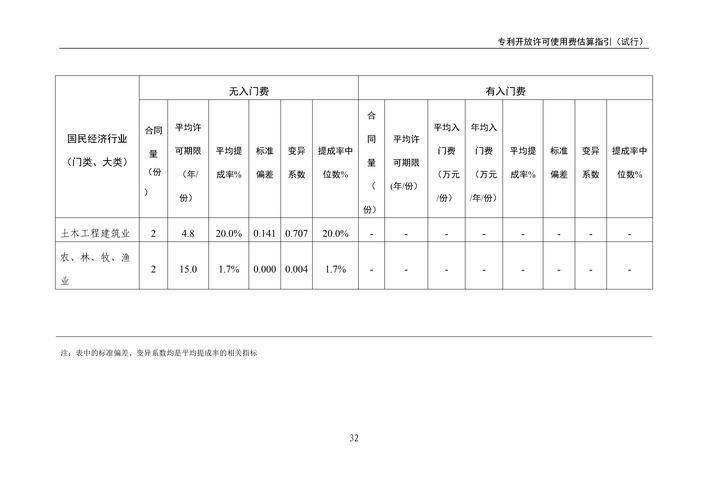
4. Strengthen pricing guidance. Through various means, the provincial authorities have widely publicized the usual methods of payment, such as lump-sum payments for patent licences, lump-sum payments, introduction fees, etc.; directed patent holders to achieve reasonable, fair and low-cost pricing by reference to the average amount or rate of licences in the same industry in the data on royalties for patent implementation issued by the national intellectual property agency during the “13th fiveth” period; and directed patent holders to take fully into account the “one-to-one” character of open licences and to reduce the licensing fee criteria appropriately. The patentee is encouraged to engage in periodic free licences, explore first-instance, after-payment, etc., to better stimulate the demand side of the licence and to expand the proceeds of the licence in a reasonably effective manner。
5. Secured transactions. The provincial directorates direct the licensing parties to share the same examples of patent opening licences (pilots) (see annex 2), clarify the fundamental rights obligations, make agreements on the necessary matters and guarantee the security of licensing transactions. In principle, a patentee is bound by a commitment not to refuse to enter into a licence if any unit or individual accepts the terms of the licence information form. The parties may consult on the content of the licence contract. If the patentee transfers the patent after submitting a licence information form, it shall request the provincial department to withdraw the published information。
(iii) stimulating multi-stakeholder participation to promote supply-demand interface
Incentives to guide supply and demand. The provincial directorates organize activities related to the pilot licensing of patent-based technologies for higher education institutions and state-owned enterprises throughout the province, and provide guidance on the development of a pilot manual on patent-based licensing. Institutions such as institutions of higher education, state-owned enterprises, and demonstration enterprises of intellectual property advantages are encouraged to select patented technologies with marketable prospects, applications that are widespread, practical and applicable to multiple applications. (c) to channel licences from patented technology needs, technology digestive intellectual property advantage demonstration enterprises, high-technology enterprises, science- and technology-based small and medium-sized enterprises, and “specially new” small and medium-sized enterprises, on the basis of the terms of the licence issued by the patentee. Support and encourage other business units to participate in the pilot exercise in combination。
7. Expanding the interface. In various forms, municipalities are active in organizing competitions for patent technology supply and demand, promotions, road shows and "intellectual property services " , creating conditions and platforms for patent licensing。
(iv) enhanced safeguards to ensure pilot effectiveness
8. Strengthening advocacy guidance. Strengthen organizational mobilization and fully mobilize the pilot participants. The pilot participants need to make full use of mainstream media, government websites, and microblogging to enhance the interpretation of open licences. The provincial directorates have strengthened policy synergies with the education, science and technology, trade and correspondence sectors, leading to the active participation of institutions of higher learning and small and medium-sized enterprises in pilot projects; and the timely dissemination of pilot experiences to support, guide and coordinate information verification, evaluation of pricing, transaction security and other aspects of the pilot projects。
9. Mediation of disputes. The provincial directorates provide guidance to the provincial intellectual property protection centres, municipal intellectual property offices, relevant industry organizations, etc., to make full use of existing mechanisms for the mediation of patent disputes, and to play an institutional role with the function of mediation of intellectual property disputes among the people, actively mediating disputes arising in the course of the pilot, in accordance with the law, and advising both parties to the licence to defend their legitimate rights and interests。

10. Improved incentives. In accordance with the requirements of the national intellectual property authority, participation in the pilot exercise will be an important part of the evaluation of the pilot demonstration of national intellectual property rights for the construction of priority cities for higher education and operational services systems and the related performance appraisal. The provincial directorates included the piloting of open licensing of patents in the 2022 performance appraisals of the municipal intellectual property boards。
11. Institutional interface. (c) supporting the submission of legal patent opening statements to the national intellectual property authority for patents of high quality in the pilot, with good market prospects or with market intentions. Once the system is fully implemented, the national intellectual property authority will promptly review the announcement in accordance with the law。
12. Strengthening lessons learned. Participants in the pilot process are able to draw up their analytical experience, pilot results and problems in a timely manner and submit them to the provincial bureaux. A sample of pilot cases of open patent licensing is selected and published in due course and disseminated。
Implementation steps
(i) launch of the implementation phase (may 2022-june 2022)
Work programme is developed, objectives and priorities are defined, working mechanisms are improved and municipalities are guided in the development of pilot projects。
(ii) full implementation phase (june 2022-november 2022)
A comprehensive organization has been set up to coordinate the efforts of the various actors involved in the collection of information on patent licences, content verification, information dissemination and precision interface, with a view to facilitating their completion。
(iii) deepening the stocktaking phase (december 2022)
Carefully streamline the work of the work programme, strengthen monitoring, assessment and lessons learned, and develop replicable and replicable practices as soon as possible to serve as a model driver。
Annex 1. Information sheet on patent licences (reference example)
2. Patent open licence (pilot) contracts (reference example)