What is the bone system? At the simplest level, the skeleton is the framework for providing the structure and movement for the rest of the body。
Please continue to read and learn about the 10 key facts about human bones。
1. The skeletal system does not contain only bones
When you look at human bones, 206 bones and 32 teeth come directly into the eye. But looking closely, more structures will be seen. The bones also include ligament and cartilage. Retardation is a tight and fibrous tie and key to joint function. The cartilage is softer than the bones, but harder than the muscles. The cartilage helps to raise the shape of the throat and nose. The cartilage is also found between the vertebrates and at the end of the bones, such as the femur。
2. Adult bones consisting of 206 bones
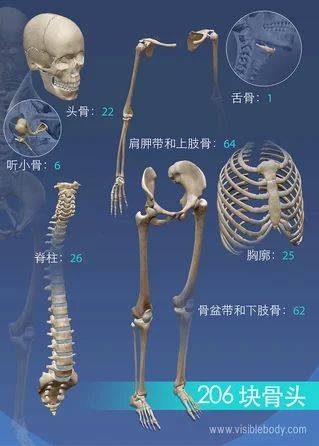
These bones provide the framework and protection and exercise. The bones come together to form a framework. The skull protects the brain and shapes the face. The chest contour surrounds the heart and lungs. The spinal column consists of more than 30 small bones. They are followed by limbs (upper limbs and lower limbs) and a belt structure that connects them to the spine。
3. Bones protect vital organs
The brain is surrounded by the bone of the skull of the component. The heart and lungs are in the chest cavity, and the spinal column provides the framework and protection of the spinal cord。
4. The interaction of bones, muscles and nerves makes the body move
How do bones move? The muscles of the body are attached to the bones. Nerves around muscles can signal muscles to move. The nervous system sends orders to the skeletal muscles to shrink them. This contraction produces motion at the joints between bones。
5. Bones are divided into middle axles and adjoining bones
Bones with limbs assist in motion, while the bone of the middle axle skeleton protects internal organs. All skeletal structures are attached to the limb bones (band structure and limbs) or to the central axial bones (cranial, spinal and chest profiles)。
Bones can be divided into five types
The bones are divided into five types according to their shape and function. The femur is an example of a long bone. The forehead is flat. The gillbone, also known as the kneecap, is a seedbone. The wristbone (in hand) and the gillbone (in feet) are examples of short bones。
7. Long bones have three main components
The outer side of the long bones consists of a layer of osteoporosis. The inner part of the long bones is a marrow-filled marrow marrow。
Some bones produce red blood cells
The marrow is a soft tissue located in certain intrabone pine networks. Among adults, the red marrow produces blood cells at the end of the skull, vertebrate, shoulder bone, rib, pelvis and larger long bones。
9. Some joints are inoperable or of very small scope
One way of classifying joints is through the range of activities. Inactive joints include those between the skull stitches, the teeth and the jaws, and those between the first pair of ribs and the chest. Some of the joints have a slight activity; one example is the remote joint between the gill and the femur. The joints (thinking of shoulder joints, wrist joints, hips and ankles) of a wide range of activities are allowed to be placed on upper and lower limbs。
10. Babies have more bones than adults
The baby's bones are nearly 100 pieces more than the adult bones. The formation of bones begins in about three months of pregnancy and continues into adulthood after birth. An example is the gillbone, which, over time, is integrated into one piece. At birth, the gill was five vertebrae, with an intervertebrae. Usually in the fourth decade of life, the gills are fully integrated into a bone。