[executive summary] a number of state council opinions on accelerating the construction of intellectual property power in the new era proposed “to foster an intellectual property-intensive industry”. Patent-intensive industries are an important part of an ipr-intensive industry and refer to industries where the number of inventions per unit of employment is higher than the average for all industries as a whole. The experience of developed countries in europe and the united states shows that patent-intensive industries make an important contribution to socio-economic development. As the role of patents in the national economy has become more prominent, our country has also made patent-intensive industries an important player in building strong intellectual property rights and implementing innovative-driven development strategies. This paper provides a systematic analysis of the definitions, characteristics, roles, etc. Of patent-intensive industries and suggests that local governments foster the development of patent-intensive industries。
[keywords] define characterization responses for patent-intensive industries
More recently, the national intellectual property agency published the patent-intensive industry catalogue (2016) (piloted), which includes eight major industries and covers 48 sectors of the national economy. The “spread-out” of patent-intensive industries marks the addition of new members to the “intensive industries” family on a resource-intensive, labour-intensive, capital-intensive, technology-intensive basis. Patent-intensive industries represent a large pool of enterprises with key technologies and core patents that have a significant impact on the implementation of innovation-driven development strategies, industrial transformation upgrading and sustained economic growth。
Definition of patent-intensive industries
Depending on the type of demand and degree of dependence of different industries on factors of production, industries can be divided into types of intensive industries such as resources, labour, capital, technology (knowledge). As the economy develops, the regional industrial structure tends to shift and evolve along the webs of resource-intensive (e. G. Agriculture, mining) labour-intensive (e. G. Textiles, clothing, food) capital-intensive (e. G. Steel, machinery, chemicals) and technology-intensive (e. G. Aerospace, computer, biomedicine)。
In terms of factor intensity, patent-intensive industries are those in which patent intensity (patents/persons) is higher than the overall average. In terms of measurement standards, patent-intensive industries are characterized by technology-intensive industries, relying mainly on technological innovation and patent advantages to compete in the market; in terms of scope, patent-intensive industries together with trademark-intensive industries, copyright-intensive industries, etc., constitute ipr-intensive industries. Like all other industries, patent-intensive industries require a large amount of inputs of people, finance and other factors of production, depending on the focus on technology development and transformation。
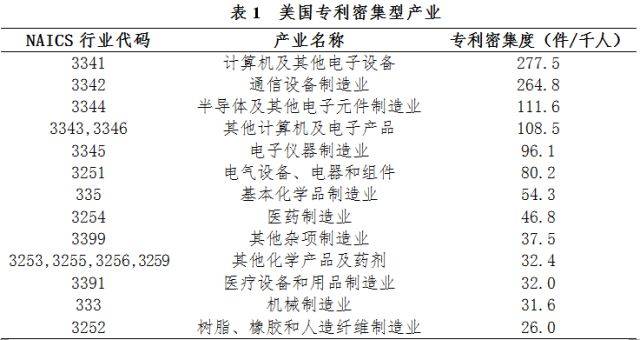
The united states is one of the early countries to undertake research on intellectual property-intensive industries. In april 2012, the united states department of commerce, economics and statistics administration, jointly with the united states patent and trademark office, published a report entitled intellectual property rights and the united states economy: industrial focus. Using data from 2004-2008, the report defines 13 industries with higher than average patent intensity (25. 5 per 1,000 persons) as patent-intensive industries。
The national intellectual property strategy framework was issued in june 2008, raising intellectual property rights to the level of a national strategy, and the state council's opinions on accelerating the construction of intellectual property power in new situations were issued in december 2015. It clearly states that “to explore the development of an intellectual property-intensive catalogue of industries and development planning, to channel social funds into intellectual property-intensive industries, and to pilot a model base for intellectual property-intensive industrial clusters and intellectual property-intensive industries”, and that intellectual property-intensive industries are gradually falling. In october 2016, the patent-intensive industry catalogue (2016) (piloted), published by the national intellectual property agency, defined as patent-intensive industries the 48 national economies of the eight major industries, namely, information fundamentals, software and information technology services, modern transport equipment, smart manufacturing equipment, biomedicine, new functional materials, efficient energy conservation and environmental protection, and resource recycling。
The “three-high” characteristics of patent-intensive industries
The level of intellectual property creation and application represented by patents is an important manifestation of innovative countries and a central expression of the capacity for industrial autonomy to innovate. In the world economic arena, patent-intensive industries play an important role as proxies for high-technology content, high-growth and high-productivity contributions, and are central to the implementation of innovation-driven development strategies, key players in industrial transformation upgrading and key drivers of sustained economic growth。
(i) high-technology content
Patent-intensive industries rely significantly more on technology, intelligence, patents, etc. Than on other factors of production, and their development is based on advanced technology research and development, applications and “knowledge”. Within patent-intensive industries, the main ways in which enterprises compete are also from low-level price wars, advertising wars to high-level technology wars, and brand wars. Behind the high-tech content of patent-intensive industries are high levels of investment in technology and research and development finance. According to the report on china's major statistics on patent-intensive industries (2015) issued by the national intellectual property authority, the strength of r&d inputs in patent-intensive industries (the ratio of r&d to the number of employed), and the intensity of r&d investments (the ratio of internal expenditure on r&d funds to income from main operations) have increased from 2. 4 per cent in 2010, 0. 6 per cent in 2014 to 4. 3 per cent and 0. 9 per cent in 2014。
(ii) high growth
Patent-intensive industries are a combination of high-technology, high-value-added, highly innovative dynamism and competitive market advantages, with enormous development potential and value-added space that can lead industry in the direction of development, and are powerful drivers of industry moving from the lower to the upper middle end of the value chain. For example, the biomedicine industry is typical of patent-intensive industries, with an invention patent density of more than 1 million per 10,000 people, and one of the few less affected industries, such as the slowdown in economic growth, with defined growth. In 2011-2014, the value added of the biomedicine industry and the annual average growth of income from the sale of new products amounted to 15. 8 per cent and 25. 5 per cent, respectively, which was 7. 8 per cent higher than the national economy average, 6. 3 per cent higher than the non-proprietary-intensive sector, and 8. 7 per cent higher than the generic-intensive sector, 12. 3 per cent higher。
(iii) high-yield contribution
Intellectual property-intensive industries, represented by patent-intensive industries, with high potential for development, radiation-driven capacity and economic efficiency, are making a direct and important contribution to economic growth and employment growth and are emerging as new growth poles of economic development. According to intellectual property rights and the united states economy: industrial focus, in 2010 the 75 intellectual property-intensive industries in the united states provided 40 million jobs, or 27. 7 per cent of united states employment in that year; contributed $5. 06 trillion to united states GDP, or 34. 8 per cent of total GDP in that year. In 2014, the value added of patent-intensive industries as a share of GDP reached 12. 5 per cent, contributing to GDP growth at 22. 6 per cent; income from the sale of new products represented 22. 5 per cent of the income from the main business, and the value of export deliveries as a share of sales production at 16. 7 per cent。
Iii. Proactive development of patent-intensive industries
In recent years, as the role of patents in the national economy has become increasingly prominent, patent-intensive industries have become “honorers” for local governments. In jiangsu province, for example, an intellectual property-intensive industry statistical indicator system was established, the city of tianjin implemented a patent-intensive industrial park development project, and guangxi developed an implementation programme for manufacturing industries to accelerate the development of guangxi patent-intensive industries (manufacturing). On the basis of a long-term focus and in-depth study on national intellectual property strategies, patent-intensive industries, the sidi advisers provided responses to the development of patent-intensive industries, taking into account specific local practices。
(i) criteria first, research to define patent-intensive industries
Based on the evaluation indicators of patent-intensive industries, and in line with the strategic needs of economic and social development, the system of patent-intensive industrial indicators is being developed in the context of the current state of local industrial development and the actual development of patents, identifying a number of priority breeding areas, and establishing a patent-intensive industry catalogue and development planning that reflects local characteristics. At the same time, statistical monitoring has been strengthened, specific statistical systems for patent-intensive industries have been developed, patent-intensive industry developments have been regularly published, policy measures have been put in place and patent-intensive industries have been adapted to the actual situation。
(ii) parking to promote patent-intensive industrial cluster development
The consolidation of innovative resources and the promotion of patent-intensive industrial clusters, based on high-rent zones, economic development zones and pilot demonstration parks for intellectual property. Piloting of patent cluster management, implementation of development strategies with policy support, business ownership, collaborative research and innovation, high-end service providers, deployment of innovation chains around industrial chains, deployment of patent chains, establishment of campus intellectual property work systems and patent service platforms, and promotion of the organic integration of patent resources, industrial resources and locally advantageous resources。
(iii) enterprise ownership to enhance enterprise patent creation and application
The establishment of a patent-intensive enterprise identification system to help enterprises achieve “zero-free” patents for inventions, and the implementation of high-value patent-breeding programmes to increase the quantity and quality of the output of patented inventions. In-depth implementation of the corporate intellectual property strategy promotion programme, comprehensive implementation of the corporate intellectual property management (ipr) regulatory framework, leading to the use of patents to enhance competitive advantages, and the creation of a group of highly patented firms and patent-based firms. Inducing enterprises to form a number of patent unions linked to relevant patent technologies to enhance industry-wide ability to use patents and enterprises to respond to international patent disputes
(iv) finance as a means of understanding, production and integration
Studying new models for piloting intellectual property investment financing, accelerating the advancement of proprietary pledge financing, organizing multi-stakeholder advocacy and business interfaces with governments, banks, guarantees, evaluation agencies, etc., improving mechanisms for compensating for proprietary pledge risks, and transforming the intangible “intelligence” of enterprises into valuable assets. Actively develop patent markets, explore market vehicles such as patent trading platforms, technology transfer centres, etc., that combine online and offline, and provide patent operations services to various subjects of innovation, such as universities, research institutes and enterprises. Promote patent securitization and support direct financing by enterprises through capital markets。