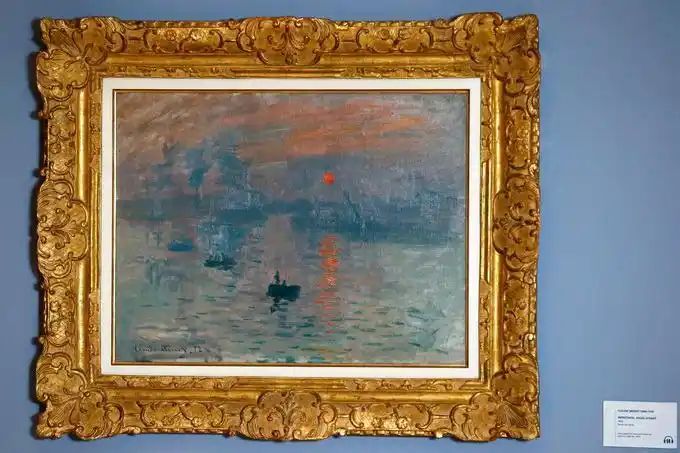
In the early hours of the late autumn of 1872, the french artist claude monet was awakened by the sound of a siren outside the hotel port, and looked out of the window, the dawn appeared, the fog started, work started on the lebois and kulbe docks, the chimneys smouldered, the cranes moved their arms and several large boats with masts gathered at the entrance to the atlantic gate. The sea, the sky, the ships, the buildings, and the people on the nearby small boats are shaking in the shadows。
Xinhua information map
The view of the port is already familiar to monet. He has lived in the coastal city of le avere since he was four years old, playing on the edge of the cliff and in the sea for a much longer time than in the art school class, until his cartoons were appreciated by the seaview painter of the small town, eugène boudan, and he was directed to the sea for writing. When he first arrived in paris at the age of 19, he instinctively did not like sharon's one-time college painters, attracted by the barbies and koro landscapes, followed by sketches during his military service in north africa of the bright light and colour of algeria, and his father's “foreclosure” when he came back and monet was still painting on his beach home. When she saw his nephew's sketches of grass as graffiti, she asked him to go to paris to learn to paint with a regular teacher, i. E. A college student. For two years in greer's studio, monet couldn't stand it, because his idea of a faithful record of what he saw was not recognized by his mentors, but he reaped friendship with his classmates renoa, sislai and bazij. Monai, a group of people, drew trees and studied forests in small villages on the edge of the maple danboro forest, and they were laughed at by the idle. The example of monet at the time is the first bobbyson who was elected to sharon and was repeatedly attacked. Dubini, who was accused of being “satisfying with impressions and neglecting parts”, was in the same mood as monay. This was followed by joan coon, who was a watercolor writer at the port of omfrell, who learned from him the different images of nature in the same place in a changing environment and made his own seascape into sharon in 1865。
At the age of 25, the desire to draw “outlight” became stronger when it first tasted success. On the balcony of the louvre, he paints the city view of paris, and is ambitious enough to figure out how to draw a group of picnics and women in beautiful dresses under the natural light of the forest, as well as drawings more than two metres above. At that time, he had made it clear that outdoor painting had to be done in the same light in order to ensure the unity of the picture and to paint a thick colour with a large pen and a thick print. He paints the light in a non-transparent colour, and puts it together with bright and pure blue, red or yellow, and it is not mixed, and the images appear to be alive. The same modulation changes a short pen to paint a tree, showing a tremor of light. With these experiences, monet has been persuasive in the debate over the shadows at the cafe of geirbois in paris. The landscape painters are opposed to drawing shadows with a single bitumen, arguing that the shades can be coloured by the colours associated with them。
In 1869, monet was accompanied by renoa at the frog pond to study how to draw water. They found that the dynamic clusters that express water must rely on the subtle colours, rather than the wires, but rather on the liveness of the brushes, which make up all sides through the small colours of the different tunes, preserve the tremors of light and water, which are practical. In the days when monet lamented that he had no bread, no paint or even no hope, his art had matured. He also lacks the last impetus — the 1870 common law war. Monet met his distinguished man in london, paul brown-luer, the painter, and escaped poverty. He drew a view of london at the same time as pizarro, and watched turner and constairs at the gallery, surprised to discover that british forebears had been studying exterior light and transient effects. Mona, while criticizing turner's romanticism, unwittingly accepted his influence (not until later). Monet then went back to the dutch writer and developed a layer from a very different ash。
Monet, returning to france, is no longer in financial straitjacket, is in love with his wife and son, and his career has begun. Concepts, techniques and subject matter, all of which had been resolved before, await only one outbreak. This morning, when he returned to his home town in november, monet had the usual painting racks, and the sight of him was a source of ulterior excitement. He did not seem to realize that the seaport at this time was already very different from his childhood, that le avere had no crane pier in the past, that the boat was not so big, that the chimney was not so high, and that he would not throw up such smoke. When monet painted all of this, he did not think that the industrial revolution had actually added modernity to the light of the sea, and he was simply rushing towards the light because the light changed and the color changed. All previous observations of home and off-shore seawater and sky, respect for for ancestors and peers, and control over colour and pen touch were gathered in half an hour. He was aware that it was necessary to draw very concisely, and the colour used was thin, in order to preserve at maximum intensity the immediate effects of the sunrise and not to destroy the freshness of love pens。
On 13 november 1872, at 7. 35 a. M. (according to the 2014 results of the mamodan monay museum in paris), monet stopped writing and named the painting " sunrise impression " . The word “impression” was not a monet invention, but, at least around 1867, it was used by commentators to describe dubini and joancon's landscapes, both of them, with a set of intentions. In 1874, he insisted on holding a joint exhibition of artists independent of sharon, and threw out the " sunrise impression " that provoked the displeasure of journalists, a painting that brought together the exploration, frustration and amazement that all the artists later known as “impressives” had experienced at the historical juncture of painting change at the end of the nineteenth century, bringing monet to the head of the impressionist to the chair, which was to be put to the credit. Around 1885, monet settled in the town of givini and was obsessed with the construction of secret gardens and the painting of sleeping lotions. He often missed the seaport, even though he was prevented from going out because of his years of age and loss of sight, and was able to draw " sailboats, night impressions " , " ammon mouths " , " morning impressions " , " london chaz bridge, mist cloud impressions " and " ships in the port of onferr " 。
Not long ago, sunrise illustrated, which was seen as an image of the opening of the mountain, arrived in shanghai, china. The sunrise impression is only one thing more valuable than the large number of monet's “sleeping lotus”. When we have the opportunity to stand in front of this little masterpiece by cloud viewing, you can imagine that you are the rower who paints the small boat and is on the rise to open the next bright course of life。
China cultural hall shares national populist art
In recent days, the central library of history has launched a national project entitled “culture of china”. More than 130 cultures, in the form of master lectures, forums, exhibitions, art creations and so on, have been able to share the essence of the country with the general public for a “super-cultural connection”. Among them, a single-song, once known as the “man of the palace”, served as the “christ of china's culture” and continued to be the speaker of the lecture, along with a wide range of artists, such as zhang jin poe, liu monk creek, wang liping, xue young-yin, zhang zhang, tian qing, su zheng, liang xiaoqing, van dian and other countries。
They will lead the public to learn the classics, explore the heritage of cultural heritage, visit the human landscape and enjoy the aesthetics of art, from the diversity of dimensions of chinese valour, chinese art, chinese art, cultural heritage and philosophical history. It is understood that the lecture hall is based on the concept of “prevent, online, on the ground”, using 5g, cloud technology and various new media outlets to break the limits of the physical space, bringing the masters closer to the general public and bringing them into contact with the masters, so that the relics of the scriptures that lie in the storerooms, the wisdom that binds them in words, and the wisdom of philosophy can live。