A fundamental logic that once underpinned the entire internet content industry is silently failing。
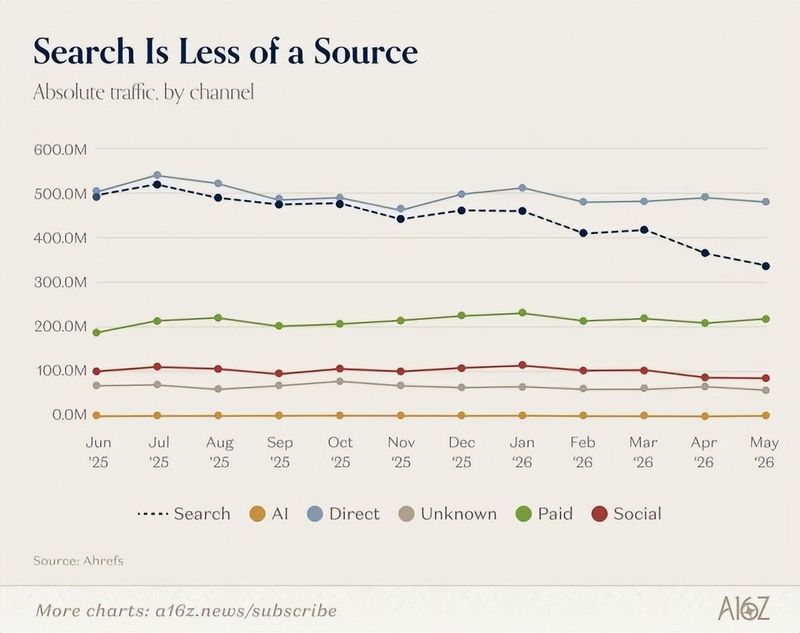
The latest report of the venture capital agency a16z citing ahrefs data shows that the number of site visits from the search engine fell from about 500 million per month in mid-2025 to about 335 million in may 2026, a decrease of nearly 25 per cent the same year. At the same time, other major sources of traffic, such as direct access, fee-based searches and social media, have remained relatively stable, with only natural search flows having experienced a clear fall in the cycle。
The perpetrators are hardly controversial: google's ai overview function (ai overviews)。
The search has changed a lot, the clicks have decreased
On the surface, the total use of google searches has not decreased or even increased. But this growth is meaningless for the site owner, because the user's questions have been answered in the ai-generated summary above the search results page, and there is no need to click on any site。
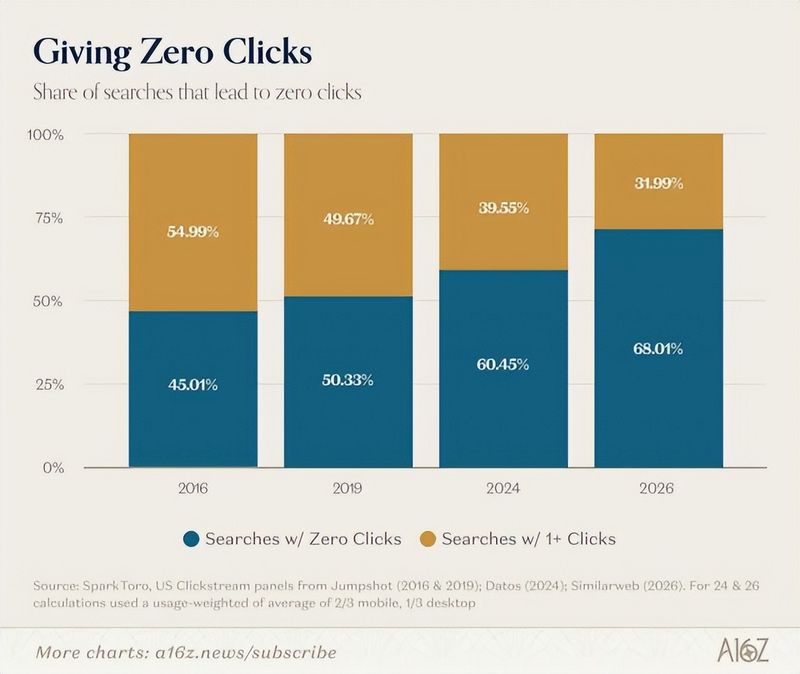
That's the heart of the zero click search problem. Sparktoro and rand fishkin statistics show that in the first four months of 2026, as many as 68 per cent of google searches ended with zero hits, meaning that more than two thirds of searches did not take any site visits from scratch. For the first time, this proportion exceeded 50 per cent in 2019, reaching 60 per cent in 2024, while the curve was moving upwards by 2026。
At the same time, according to data from independent research institutions, the googleai overview function now covers about 48 per cent of search queries, an increase of nearly 60 per cent over the same period, while natural hits on the respective websites will decrease by 34 to 61 per cent once the search results page is available。
The impact is particularly direct for news and information content sites. Similarweb's data show that the natural search flow of major news sites fell to less than 1. 7 billion in may 2025, while just a few months ago it peaked at more than 2. 3 billion, a dramatic drop。
Intra-industry stress has begun to emerge. The chief executive officer of atlantic monthly publicly stated that he expected that the flow from google would eventually reach zero and that publishers would have to rebuild their business model accordingly; business insider had been downsized by about 21 per cent in early 2025, and management had explicitly classified the drop as a structural factor "out of our control"。
Google challenged some of the data, claiming that the ai overview function had actually increased the breadth of content discovered by users and that user hits and conversions were better as a result of ai-assisted searches. At the technical level, this statement is not unfounded, but there is widespread doubt as to whether it applies to the vast majority of content sites that depend on search flows for their livelihoods。
It's too small
Another interesting feature revealed by the a16z report is the status of the ai tool as a source of flows。
The chatgpt, perplexity and other ai platforms already have hundreds of millions of live monthly users, but they actually channel the traffic back to various websites, still representing less than 1. 1 per cent of all traffic sources. According to martech's analytical data, although ai traffic is growing slowly at about 1 per cent per month and the transformation quality is about twice as high as traditional search traffic, absolute volumes are still small and far from sufficient to fill the gap left by the decline in natural search flows。
In other words, ai took part of the user's attention from google, but the vast majority of that attention was retained by ai platform itself and not redistributed to other websites。
Gartner's projections are even more pessimistic, and the agency estimates that by 2028 traditional natural search flows will be reduced by a further 50 per cent from current levels. This means that the whole content business model, with the "seo-driven flow" as its core logic, faces a structural rather than cyclical adjustment。
For start-ups, content creators and media outlets, the formula that worked well over the past 15 years has now failed: optimizing content to google rankings allows continuous access. The ai search came not by adding a new rule to the rules, but by changing the entire foundation。
Those who first find a new way of survival in the "post-search flow age" will have tickets to the content industry for the next decade。