Hello, everyone. I'm an eyebrow
High school's full of efficient methods of learning. Hold on to these pieces
I. Pre-school preparation: not time-consuming but significantly more efficient attendance
1. Short-term rough learning (5-10 minutes)
(a) read the title of the section, the formula, the caseline, and indicate the points of knowledge that are not understood without further study
2. Attendance with questions
The focus of the course is on the difficulty of marking itself, which does not lead to a full-scale, highly targeted attendance
3. Vulnerable disciplines must be studied in advance and the dominant disciplines can simply go through the framework。
Ii. Attendance in the classroom: the core of high school points is more important than after-school brushes
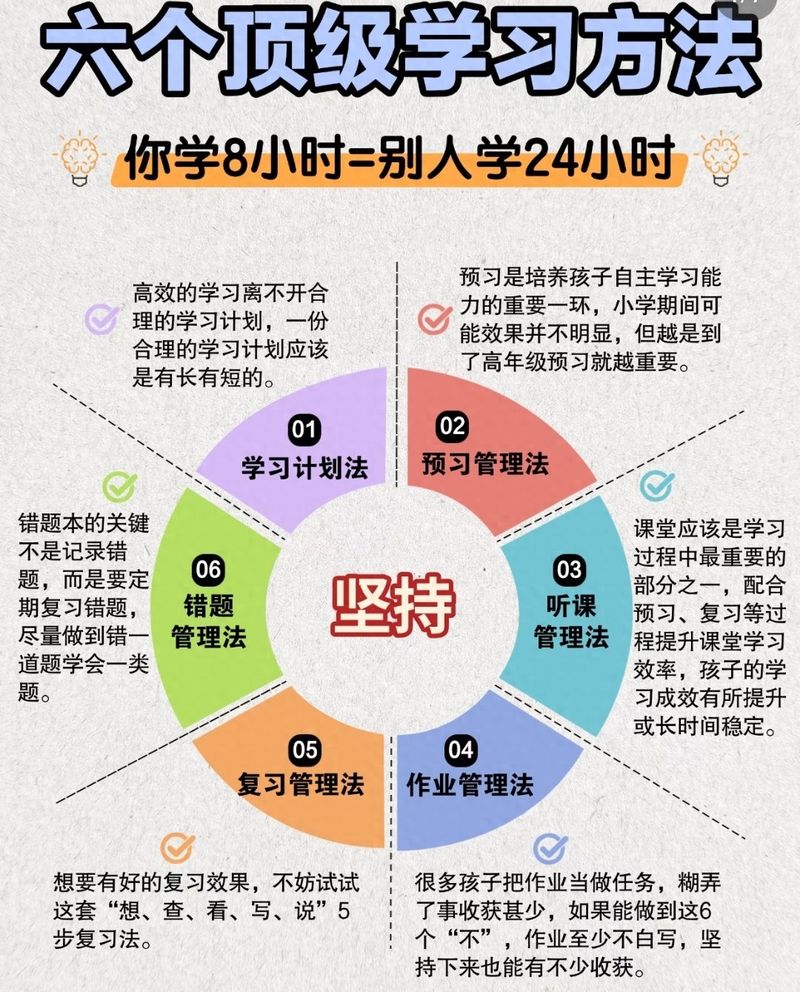
1. No blind copying of notes
(a) to understand the priority, to keep in mind only the thought, the error, the teacher's conclusion, and not to repeat the text
2. Following teacher logic, active thinking
When asked by a teacher, he or she calculates, thinks, and does not wait for answers
3. Cleaning up the doubt
If you don't know how to mark it, ask the teacher/student immediately after class。
Scientific notes (in two categories, rejection of invalid copying)
1. A summary of the classroom: formulae, secondary conclusions, typical fault lines, error-prone traps
Mistaker (first priority)
(a) not a transcript, standard format: the cause of error in the original question (intellectual confusion/calculating carelessness/intentional error/in thinking) in the standard solution of similarity
The error is repeated once a week, and the same type is understood without repetition。
Iv. Late self-study/post-school review: following ebeinhos, refusing to forget
Fixed refresher rhythm:
1. Self-study at the end of the day: repeat the contents of the classroom on the day and complete the work
2. Every weekend: combing the chapter frame of this week and revisiting the mischaracterization of this week
3. End of each month: integration of whole-module knowledge and drawing of thinking maps。
Retrospect order: read it first, then write your homework, and don't sit down and brush it。
V. The correct logic of brushing: rejecting the sea, doing more
1. Layers topic
(a) foundation: to ensure the correct rate, without loss of simple points
Medium-term: repeated exercises, where most of the scores are concentrated
(a) the challenge: to do everything in their power and not to fall into the wrong hands on their foundations
2. Time-bound training
(b) normal working hours, strict book count, simulation of the speed of the examination field and resolution of the problem of incomplete examination
3. Collapse closed loops: to revise the summary pattern of the issue and to do the same thing in the interval。
Vi. Elaborary learning in sciences
Science (meta-chemical)
1. Eating textual definitions, formulae extrapolation, and not dying back
2. Categorization and summary of a fixed solution template
3. The importance attached to calculating norms, completing steps and avoiding step deductions
4. Chemical, biological, detailed knowledge points reinforced by a combination of brushes。
Arts