A lot of students have said that the philosophy part of political studies is just like a book, but it doesn't mean anything and it's hard to remember
Part i: links to the law of material evidence watch
Back:
I. Principle of universality of linkages [focus]
1. [mechanical content]: linkage is the interaction, regulation and interaction between things and among the elements within them. Linkages are universal. Everything in the world is connected to everything else around it. Parts and elements within each thing are interlinked. The world is an organic whole of universal connections. There are no isolated things。
2. [methodology]: to look at the issue from a connecting point of view against one-sided and isolated views。
Objectivity of the link
[the content of the doctrine]: the link is objective. Linkage is inherent in the thing itself and does not shift by the will of the human person。
2. [methods]: to engage in the control of things in their intrinsic connection and to refrain from subjective arbitrariness。
The link is objective and does not mean that people are incapable of connecting things, and that people can change the state of things by creating new, concrete links based on their intrinsic connection。
Iii. The diversity of linkages
1. [scientific content]: things in the world are very different, and the links are very diverse。
[methodology]: attention to the conditions for analysing and managing the existence and development of things. Everything is moved by time, place, conditions。
Understanding:
Iv. Equipment for conclusion
[mechanical content]: communication is conditional。
2. [methodology]: everything is transposed by time- and place-to-place conditions, with a specific analysis of the conditionality of inter-matter linkages。
Back:
V. Comprehensive and particular contexts [focus history]
1. [mechanical content]:
The whole and part are the same
(1) the whole is dominant, partly overarching, partly non-existent, partly integral
(2) the whole is made up of parts that partly constrain the whole, and the functions of the key parts and their changes determine even the function of the whole。
2. [methods]: develop a holistic vision that is holistic, integrated and achieves optimal goals; focus on partiality, localization and local development。
Back:
The relationship between systems and elements
[mechanical content]: the relationship between whole and part is, in a sense, the relationship between systems and elements。
The system is a unified whole of interrelated and interactive elements. The basic features of the system are a trend towards integration, sequencing and internal structure optimization。
2. [methods]: we are asked to understand things in a holistic way. It is necessary to look at the whole of things, to see things and systems in a holistic manner, and to look at the various components and elements of the system, to consider them in an integrated manner, to optimize the combination, and ultimately to develop a complete and accurate understanding of the matter。
Part ii: development of the law of material evidence watch
Back:
I. The world is the principle of eternal development (the principle of universality of development)
1: everything is changing. The essence of development is the advance and rise of things, the creation of new things and the demise of old ones。
2. [methodology]: to look at the problem from a developmental perspective; to reject the static view。
Ii. Internal and internal conflict context (for reasons of development) (as reference)
1. [the content of the principles]: the development of things is the result of a combination of internal and external processes. Internal factors are the basis for the development of things, external factors are the condition for their development and external factors work through them。
2. [methodology]: when looking at things and analysing them, it is important to see both internal and external factors and insist on combining internal and external factors。
Back:
Iii. Development of things is the principle of convergence between forwardness and twist
1. [scientific content]: things move forward and upwards, and things move forward in twists and turns, which is the general trend of everything。
2. [methodology]: the future of things is bright and the road is twisting. It is necessary to have confidence in the future and to promote the growth of new things; it is also necessary to be prepared to overcome the convoluted thinking。
Back:
Iv. Quantitative and qualitative dialectics (development status) [focus management]
1. [mechanical content]: the development of things always starts with a quantum change, which is a necessary preparation for a qualitative change, and a qualitative change is the corollary of a quantitative change. This is how things move from quantity to quality, and how they start to change again on the basis of new quality, so that the cycle continues。
2 [methods]: emphasis on quantitative accumulation; seize the moment to enable qualitative leaps; adhere to the principle of proportionality
Part iii: contradictions in material evidence watch
(substantive and core material evidence)
Each one must be mastered and applied
I. Corrective competition and equal terrorism responsibilities (i. E. Opposing unifying principles)
1. [mechanical content]: everything in the world contains two aspects that are both opposing and unified. Paradoxious is unity. The two parties to the conflict are interdependent and transform each other under certain conditions。
2. [methodology]: the contradictory view requires that we look at the problem with a two-sided, comprehensive view, with two-point, two-dimensional approach. Oppose a one-sided view of the problem。
Ii. The universality (objectivity) of contradictions [focus on]
1. [the content of the doctrine]: the universality of contradictions means that contradictions exist in everything, that there are contradictions and that there are contradictions. Paradoxically objective means that contradictions are inherent to everything and are not diverted by the subjective will of the people。
2. [methodology]: recognition of the universality and objectivity of the contradictions, analysis of the contradictions, courage to expose them and to find the right solutions to them; and adherence to the dichotomy。
Iii. Elements of the difficults
[the content of the doctrine]: different things are different, different things are different, different things are different in the process and at different stages of development, and different things are different and distinct。
[methodology]: consistent with specific analysis of specific issues。
Iv. Generality of contradictions and the rationale for the dialectic of speciality [focus of emphasis]
[the content of the doctrine]: a contradiction between universality and specificity is linked. On the one hand, universality is embedded in and manifests itself through specificity, without which there can be no universality. On the other hand, universality is essential
2 contradictions of universality and specificity can be translated into one another under certain conditions。
2. [methodology]: analysis of specific issues, ongoing harmonization of the universality and specificity of contradictions, commonalities and individuality, history。
(additional: this rationale is the philosophical basis for the integration of the general principles of marxism with china's concrete reality, and the theoretical basis for building chinese identity socialism. To adhere to this principle helps us to understand things correctly and to understand the order of understanding from “special to universal, and then from universal to special”; to learn scientific methods of work such as “anatomy of sparrows, capture of classics, call for a combination of individual guidance, from mass to mass”
V. Presentation of main and substantive corrections [focus history]
1. [the content of the doctrine]: the main conflicting decisions, affecting the existence and development of other contradictions. It is dominant and decisive in the process of development. Other contradictions that are subordinate and undecided about the development of things are minor. The main and secondary contradictions are interdependent, interact with each other and transform each other under certain conditions。
2. [methods]: focus on key contradictions, focus, focus, focus, and balance, without neglecting minor contradictions。
Vi. Jurisdiction of the main and substantive contexts of the corrective
[the content of the doctrine]: the main aspect of the contradiction is dominant and dominant in each. The nature of the matter is largely determined by the main aspects of the main contradictions. The main and secondary aspects of the contradiction are both mutually exclusive and interdependent and, under certain conditions, reciprocal。
[methods]: when recognizing a contradiction, focus on the main aspects of the contradiction and capture the mainstream; but do not lose sight of the secondary aspects of the contradiction, namely, the tributaries。
Vii. Observations for conflict and conflict
1. [mechanical content]:
The main paradox is that it is dominant in the development of things and decisive in their development. The principal contradictions are interdependent, interact with each other and transform each other under certain conditions。
The nature of things is determined by the main aspects of the main contradictions. The main aspects of the contradiction are both mutually exclusive and interdependent, and transform into one another under certain conditions
2. [methodology]: the rationale for the main contradictions and minor contradictions, the main aspects of the contradictions and the dialectics of the secondary aspects requires that we adhere to a two-part approach to the analysis of the contradictions and to a two-point and focused approach to understanding。
Part iv: innovation (2 rationales)
Back:
I. Termination of the synthesis
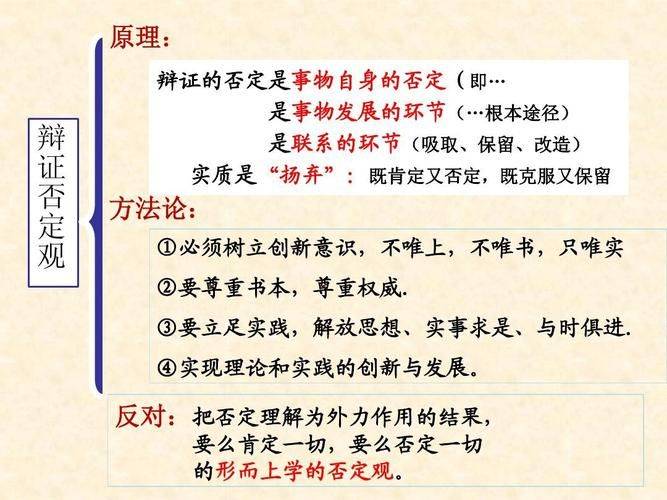
1. [the content of the doctrine]: the rebuttal is the denial of the thing itself, that is, the denial of itself and the development of itself. The essence of the rebuttal is “rejection”。
Ii. [methodology]: the need to create a sense of innovation, respect for the knowledge of books, respect for authority, and be based on practice, liberation of ideas, realism and change of circumstances
Understanding:
Ii. The current construction of terrorism
1. [merits of doctrine]: the dialectic of dialectics, in its positive understanding of what exists, contains a negative understanding of what exists, that is, an understanding of what exists, that is, of the inevitable demise of what exists; the dialectic of dialectics, which is understood in every form in constant motion, and therefore in its temporary nature; and the dialectic of dialectics, which does not worship anything, and is, by its very nature, a critical revolution and innovation。
2. [methodology]: the revolutionary criticalism and innovation of the dialectic is closely linked. The revolutionary spirit and critical thinking of the dialectic requires us to pay close attention to the realities of the evolution, to break the stereotypes that do not correspond to the reality, to break the mindset of backwardness, to focus on new situations, to raise new issues, to find new ideas, to build new ideas and to open new horizons. This is the key to our continuing success。
You're pretty lighted. I thought i liked it