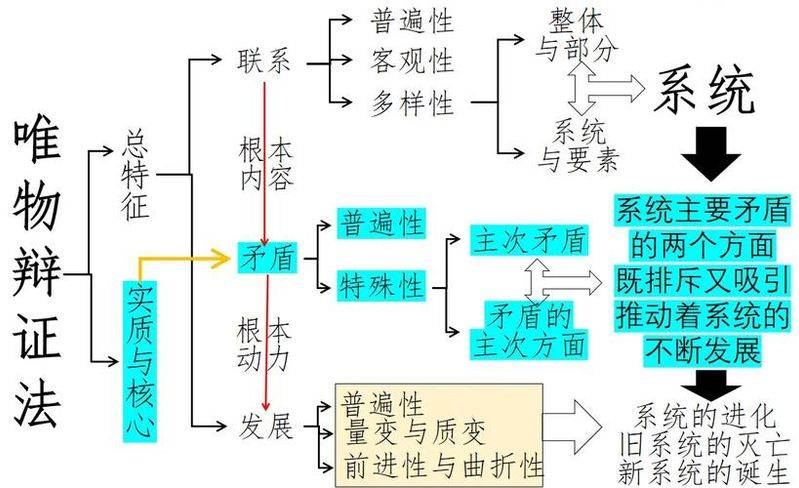
Please describe the content of the dialectics and some of the principles of the philosophy of the lord's reasoning, the principles of material and cognitive dialectics (1) material decision-making consciousness, material firstness, consciousness secondity, awareness is an objective reflection of the human mind. (2) at the same time, awareness is also dynamic in matter, and it can correctly reflect objective things and counterproductive things. The right ideology can guide people to practice effectively and contribute to the development of objective things; the wrong mind can lead people's activities astray and hinder the development of objective things. (3) we are required in practice to adhere to all practical principles, to make subjectivity objective and to harmonize subjectivity with objective and specific history. (4) we must value the role of consciousness, the power of spirit, the right ideology, the active participation in the construction of socialist spiritual civilization. 2. The principle of a universal connection (1) is the relationship between the things and between the elements within them, and between them. (2) everything in the world is in universal connection, and none of it exists in isolation, and the whole world is a united whole of universal ties. (3) the connection between things is objective, and to understand and grasp the true connection of things, it is necessary to analyse it in detail. (4) as we observe and deal with the issues, we must maintain the point of connection and reject the rationale of the linkage between the isolated views, the causes and the results (1) because of the phenomena that give rise to a certain phenomenon, the result of which is a phenomenon caused by a certain phenomenon. (2) the causal link between the thing is both a follow-up and a causal and induced relationship. (3) any phenomenon may give rise to other phenomena (the cause is always the result) and any phenomenon is caused by other phenomena (the result must be the cause). (4) in the specific causal link of each thing, there are strict differences between cause and result, which can be converted to each other under certain conditions. (5) in practice, we must recognize the universality and objectivity of the causal link, properly grasp the causal link of the thing, enhance the self-consciousness and predictability of people's activities,4 and the principle of the relationship between whole and part (1). The whole is the organic unity of the thing and the whole process of its development, in part the various aspects, elements and stages of the whole process of its development. (2) the two are distinct, being in the decision-making position of the commander-in-chief as a whole, and partly subordinate to the whole. When many parts form an organic whole according to order, the whole has a partially non-existent function; when the parts are formed in an orderly, rational and optimized structure, the whole function is greater than the sum of the parts; when the parts are formed in an disorderly, poorly structured structure, the whole function is smaller than the sum of the parts. (3) the two are indivisible and interact with each other, without the whole, not the whole, not the whole. The whole state of performance and its changes will affect the whole, partly constrain the whole, and sometimes have a decisive impact on the whole (under certain conditions, key parts of performance will determine the whole state of performance). (4) we think about issues, we do things, we think about the whole, we think about the best, we think about the best, we do the best, we do the best, we do the best, we do the best