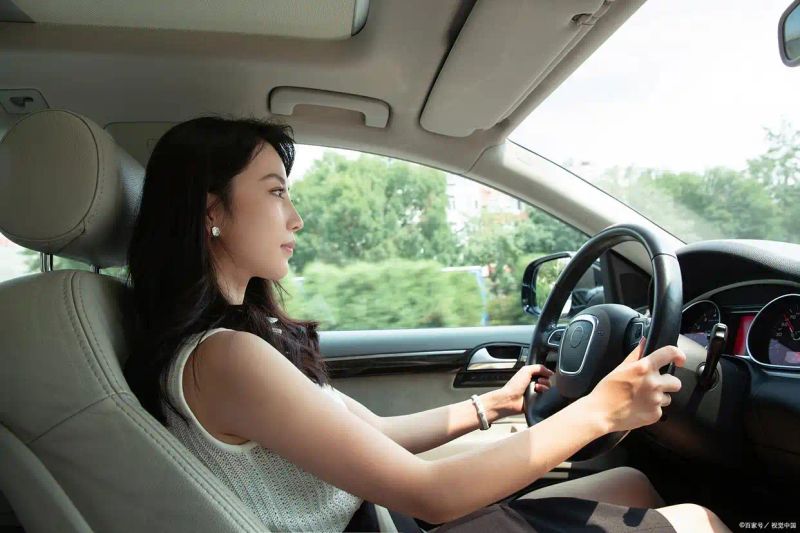
Rhythms are good, bold, quick, slow, stop, wait, be reckless。
Interpretation: driving technology requires constant exercise to be proficient, with bold and careful mentalities. Flexibility to adjust speed and operations to road conditions, which accelerates decisively, does not hesitate to slow or stop, but does not act recklessly。
Get in the car and look around。
Interpretation: prior to the start-up of a vehicle, the habit of detouring the vehicle for a week or observing the surrounding environment is established that there is no impediment or danger. It is important to wait until the reverse image system is fully displayed and secured before the reverse operation begins。
Transvestite supercars, lighted and then observed; right-turn multiple-view mirrors, deblind areas before turning; human-cars mixed left to break the column a blind。
Interpretation: before changing the driveway or overload, the switch light must be activated to alert others and then the rear vision mirror should be carefully observed. When turning the right, the blind zone is larger and multiple observation mirrors are required to ensure safety. In the left turn of the mixed traffic intersection, both the right and the left are used to remove the visual veil caused by column a。
There's three of them. There's six of them. The bend, the intersection and the ramp bridge do not cross the line, and the right side does not cross the vehicle. It takes more distance than taxis, goods, public transport, internships, sports cars。
Interpret: when crossing, remember three cases of not exceeding. We need to avoid six dangerous vehicles. The right side of the road is prohibited from crossing the main line of the road and crossing the right side of the line of view, where it is not good. When travelling, taxis, trucks, buses, traineeships, vehicles and vehicles are avoided, and longer safety distances are maintained with new energy vehicles。
Cars are prohibited from mobile phones, information, fights, anger; attention must be focused, distracted and exhausted; sights must not exceed two seconds, and navigation and water should be diverted。
Interpretation: the driving must be focused and the use of mobile phones, the response to information, quarrels or emotional driving is strictly forbidden. To avoid distraction and fatigue, the sight must not exceed two seconds from the road ahead. If mobile phone navigation or water is required, it should be stopped safely。
Cars are expensive. In the case of gazeh, calm and calm. Security is more important than time. See the truck turning, avoiding, not parallel, and guard against turning。
Read: drive in a spirit of comity. In case of forced cross-lines or gaza, try to stay calm and not fight, as security is more important than saving time. When the truck is seen turning, the van should be allowed to go first, not to rob the road, let alone to row with the truck in order to prevent a serious accident when it goes out of control。
If the road is not full, the entrance will be slow to observe; before the entry, the vehicle will wait, will stop, will not be slow, and will be protected from “ghost scouts”。
Interpret: do not go beyond your own side of the road. The entrance should be slowed down and carefully observed. If a vehicle slows down or stops at the intersection, it should also stop immediately and do not attempt to go beyond the vehicle moving slowly at the intersection in order to prevent any sudden movement of pedestrians or non-motor vehicles (i. E. “ghost scouts”)。
Drives without heels, with flat soles inside the vehicle, with a tight entanglement of the shoe belts, and does not make water bottles pedals。
Interpretation: female drivers should not drive in high heels, but should always have flat-bed shoes in their cars. Make sure the shoelaces are tied and that they are not entangled under the pedals. At the same time, be careful not to let the rolling water bottle jam the brakes or the oil door pedals。
Flat road parking: direct p to hold hand brakes. The ramp stops: first n block, hand brakes, loose brakes, then p block。
Interpretation: auto-stop vehicles may be placed directly in the p block and tighten their hand brakes when they are parked on a flat road. When the ramp stops, however, in order to protect the gearbox, the n block should be mounted, the hand brakes should be tightened, the foot brakes should be released so that the brakes are fully activated, and then the p block should be placed。
10
Complex road condition brakes, with no need for refuelling foot brakes; the front brake lights are on and the distance is immediately released。
Interpretation: in the complex and non-accelerated sections of the road, the foot should be moved ahead of the brake pedal to prepare the brake. Once the front brake light is on, the door should be released and sufficient safety should be maintained。
Eleven
Lights are used properly: the night road travels at high speed and closes to the car; the rain fog weather opens fog lights and the supervan flashes。
Interpretation: reasonable use of vehicle lights according to the environment. Long-lights can be activated at night in areas with insufficient lighting, such as on highways, but should be switched to near-lights when approaching or approaching a vehicle. The fog lights are to be turned on in rain or fog. When moving beyond a big truck, the other side can be alerted by shimmering in close light。
12
The sight is foretold and the front car is not allowed to block the line; it is close to the car to look at the cracks and see the front car。
Interpretation: driving should be predictable and long-sighted, rather than just staring at a few dozen meters. To avoid being completely blinded by the front car. In the event of traffic jams or close proximity to the vehicle, efforts should be made to observe the movement of the forward vehicle through the traffic gap。
13
(b) the turnways of the mountain forest road shall be flute, and slow down not to cross the line; and when a truck or a flute is heard, the straight path shall wait for no turning。
Interpret: when the sights of mountain roads, inter-forest roads, etc. Are blocked by mountain or tree bends, frequent sirens shall be used to warn the vehicle to slow down and not to cross the central line. If a truck is seen or a siren is heard, it should wait for a meeting in the direct section before entering the bend。
14
In the rainy days, cars drive away the ac from fog; the road slows down, the bend slows down and the direction of the car is too slow; the high-speed water is slowed down and the double-wheeling is better。
Interpretation: rain-day vehicles should not only turn on their wipers but should also open air-conditioning ac switches to prevent fog in their windows. The roads are wet and watery, slow and slow, and even slower when turning, avoiding emergency brakes and sharp swings. Water catchment areas encountered at high speed should be slowed down and, to the extent possible, both sides of the vehicle's wheel should be brought into the water at the same time in order to maintain a stable body。
15
Tyres have been crackable for more than six years, with high-speed pre-temporary examination of tire pressure and wear; broken drums are fast and flattened at lower than higher levels。
Interpretation: tyres are prone to cracks after more than six years of use. It is important to check whether the tire pressure is normal, the wear is excessive, and there are broken and drum packs before running the high speed. Tires with drums must never go high. It should be noted that the low pressure of the tires is more dangerous than the slightly higher rate of the flat。
16
The night drive is a dead end, and the dark stops. Ash is the normal path, white is the place where the water accumulates, and black is the porter of the pit。
Interpret: this is the night-time experience of judging road conditions based on the reflection of the road. Normal road surfaces are grey; reflective luminous white normally indicates water accumulation; reflective blackness or dark colour may foreshadow pits or obstacles and should be avoided or stopped for observation。
17
Tunnels are prone to frequent accidents, before entering the tunnel the lights are turned down and the entrance/exit point is carefully overloaded and the front vehicle is shielded。
Interpretation: tunnels are accident-prone sections. Before entering the tunnel, large lights should be activated in advance, slowing down and increasing distance from the vehicle. In the vicinity of the tunnel entrance and exit, as far as possible, the vehicle should not exceed the vehicle in case of a sudden diversion from the barrier inside the tunnel。
18
The seat belts are more important than the airbags and the first thing to get in the car is to fasten the seat belts。
Interpretation: in collisions, safety belts are the first and most basic security and even more important than airbags. On arrival, the driver, the co-pilot and the passenger in the rear should be fastened immediately。
19
The zebra line will be slowed down, before the car stops, and i will stop to guard against the ghost。
Interpret: passages must slow ahead. If a vehicle is seen in front of the zebra line slowing down or waiting for it to stop, it must also follow it in order to avoid the “ghost scouts” that suddenly pass through because the sight is blocked。
20
Fire extinguishers, window breakers and tripods are required. The tripod should be next to the driver's seat and should be free of two accidents。
Interpretation: the vehicle must be equipped with fire extinguishers, window breakers and triangular warning signs. It is proposed that triangular warning signs be placed near the driver's seat where they are easily accessible, so that in the event of an accident there is no need to go to the trunk and the vehicle can be placed quickly to warn of a second incident。
21
High-speed navigation is required and the images are placed in sight; the error-proof route is heard and the navigation is not aligned。
Interpretation: the navigation must be activated when the highway is moving and the navigation screen placed within sight. It is not easy to go the wrong way by relying on both hearing and visual information. Remember not to operate or adjust navigational settings during travel。
22
Do not overload on the right, with a high risk in the blind sector; in the event of an accident, the right overload is fully responsible。
Interpret: never cross the right non-motorized or slow lane. The right-hand variants and the hyper-blind areas are large and highly prone to accidents. Moreover, traffic regulations provide that in the event of an accident on the right side of a supercar, the supercar party usually bears full responsibility。
23
High-speed malfunctions or accidents, with no scratching on the head of the car; when the vehicle moves, the vehicle pulls over and is evacuated before calling the police to avoid a second incident。
Interpretation: vehicle failure or accident on the highway and no argument of responsibility on the driveway. As long as vehicles are mobile, they should be moved quickly to the emergency lane. The personnel are required to evacuate immediately to the safe area outside the fence and to report to the police for processing in order to avoid further incidents。
24
The city park side by side, as close as possible to the road teeth, without electric vehicles crossing the gap, and without “opening the door”。
Interpret: when the urban road pulls over, stop as close as possible to the road stone and do not leave enough room for electric traffic. This would effectively prevent collisions (i. E., “open doors” killing) caused by the driver's sudden opening of doors when electric vehicles travel through the gap between the car and the road teeth。
25
Before getting off the roadside, look behind and confirm that there is no car before opening the door and stop “opening the door”。
Interpretation: when preparing to get out of the car by the side of the road, the door must first be opened when the rear of the vehicle is observed through the window and the rear vision mirror, confirming that there is no vehicle, pedestrian or bicycle approaching. This is a direct and effective way of preventing “open-door killings”。
26
Fire lighters, perfumes, recharges, etc., are prohibited from being placed in summer cars。
Interpretation: items such as lighters, compressed gas perfumes, old chargers, etc., are at risk of burning or explosion in high temperature storms and are therefore strictly prohibited from being placed inside the vehicle。
27
Lights at the start of the road, do not rob the main road lane; the speed of the high-speed transfer into the main road will be controlled, and the traffic will be moved into the no-go route, with the fear of continuous diversion。
Interpretation: before entering the main road from the side of the road, the switch light must be placed and no vehicle that affects the normal functioning of the main road should be forced into it. Similarly, when moving from the high-speed ramp into the main road, learn to control the speed of the car, find the right time to follow the forward route, not to force the transfer, let alone to repeat it immediately。
28
Remember to block the way. In case of an emergency barrier or a car to force a line, do not rush in the direction, and make an emergency brake。
Interpretation: this is an important defensive driving principle. When there are sudden obstacles in front of you or when there are forced vehicle diversions to your driveway, the wrong approach is to move in the right direction, which can easily lead to vehicles losing control or crashing into other lanes. The correct course is to hold the wheel tightly while at the same time making a major brake to slow down and avoid concessions in their own lanes。
29
Quick sand slow water. Low speed of water accumulation and waterproofing of the engine; if the fire is out, the engine will not be restarted and the insurance will not be compensable。
Interpretation: sands should pass quickly in case of crash, while water catchments should pass slowly. Low-intensity, slow-paced speed when water is accumulated, preventing excessive splashing from causing engines to enter and fire. Once the fire has ceased in the water, the vehicle must not be activated again, otherwise it will cause severe motor damage, and such human damage will not normally be covered by insurance。
30
Sliding doesn't hit the roof. The uphill slope is refuelling, the edge of the slope has to be prepared for the brakes, and the post-mortem blind zone is in danger。
Interpret: routine behaviour can be appropriately refuelled when the slope is up, but when it is close to the top and the road behind the slope is not visible in sight, the oil is collected in a timely manner and the foot is moved to the brake pedal to prepare the brakes to deal with possible outbreaks of vehicles, pedestrians, etc., in the blind zone of the slope。
31
When there is a high-speed traffic jam, a space distance is maintained; the rear-view mirror is stopped, the van is stopped and the vehicle is evacuated to the safety zone at a speed。
Interpretation: in case of traffic jams on the highway requiring parking, the distance from the front car should be approximately one parking space. Once stabilized, the rear position is immediately observed, in particular the presence of large trucks that may not be able to brake. If a risk is detected, it should be quickly avoided by avoiding tailings to the side of the security zone (e. G., emergency lanes)。