Henan's daily news, visual media center. Winn
No tails, no collisions, no spontaneous combustion, and a good-end mini-su7 was injured by equipment purchased by the car owner to “savage”。
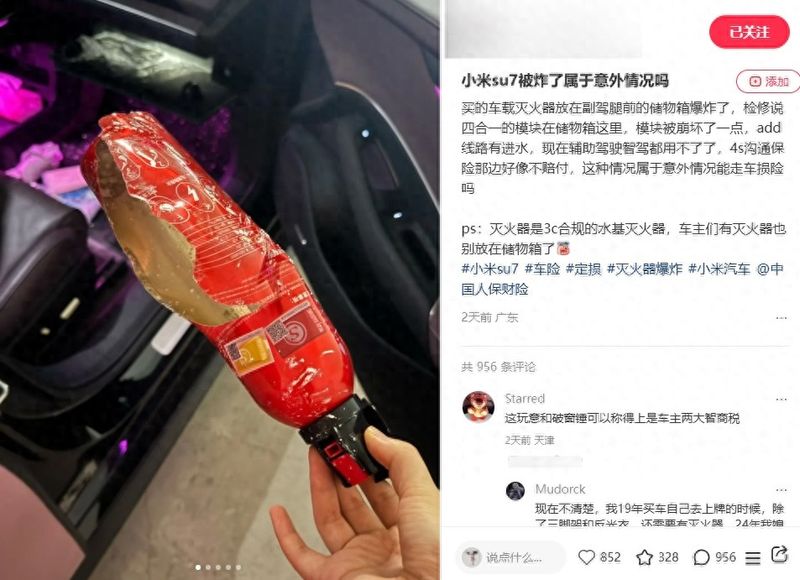
In recent days, a small red book user has posted a record of this ludicrous encounter: a bottle of 3c certified water-base fire extinguishers was inserted in a storage box in front of the co-pilot's leg. One day, the fire extinguisher exploded without warning。
The shock wave of the explosion directly affected the four-in-one electronic module inside the storage box, which was damaged and the add line was watered and the auxiliary and intelligent driving functions were completely paralysed。
The owner contacted mi4s and, after communicating with the insurance company, indicated that the insurance aspects of this situation might not be compensable. The owner of the car asked in his post whether the damage caused by the fire extinguisher was an accident and whether the damage would be useful
How bad is this malfunction
Following this case, mr. Zhang, a specialist in car accident identification, indicated that the four-in-one electronic module was one of the core control units of the new energy vehicle and that it incorporated several critical features of the vehicle. “this module typically integrates electric controllers, vehicle-mounted chargers, direct-flow converters and electrical distribution units, equivalent to the `brain hub' of vehicles.”
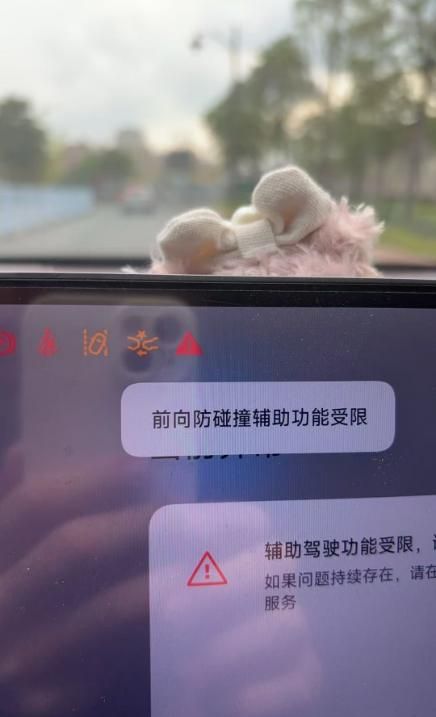
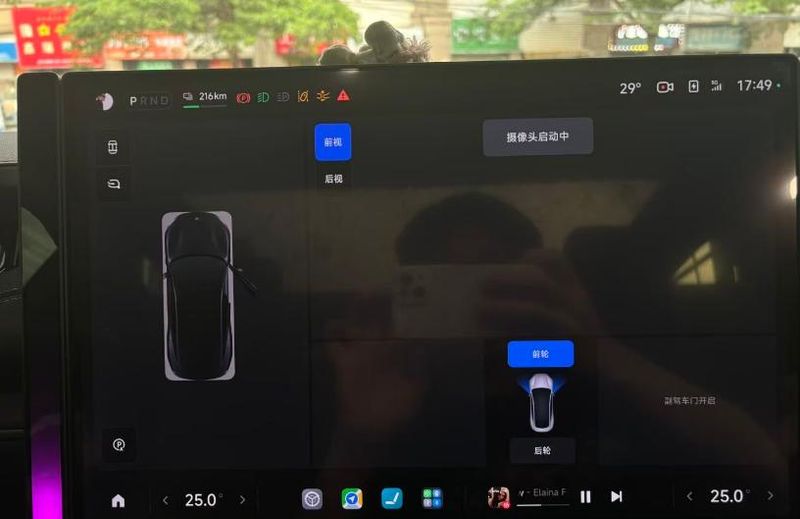
Mr. Zhang explained that the collapse of the module meant physical damage to internal circuit boards and chips, while access to the add line was more difficult. “add is the data transfer route of the advanced driving auxiliary system, which not only results in short circuits, but also in continuous erosion of the line interfaces and sensors, leading to the distortion or even interruption of signal transmissions, once water enters.”
He further stated that such failure would directly result in the complete loss of auxiliary driving, smart driving, automatic parking, etc., and that “cars can still drive, but all intelligent configurations cannot be used, amounting to the return of an intelligent electric vehicle to a normal walker”。
With regard to maintenance costs, mr. Zhang gave an approximate range: “if a four-to-one module needs to be replaced as a whole, the cost of a single component would be between $10,000 and $20,000, plus beam repair, sensor testing and calibration, working hours, etc., for a total cost of between $30,000 and $50,000. If the damage to the module is not particularly severe and can be tried and repaired, the cost will be lower, but more than 10,000.”
In particular, he reminded that such maintenance, which involved the core electrical control system, had to go to an officially authorized service centre, “because ordinary repair plants were not possible because of the need to repaint the programme and to mark sensor parameters”。
The journalist then made a telephone call for the mini car。
After hearing the description of the case, the client said: “we have documented the case and will verify the circumstances as soon as possible, requiring further evaluation by the technical department and the post-sales team”
Once the post had been issued, the discussion was quickly detonated within the owner's group。
Someone's scared. A comment was made by an online friend, little potato czd, who said that he had painted a similar fire extinguisher case and had taken out the fire extinguisher in his car at the first time。
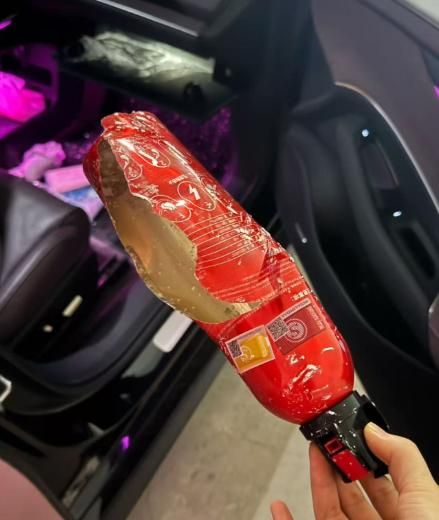
It was pointed out that the root cause of the problem was “the wrong model”. Netist “alssie” has done some research: water-based fire extinguishers have very limited coverage and can only respond to fires in solids (category a) and some liquids (category b, e. G., grease) and are completely powerless to fire electrical equipment. The real combination of vehicles is a dry powder extinguisher for steel tanks, with more types of fires that can be extinguished and more stable and secure。
And the netizens moved out of the national standard. In accordance with the requirements of section 5. 8 of the portable fire extinguisher, the current national standard gb4351-2023, any water-based product that is marked as capable of extinguishing fire types a or f must also have electrical insulation capability and be marked on product identification as applicable to fire types e (with electrical equipment). In other words, not all water-based fire extinguishers are entitled to be placed in the vehicle。
With regard to insurance claims, the confusion of the owners is not an example。
From the information received by many in the insurance industry, the losses caused by vehicle-borne fire extinguishers are often more controversial. The fire extinguisher is a self-placed item of the owner and is not an original component of the vehicle leaving the factory, and the resulting damage is normally classified by the insurance company as “loss of the contents of the vehicle” and is not covered by the normal payment for the loss of the vehicle. Whether or not compensation is specifically available is determined by reference to the terms of the policy and the details of the case。
A number of drivers have another layer of tension: did not the annual check require fire extinguishers in the car
Indeed. In accordance with the relevant provisions, vehicles are required to be equipped with fire extinguishers at the time of annual inspection. But the core issue is not “do you want or not”, but “what” and “where”。
The fire extinguisher's fine. Why did it blow up in the car
The correspondent at the agricultural west road fire station of the chumzhou central fire rescue brigade informed journalists that such accidents were not uncommon. “many of the cars are convenient and throw a bottle of water-based fire extinguishers. In the summer, for hours in the sun, the temperature inside the car rises to above 60°c, which is fatal for water-based fire extinguishers.”
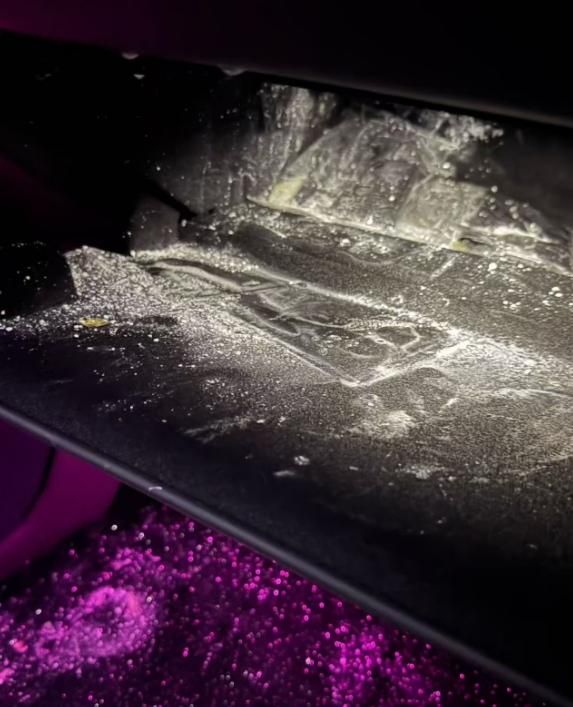
Xu xuan explained that the water-based fire extinguisher tank contained mainly liquid water solutions and that the capacity for sealing the pressure itself was limited. Under continuous high-temperature baking, liquids continue to swell, and the pressure in the tank rises sharply, and when the threshold of the safety charge is exceeded, “the light tank drum is deformed and the weight is blown apart”。
He further analysed three reasons why water-based fire extinguishers were not suitable for long-term carriage。
"first, it can't hold the heat." suh said that, unlike dry powder extinguishers, water-based fire extinguishers were mainly filled with liquids, and the steaming of the sun was expanding very quickly, and the tank pressure was easily exceeded。
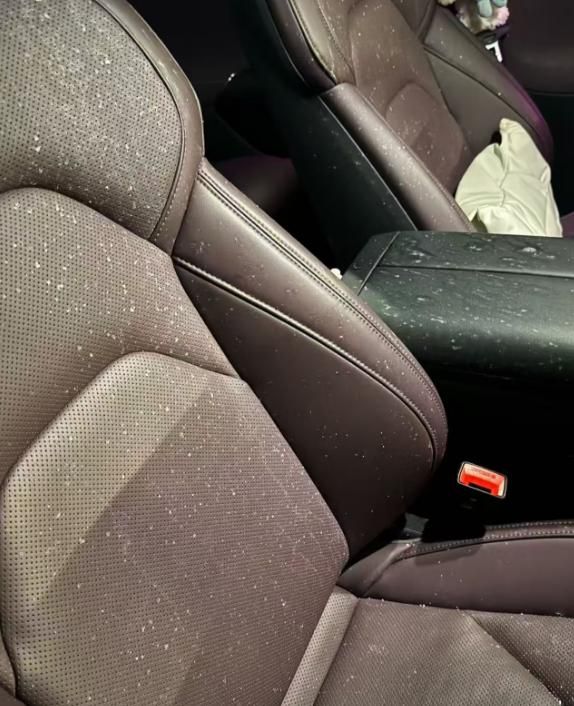
The second is the ease of sealing. Xu xuan indicated that there was a high probability that the valves and seals would age and break with frequent cold-hot alternations in the vehicle environment, combined with long-term uv erosion. “if the seal fails, not only the fire extinguisher itself is destroyed, but the leaking fluids also corrosive the interior of the car, such as chairs, carpets, etc.”
The third reason is that there is no match for the fire. In particular, xu xian stressed that the water-based fire extinguishers could not put out the conditions of electrical circuit fires and the burning of lithium batteries, “in particular, new energy cars, batteries that are out of heat, and water-based fire extinguishers are completely useless, and the owner of the vehicle holds it as a setup”。
And once the explosion actually occurs, the consequences are far more serious than expected。
“as a result of the blast, metal fragments and high-pressure liquids were splattered, windows were likely to be pierced, and persons in the vehicle faced cuts or even more serious injuries.” suh said that it was even more dangerous for splattered debris and liquids to ignite inner-decorative materials such as chairs, roofs and so forth, causing a second fire, “it would not be a matter of property loss, it would be a real personal safety hazard”。
What kind of fire extinguisher is that
Seo-ho made specific recommendations. A dry powder extinguisher of 1 kg or 2 kg size preferred by a fuel truck “to withstand high temperature, strong pressure, unexploitable and expensive, which is the highest value for money”. Aerosol or carbon dioxide extinguishers are recommended for new energy vehicles, which are compact, have no residue after fire suppression, have reliable blast-proof properties and do not cause damage to precision electronic components inside the vehicles。
At the same time, he made it clear that water-based fire extinguishers and high-pressure fire extinguishers in large quantities could never be kept in the vehicle for long periods of time。
Pick the right model and put it in the right place。
The fire extinguisher must be firmly secured in the vehicle with a dedicated slab, magic sticker or strap, “preferably on the side of the trunk or in the storage of gerry, without rolling impact when the brakes, collisions, are not easily broken”。

There's also talk in the area. He reminded the owner of the position of the sun in the middle control, directly below the windshield, and in the back window, that the fire extinguishers should not be put in place, and that “the cool and ventilated corners of the back-up compartment are ideal”。
It is also important to ensure rapid access in times of emergency. “don't bury a fire extinguisher under a pile of groceries. There's a fire coming out in a few seconds.” seo-hyun suggested that it be placed in an empty space on the side of the trunk or under the seat, so that it could reach。
In terms of routine maintenance, firefighters advise the owner to keep the fire extinguisher in place and not to reverse or squeeze. “look at the pressure sheet every six months, the pointer is fine in the green area, and once in the red zone or beyond the warranty period, it is replaced without incident.”
For new energy vehicle owners, no generic high-volume high-pressure fire extinguishers should be placed in the vehicle, and special aerosols or clean gas fire extinguishers should be selected for use in the vehicle, “and it is important to stay away from battery packs and avoid new risks from high temperature conductor”。
In particular, firefighters stressed the point: “summer cars are a sealed oven, not just water-based fire extinguishers, lighters, hair spray cans, carbonated beverage bottles, and all pressurized containers should not remain in the car for long”