Woodpeckers are recognized as beneficial and are known as “the forest doctor”. Data show that a woodpecker with enough “quick” can hit a tree with his head 12,000 times a day, with a frequency of up to 15-20 times a second. One goes on to say, “when a woodpecker pecks a wood, his head moves more than twice as fast as the bullet shoots.” one wonders: does a woodpecker have a “brain concussion” at such a high rate of impact and rate of impact
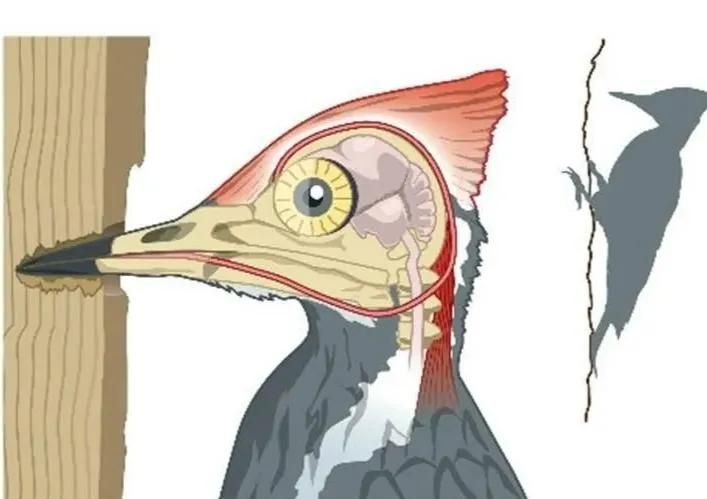
In the past, a common explanation was that their skulls were able to absorb shocks and thus protect their brains. Those who hold this view believe that the woodpecker has a special skull structure, and that it has an empty spongy skeletal layer beneath its hard skull, wrapped in the brain. This structure helps to absorb and reduce the impact and protects the brain well. This view also inspired us to design helmets and helmets, to leave a gap between the top and the top of the helmets, and to fill them with flexible sponge fillings, which would make the head very protective in the event of collisions。
However, a new study published in contemporary biology points out that this is not true. Researchers first need to test whether this “shock-mitigation” is real: if there is a shock-mitigation device between the beryllium and the brain, the reduction in the brain is significantly slower than when the beryllium is hit. They recorded three species of wood peckers (black peckers, black peckers, big peckers), videos of wood peckers, and mainly selected the mid-point of beaks, the base of beaks, and the eyes as key markers. An analysis of the video showed that there was no significant shift between the reference points and the eyes of the beak during the impact. A linear regression analysis also shows that the seismic effects are minimal or non-existent. This suggests that a woodpecker's head is more like a hard hammer than a shocker. The absence of a shock does not mean that the brain of a woodpecker is in danger in a seemingly violent impact. Even the strongest pecker hits more than 100 times, it should still be safe for the woodpecker's brain — calculations show that the woodpecker's brain was still carrying less than that of a human being suffering from concussion. Researchers created a model for calculating internal pressure on the skull of a woodpecker, and found that a woodpecker had to hit a tree at twice the current rate before having a concussion。
Researchers also pointed out that, while the data indicated that head impact was not sufficient to cause concussion, woodpeckers had been feeding and communicating in this manner for a long time. Such repeated long-term impacts also put some selective pressure on woodpeckers to evolve to prevent brain damage or some mechanisms of brain repair. The study concluded once and for all with the view that some parts of the skull of a woodpecker would act as shock-mitigators. So what's the reason the woodpeckers don't have a concussion after hitting the trees? Researchers think it's about the size of their heads. The woodpeckers have a small brain size and mass of about 2 grams and are attached to the skull and do not experience as much pressure change as the human brain at the same acceleration. So, the smaller the brain, the smaller the injury