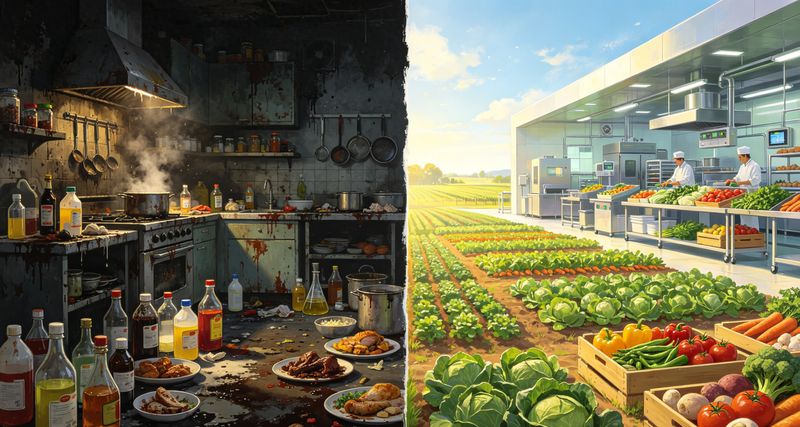
And the people eat of the sky and eat of peace. Food safety is directly related to the physical health and safety of life of each individual and is the bottom line in the bottom line. In recent years, negative news has surfaced from time to time in the food industry, ranging from material forgery, additive abuse, to poor production environments, with many lamenting “the moral base of the food industry being crushed by benefits”. But we cannot see only the dark side, but beyond the chaos, there are still a large number of conscientious and honest businesses that are silently guarding the public's tongue. Today, let us talk rationally about the current state of the food industry, without avoiding problems or neglecting the light, and with a view to sharing practical food safety identification techniques。
I. Confronting industry disorder: demeaning behaviour induced by interests
It is undeniable that the food industry does have a part of the business that is profit-oriented and breaking the bottom line, which not only harms consumers but also lowers the reputation of the entire industry。
1. Fabrication of food products with secondary filling
This is one of the most common disruptions, with the core driving force being the large price differential. For example, pure cattle and sheep cost about $40-50 per pound, while ducks cost only $7-15 per pound, a four-fold difference that drove many businesses to obscurity. In the past, liu wen was exposed as a cow and goat with duck, and the shopkeeper even argued that “can $20 a pound be pure beef” torn the food products off the veil。
Others use synthetic meat as real meat, mixed with starch, edible glue, perfume, etc., and have little meat content in oral q bullets; use cheap vegetable oil as olive oil, peanut oil, and ordinary rice as five millimetres, to deceive consumers to make sharp profits through false labelling, disguise texture, etc。
Additive abuse, proliferation of “technology and hard work”
Food additives are not in themselves scary, and compliance can improve food tastes, extend the shelf life, but some enterprises are over-standard, over-scope and even add illicit substances. For example, in order to make fruit visible, excessive use of precursors, preservation agents, misuse of nitrites to make meat products red and non-transformable, and in small workshops, double-oxygen water is used to impregnate chicken claws, pig hoofs and decomposed while seriously endangering health。
More merchants sell “zero-adding” “pure-natural” headheads, but secretly add preservatives, sweeteners, just changing labels and misleading consumers。
3. Disruption of the production environment and the absence of sanitary standards
A number of small processing plants and workshops are not regulated and the production environment is worrying. There is no guarantee of safety for the products produced by the workshop, which are covered by oil, sewage, raw materials, and even garbage; staff who are exposed to food without wearing work clothes, masked gloves and bare hands; and equipment that is not cleaned up for long periods and breeds bacterial fungus。
There are also some red foods, live foods, without formal qualifications, which are “three products without products” and are produced in a “small-scale workshop” process of all quality and quality。
4. False propaganda, exaggerated utility, misleading consumption
In order to attract flows and increase sales, a number of enterprises have “exaggered”. Common foods claim to be “cancer-resistant” “contagious and healthy” and blow ordinary snacks into “health care”; beverages label “100% pure juice”, while the first on the distribution table is water and white sugar; bread labels “all wheat”, and the first on the distribution table is wheat flour, which ranks behind, and is a purely word game。
The area of live delivery is also a disaster-prone area, with some of the anchors promoting food products for commission, knowing that the products are problematic, concealing the origin, quality deficiencies and even using technical means to glorify the appearance of food products and misleading consumers to issue orders。
Ii. The industry is not entirely black: the conscientious enterprise that stands on the bottom line has never been absent
Despite the eccentricity, we cannot be partial. The food industry is the basic industry for the livelihood of the people of the country, and the vast majority of businesses are compliant and conscientious, with qualities and responsibilities that support the mainstream of the industry and safeguard the safety of the public。
1. Heading enterprises: chain-wide controls and secure lines of defence
Large domestic food enterprises have a strict chain-wide control system, ranging from the procurement of raw materials, the processing of production, the detection of the plant to the traceability of the product. For example, large dairy companies, self-built rangers control milk sources, cattle breeding, feed rationing and milking processes are standardized throughout the entire process, with dozens of tests to be performed at the former milk feeding plant; production workshops employ sterile designs, automated equipment reduces manual contact, each batch is tested, and only after certification, consumer scans allow access to trace information on the entire product。
There are also leading enterprises for food oil and meat products, which insist on “quality first”, reject low-priced raw materials, do not misuse additives, open production standards and testing reports, are subject to social oversight and gain consumer confidence through long-established reputations。
2. Small and medium-sized conscience merchants: small and sophisticated, based on good faith
In addition to large businesses, many small and medium-sized food merchants and couples' shops also hold their conscience. Such as traditional bakeries in the streets, which insist on making them manually and without preservatives, which are sold on the same day, with good food and pure taste; fresh shops in the community, which insist on purchasing fresh food, without three products, short-term products, price-fixing and short-term discounts; and local specialty snack shops, which pass on old crafts without “technologies and hard work”, which operate on earth tastes and integrity and retain returning visitors。
These small and medium-sized businesses are small in size and have low profits, but they are well aware that “good faith is the foundation of their business” and that, without earning money, they slowly accumulate their customers by reputation and maintain their own moral base in the midst of industry。
3. Increased policy regulation, forcing industry regulation
In recent years, the state has given high priority to food safety and has introduced a series of laws and regulations to secure food safety lines with “four strictest” (the strictest standards, the strictest regulations, the most severe penalties and the most serious accountability)。
In 2026, the superintendence of markets implemented a number of new regulations: in january, the food recall management scheme was issued, requiring enterprises to immediately recall food products that were found to be problematic; in january, a new regulation was introduced on online food sales, undermining platforms and business responsibilities; and in march, a live food delivery regulation was introduced, stating that “four must not be allowed” and strictly prohibiting false propaganda and sales of prohibited foods. At the same time, the general customs administration has amended the regulations governing the import of food products to strengthen the registration of offshore enterprises and control the safety of imported food products from their source。
There are increasingly stringent regulations and penalties, and many enterprises are afraid to touch the red line and proactively regulate their production operations。
Practical skills: how to avoid food safety traps
In the face of the complex state of affairs in the food sector, we do not use excessive panic or relax our vigilance. With simple practical identification techniques and daily attention, the probability of buying problematic food can be significantly reduced and the health of the person and the family protected。
1. Packaging: a tag-reading text game
- qualifications: identification of sc production licence number, which is not always purchased; verification of production date, warranty period, and avoidance of late and obsolete products。
- read the table of ingredients: the table of ingredients is sorted in order of content and the first three determine the nature of the food. For example, the “wheat bread” table must be first in whole wheat powder; the “pure juice” table should be first in fruit juice rather than water and sugar; and the top three foods with white sugar, gravy and preservatives should be avoided as much as possible。
- advocacy: be alert to exaggerated propaganda such as “zero additions” to “purely natural” “cancer-resistant production”; ordinary foods cannot mark health effectiveness, but only those marked with “blue hats”。
2. Food-defunct: a first-hand identification of counterfeit goods and poor quality products
- meat: real cattle and goats are naturally coloured, texture is clear, and when cooked, the meat is compact and non-frozen; fake meat is exceptionally coloured, texture is messy, and then cooked, it is fragile and oral。
- edible oils: high-quality oil colours are clear, impurity-free and taste-free; poor oils are obscurous in colour and smell of sediment and halama; olive oils are yellow and green and smell of nostrils。
- vegetables and vegetables: to avoid an abnormally bright colour and a smooth and impervious skin, there may be excessive use of preservatives and catalysts; natural ripe fruit and vegetables colours may be natural, skins may have a small spot and smell natural fruit。
- maroons/manufactured meat products: synthetic pills are too loaded, they are cut open, they are thin and smelly and smelly; real meatballs are flexible, they have small gas holes, they have light meat。
3. Selection: prioritization of formal premises, away from three products
- priority is given to large supermarkets, chains of convenience and the formal market for vegetables, which have strict access, formal qualifications and guaranteed sales。
- carefully purchase roadside mobile vendors, internet-based red foods without physical shops, and three low-cost live deliveries, which are of unknown origin, undetected reports and have difficulty defending their rights。
- priority is given to businesses that have a physical store and a well-documented business, avoiding a “ghost shop” with no food and no qualifications。
4. Human rights defence: food at risk, decisive complaints
Once the problem food has been purchased, the purchase vouchers, food packaging, surplus foods are kept and the evidence is recorded。
- call the 12315 market regulatory complaints reporting phone or through the 12315 platform。
- statutory compensation: 10 times the price or three times the loss may be claimed and less than $1,000 at a rate of $1,000。
- don't take it personally. Every time you defend your rights, you push the corporate code and drive the industry forward。
Iv. A rational view of the industry: chaos is a minority and conscience is the mainstream
The food industry, like other industries, inevitably suffers, but we cannot deny the whole industry because of a few things. From the field to the table, the food industry has a long chain and a large number of links, involving hundreds of millions of workers, and the vast majority of them are doing what they want to do。
Firms and businesses that hold the bottom line may not be over-marketed, unsettled, but they operate in good faith day after day, guarding the security of our tongues and transmitting the positive energy of the industry。
At the same time, food safety does not have a “stander” – it requires both continuous regulation, strict enforcement, and the commitment of businesses to good conscience, good faith, and, more importantly, greater awareness, rational consumption, and proactive advocacy among our consumers. It is only by working together that we can continuously clean up the industrial environment and return the food industry to its “safety-based, integrity-based” nature。
Topical discussion
What food safety problems do you encounter when you buy food? Have you ever seen a good-faith food dealer? You are welcome to share your experiences and views in the comment area。
Disclaimer
The content of this paper is based on public information and is not specific to any particular enterprise or product. The identification techniques mentioned in the text are for reference purposes only and are not the sole basis for advocacy. Some of the cases and data are based on public reporting and publication by the regulatory authorities, and if there are omissions, please correct them。