Chapters and links to radar principles
Chapter i: introduction
Chapter ii: launchers
Chapter iii: receiving machines
Chapter 4: monitors
Chapter v: role distance
Chapter 6: distance measurements
Chapter 7: angle measurement
Chapter 8: speed measurement
The study link to berry university
Radar ranging principle, precision, resolution and maximum non-magic distance
Radar, as a device to use electromagnetic wave detection targets, is widely used in a wide range of fields. The range function is one of the fundamental tasks of radar, and this paper will provide detailed information on radar ranging principles, precision, resolution and maximum non-mixable distance, with the aim of helping readers to understand in depth the core elements of radar range technology。
(i) fundamentals
Radiowaves are transmitted in a straight line at fixed speed in the flat media (the speed of transmission in free space is approximately equal to the speed of light c = 3 x 10⁵ km/s). The slope from target to radar r can be obtained by measuring the time transes required for an electromagnetic wave to travel between the radar and the object, i. E. R = 1/2 ctr, which is the delay of the echo relative to the launch signal, so the key to the measurement of the target distance is the precise determination of the delay tr. Depending on the signature of the radar launch, the determination of the delay time is usually based on pulse, frequency and phase methods, and pulse radar is often based on pulse and continuous wave radar is often based on frequency or phase methods。
(ii) pulse range (range on monitor)
In pulse radar, the echo signal is the echo pulse that lags behind the launch pulse. Early radars use monitors as terminals for direct reading of delays based on the sweep range and echo position on the monitor image, while modern radars often use electronic devices for automatic reading. (iii) fm-based ranging
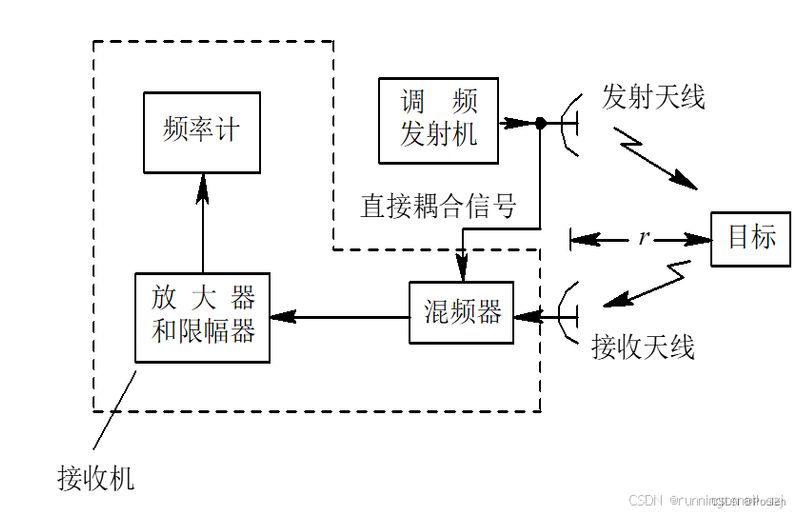
Fm range can be used for continuous wave radar and pulse radar. The transmitter produces continuous high frequency (hf) wavelengths, the frequency of which varies according to a regular pattern (e. G. Triangle, sine, etc.), the signal from the target echoes and the transmitters are added directly to the receiver mixer, generating a differential frequency voltage, which is amplified and limited and added to the frequency count, and since the frequency of the differential frequency is related to the target distance, the frequency scale may be used as a unit of distance length. Scang-wave-modern ranging principle
The frequency of the transmission signal varies according to the sawn-pattern cycle (linear fm lfm, also known as the chirp signal), with a start frequency f c, bandwidth b, duration t c and slope s. After the radar launches the chirp signal and receives the target reflect back signal, the target is determined by the frequency difference between the echo signal and the launch signal (the frequency difference is determined by the back wave delay for the non-routine motion target) and thus the target distance r = cs and 2f 0 (f 0 is medium frequency). Triangular fm ranging principles
A signal with a frequency of triangulation by cycle, with an average frequency of f 0, a frequency change cycle of t m and a maximum frequency bias of Δf. R = cΔf (tr-t m/2)/4f m (f m is a triangular fm frequency) can be obtained by calculating the different frequency between the frequency of the launch and the back frequency。
(i) composition of errors
The range error is known by the full calibration of the range formula and consists of both Δc at the rate of transmission of the wave and Δtr at the time of detection, replacing the variable available range error expression with an increase. Errors are classified by nature as system errors and random errors。
(ii) system error
The error caused by the fixed delay of the signals in the various parts of the system is theoretically compensated for on-site radar, but in practice it is difficult to complete the compensation, and the range of permitted system errors is often given in radar technical parameters。
(iii) random error
It is also referred to as accidental error. Uncertainty of the equipment itself (e. G. Time lag volatility, occasional changes in circuit parameters, instability in the frequency of crystal oscillators, reading errors, etc.) and external errors caused by occasional factors outside the system (e. G. Occasional changes in the rate of transmission of electrical waves, atmospheric refractions, random changes in target reflector centres, etc.) are all random errors. Random error values are randomly measured over time and are generally uncompensable, and are the main indicator of the accuracy of the range。
(iv) specific impact factors errors due to changes in the rate of transmission of electromagnetic waves
The atmosphere is unevenly distributed and its parameters vary over time and place, resulting in random changes in the rate of transmission of the wavesc and resulting in relative ranging errors. Changes in the rate of transmission caused by changes in atmospheric parameters at night and day are negligible in conventional radar ranging, but the radar operating environment is not the same, and the rate of transmission of electromagnetic waves should be adjusted appropriately to reduce errors. Error due to atmospheric refraction
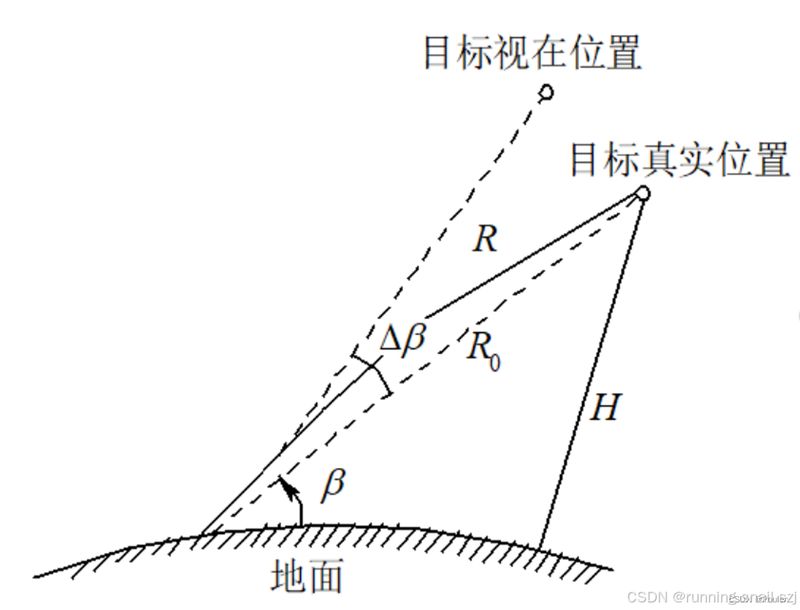
The atmospheric transmission of electrical waves results in uneven refractions of the medium, and the transmission path bends, leading to error in the range (with error in the angle) and greater error in the range caused by the refraction as far and higher as the target is concerned. Error in reading method
Early pulse radars can cause errors when measuring target distance from monitors, such as the diameter of the fluorescent screen, tic precision, artificial reading inertia, etc.; and error estimates of the echo centre (which is wider than the pulse and is inversely greater than the noise ratio) and quantitative errors of the counter, which result in error detection。
(v) summary
The radar range accuracy is the difference between the range value and the target actual value, measured by an average error, with the main factors affecting changes in the rate of transmission of electromagnetic waves, atmospheric reflection and reading methods. System error is calibrated, random error is not calibrated and is the main indicator of the accuracy of the range。
Iv. Distance resolution and range of ranging (i) distance resolution
The minimum distinguishable distance between two points equal in size in the same direction. In the range measured on the monitor (pulse-based ranging), the resolution depends primarily on the distance represented by the diameter of the light point (d) at the back pulse width; when measured by electronic means or by automatic ranging, the width of the pulse and the width of the door is determined by the width of the complex pulsed signal, by the effective bandwidth b of the radar signal, the greater the bandwidth and the better the resolution of the distance (the signal is defined as the lower of the resolution constant at the time of continuous bandwidth of the signal, and the hourly delay resolution constant is determined by a vague function). Expression
The distance Δr c = 1/2 (and +d/equi n) (d for light point diameter and υn for light velocity); the electron Δr c = c/2b for range. (ii) range of range, minimum detectable distance
Pulse radars share antennas, the receiver is unable to receive the target back during the time of the pulse bandwidth, and it takes time t0 for the pulse to return to receiving status after the passing of the antenna switch, for which no ranging can be measured, so the minimum detectable distance is r min = 1/2c (and + t0). Maximum single-value range (maximum non-mixed distance)
Tr is determined by the pulse repeat cycle and, for the purpose of ensuring single-value ranging, the tr ≥ 2r max/c (r max is the radar maximum action distance determined by the radar equation). When Δt = tr = t's corresponding distance is r u = ctr/2 the maximum unmistakable distance of the radar. If the radar repeat frequency selection does not meet the single-frequency ranging requirement, it creates a blurry distance, the distance corresponding to the target echo is r = 1/2c (tr + mtr) (m is a fuzzy value) and the problem of distance ambiguity can be resolved using multiple repeat frequency (multi-frequency technology) or “shelter pulse” methods. (iii) multiple repeat frequencies (multi-frequency technologies)
Repetition frequencies of fr1 and fr2 (pulse repeat cycles of tr1 and tr2 and fr1 t2), corresponding to a non-mangled distance of r u1 = c/2fr1 and r c2 = c/2fr2, respectively, are less than the desired non-mangular distance of r u (relative to prf fr d, r u = c/2fr d). The selection of fr1 and fr2 should ensure that the number of pulses launched under the two prfs, such as fr1 = n* fr d, fr2 = (n + 1) * fr d, are interchangeable within an expected pulse repetition cycle. Within an expected pri, the echoes of both signals are repeated at only one time, i. E. At the target position. The time lags t1 and t2 corresponding to the two echo signals are measured with the corresponding pulses under the two rpfs (m1 and m2, respectively) and the target distance can be derived from the three scenarios。
(iv) “shear pulse” method
Each of the m pulses was dropped as an additional sign, a2 of the pulse string a1-a m was not fired, and one of the echo pulses was missing per m. Cumulative launch pulses from a2 to stop counting when there is no return pulses after a certain launch pulse. The cumulative value is the number of repeat cycles m across the echo wave, which, when known, can be applied to the formula to resolve ambiguity。
Conclusion
The paper provides a comprehensive description of radar ranging principles, precision, resolution and knowledge of maximum non-mixable distance. The radar range principle is based on electromagnetic wave transmission properties and time measurements, with different ranges. There are a number of factors affecting ranging accuracy, including changes in the rate of transmission of the waves, atmospheric refractions and reading methods, where random error is key to measuring accuracy. Distance resolution determines the ability of radar to distinguish between targets, ranging between the minimum measurable distance and the maximum non-mixable distance, which can be addressed in several ways. This knowledge is important for in-depth study of radar technology, improvement of radar performance and applications in related areas。