Topic 1: 3. 6 x 11. 1 + 1. 2 x 66. 7
I. Context analysis
Observation of digital characteristics: the algorithm consists of a two-part multiplication, with no directly identical public factor and no direct multiplication method of allocation. It was noted, however, that 3. 6 and 1. 2 had a multiplier relationship: 3. 6 = 1. 2 x 3, which was a convenient breakthrough。
Construct a public factor: distinction of 3. 6 to 1. 2 x 3 and introduction of a public factor of 1. 2 for both multipliers allows the complex multiplication to be converted into a simple multiplication calculation using the multiplication method。
Simplified calculation: after split, 33. 3 + 66. 7 in brackets can be exactly 100 integers, significantly reducing the difficulty of calculation。
Ii. Steps for relief
Step 1: split numbers and construct a public factor
3. 6 was observed to be three times that of 1. 2, so 3. 6 was recast to 1. 2 x 3 and the arithmetical value remained unchanged:
3. 6 x 11. 1 + 1. 2 x 66. 7 = 1. 2 x 3 x 11. 1 + 1. 2 x 66. 7
Step 2: calculating interplications, harmonizing public factors
3x11. 1 = 33. 3, at which point both multiplications contain the public factor 1. 2:
1. 2x3x1. 1+1. 2x66. 7=1. 2x33. 3+1. 2x66. 7
Step 3: reverse multiplication allocation, extraction of the public factor
Inverse formula based on multiplication: axc+bxc=(a+b)xc
Herea = 33. 3,b = 66. 7,c = 1. 2 and withdrawal factor 1. 2:
1. 2 x 33. 3+1. 2x66. 7 = 1. 2x (33. 3+66. 7)
Step 4: concise and simplify multiplication
Add in brackets: 33. 3 + 66. 7 = 100, then multiplied by 1. 2:
3. 6 x 11. 1 + 1. 2 x 66. 7 = 120
Answer: 120
Topic 2: 4. 8 x 22. 2 + 1. 6 x 33. 4
Solve the problem:
4. 8x22. 2+1. 6x33. 4
=1. 6x3x22. 2+1. 6x33. 4
=1. 6x66. 6+1. 6x33. 4
= 1. 6 x (66. 6 + 33. 4)
= 1. 6 x 100
=160
Answer: 160
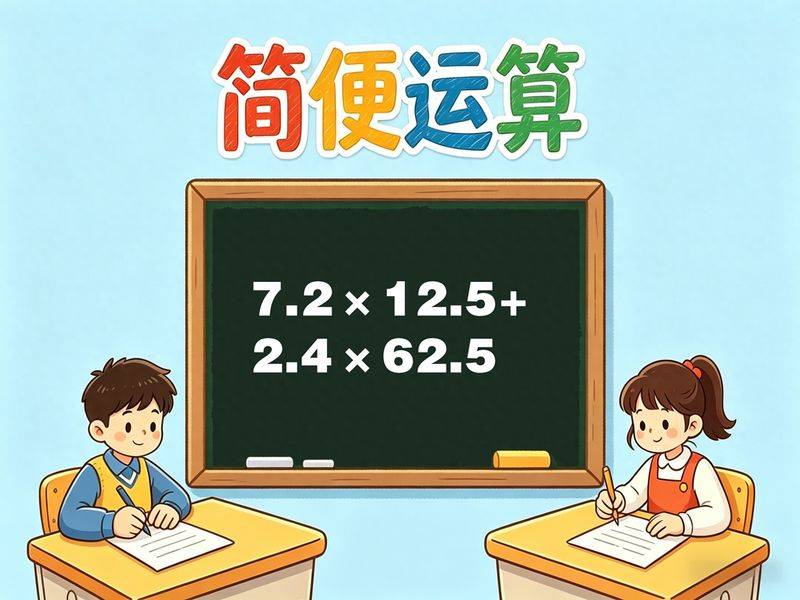
Topic 3: 7. 2 x 12. 5+2. 4 x 62. 5
Solve the problem:
7. 2 x 12. 5+2. 4 x 62. 5
=2. 4x3x 12. 5+2. 4x62. 5
=2. 4x37. 5+2. 4x62. 5
=2. 4x(37. 5+62. 5)
= 2. 4 x 100
= 240
Answer: 240
Little tip:
Core skills: in the absence of a direct public factor, the active construction of a public factor by dividing the number of relationships is key to such topics。
Evident reminder: when splitting numbers, it is important to ensure that the numerical values remain unchanged, for example 3. 6 to 1. 2 x 3, without changing the multiplication relationship。
Awareness: when decimals are seen, priority is given to seeing whether a whole number (e. G. 33. 3 + 66. 7) can be formed, which will result in faster and more accurate calculations。