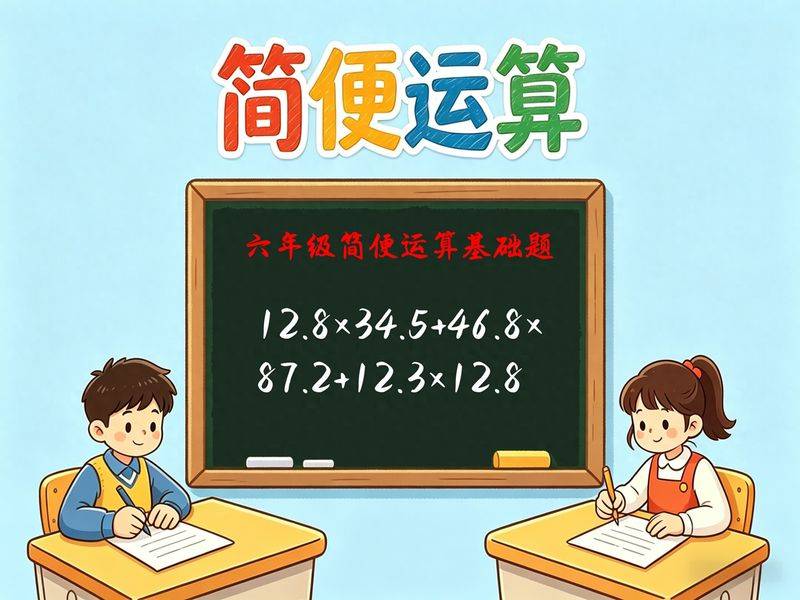
Hey, everybody, the challenge today is to have a small number of simple calculations and see who's the smartest way. Let's start
12. 8x34. 5+46. 8x87. 2+ 12. 3x12. 8
I. Observation of numerical characteristics
Original 12. 8x34. 5+46. 8x87. 2+ 12. 3x12. 8
Look carefully, there are three multiplications in this question, and the first and third multiplications show numbers 12. 8, right? 12. 8 x 34. 5 and 12. 3 x 12. 8, both of which have a public factor of 12. 8, and we can combine them with multiplication
Ii. First multiplication method to merge items of the same kind
According to the multiplication law: axc+bxc =(a+b)xc, we propose 12. 8:
Prototype = 12. 8 x 34. 5 + 12. 3 x 12. 8 + 46. 8 x 87. 2
=12. 8x(34. 5+12. 3) +46. 8x87. 2
Add in brackets: 34. 5 + 12. 3 = 46. 8
So it became: =12. 8x46. 8+46. 8x87. 2
Iii. Second multiplication method of allocation to complete calculations
Now the algorithm becomes 12. 8 x 46. 8+46. 8 x 87. 2, at which time the public factor is again present in the two multiplication algorithms
= 46. 8 x (12. 8 + 87. 2)
The addition in brackets is 100:
12. 8+87. 2 = 100
Iv. Final step of calculation to produce results
= 46. 8 x 100
= 4680
V. Offset calculations
12. 8x34. 5+46. 8x87. 2+ 12. 3x12. 8
=12. 8x(34. 5+12. 3) +46. 8x87. 2
=12. 8x46. 8+46. 8x87. 2
= 46. 8 x (12. 8 + 87. 2)
= 46. 8 x 100
= 4680
You see, we used multiplication rules twice, combining 12. 8 items, 46. 8 and 100, making complex calculations particularly simple
When you come across a subject that has multiple multiplications, you can find out if you have the same public factor and combine it one by one