The current system of creative trading introduces “price cages”, i. E. Setting a valid declaration range in successive competitive transactions。
As an innovative mechanism, “price cages” are not well known to domestic investors. In june of this year, the shanghai stock exchange issued rules for real-time monitoring of unusual transactions, clarifying the rules: the purchase price was capped, no floor, and did not exceed 102 per cent of the benchmark price at the successive competitive stage; the sales price was floored, no ceiling, not less than 98 per cent of the benchmark price. The transaction price must meet the corresponding increases and decreases。
The system is designed to prevent the overstatement and malicious pressure on stock prices, in particular by limiting the “cage” effect of high and low prices that deviate from market prices. Multi-tenderers have stated that transactions such as “sweeping” will be difficult to perform after theoretical calculations and system tests, with limited impact on normal rational declarations。
However, the same sources point out that the opening of the market is expected to be more dynamic, with high stock price volatility and a high risk of rushing to catch up or sell, with a 2 per cent limit likely to be frequented. In practice, the voucher terminal system does not provide front-end control of the investor's entrustment, and all entrustments are reported to the exchange for brokering. Objectively, there is a delay between the terminal and the exchange server; although short, it does exist. In extreme cases, there may be significant price fluctuations during this period, leading to partial commission being systematically identified as “waste sheets”。
Multiple coupons brokers also stated that, given the changing circumstances and the time lag at the end, the current voucher ap did not provide a reference range for effective price ranges. The landing of the “price cage”, which places high demands on the “hand speed” of transactions, has now been sufficiently popularized, but investors still need to become more familiar with and adapted。
Frame "sudden floor"
“price cages” impose unilateral and effective price restrictions on successive competitions, which do not block normal commissioning, but have a direct impact on instant “soft floors”, blindly chasing up and down。
On 14 june, the regulations for real-time monitoring of unusual trade in creative stock were handed over on a trial basis. It provides that the declaration is valid at the stage of successive competitions for cbi stocks, at a price of not more than 102 per cent of the base price of the purchase, or at a rate of not less than 98 per cent of the base price of the sale, when the declaration is made. This requirement does not apply to the declaration of market prices in the context of the trade in cedars, the bidding phase of the pool, and the limited declaration of prices during the opening period。
On 28 june, in response to questions from journalists regarding the establishment of a science board and the pilot registration system, the relevant cvm officials referred to the mechanism for effective pricing ranges as “price cages”。
There are two key elements to understanding “price cages”. The first is the determination of the base price. In the rules of control, the effective declaration of prices is based on the immediate disclosure of the purchase and sale price, and the non-immediate disclosure of prices is based on the latest offer and the pre-collective price。
In particular, the four priority levels of the underlying price of the purchase are the minimum selling price (i. E., the price of the sale), the maximum purchase price (i. E., the price of the purchase), the most up-to-date offer and the pre-collective price. Correspondingly, the four priority levels for the sale of the base price are, in descending order, the highest immediately disclosed purchase price, the lowest immediately disclosed sales price, the latest traded price and the previous closing price。
Such an arrangement would guard against extreme circumstances, such as lack of mobility, which would prevent commission from being concluded. For example, if priority is given to the most up-to-date offer and the pre-offer price is used in the absence of a deal, and if the purchase and sale of a price deviates significantly from the benchmark price, the market's validly declared order remains out of the order book's forefront, making it impossible to conclude. Stock orders are not cancelled, and this non-negotiable status will continue, while investors will never be able to do so。
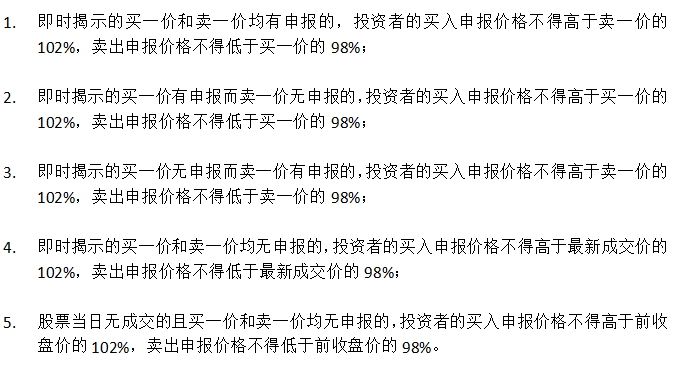
Key element two is the unilateral limitation of the 2 per cent valid range. According to the rules, there is a ceiling for buying but no floor for entrusting; there is a floor for selling but no ceiling. At the same time, setting a 2 per cent range takes into account the overall impact on the declaration. According to the analysis of historical transaction data from the submission of the master plate, only 0. 49 per cent of past transactions and 0. 64 per cent of accounts had declared prices in excess of 2 per cent。
From both scenarios, it is measured that if the price range is validly stated at 1 per cent, its impact on orders and accounts will rise to 1. 09 per cent and 1. 13 per cent, with a relatively high impact on transaction continuity and market participants. If the range of validly declared prices is 3 per cent, the level of impact is too broad and there is little value in imposing a price limitation。
The senior analyst of the new unit of the shin mangung institute, peng wengyu, has stated to the first financial journalist that a 2% price cage would limit extreme declarations that deviate from high-priced and low-priced market-priced purchase orders and, to a certain extent, curb the boom and fall without much impact on normal rational declarations. “it is expected that, at the beginning of the transaction, individual investors and institutional traders will be tested for the speed of their subordinate reaction.”
In addition to theoretical estimates, “price cages” are also practiced in mature markets。
The establishment of effective price ranges is used in our hong kong market, the japanese market and exchanges such as the chicago business exchange and the european futures exchange. In the case of the hong kong market, for example, peng wenyu stated that the hong kong stock stock had not applied price escalation restrictions and had set up nine-fold price cages at the opening and successive bidding stages. Prices on the japanese stock exchange have also been subject to wider price restrictions. The market, based on the lowest differentiated unit of quotations, and based on the latest special offer for investor decision-making, established different maximum quotation slot limits requiring that the next offer be within a certain range of the previous transaction price。
“from the practice of these two markets, there has been some disincentive to extreme irrational declarations, thereby reducing the probability of instantaneous price fluctuations that a single transaction may trigger.” peng wenyu indicates。
In addition, vouchers disclosed that in the previous market-wide tests submitted to the organization, operational rules such as the effective declaration of price ranges were tested, requiring each party to ensure that technical and business systems were in place. According to the tests, the effective declaration of price ranges does not affect stock prices to rise or fall, but can discourage extremes such as the instant “terrestrial ceiling” “sky floor”. This is particularly important in the trading day when the restrictions are not rising or falling in the early days of the opening market。
How can a “waste sheet” be avoided
As a result of institutional innovation, the landing of “price cages” will lead to market testing. On the one hand, investors also need time to become familiar with and adapt, and it is difficult to avoid a proactive approach to “price cages” during the initial active phase. On the other hand, because of the process effects of the entrustment order, it is possible that in cases of rapid and volatile price fluctuations, the user's order may be passively “waste order” because of time lag。
The official responsible for state securities indicated to the first financial reporter that the first five trading days after the listing of the cbi stock were not limited by the increase or fall, that the opening of the market might be more active, that stock prices might be more volatile, that there was a tendency to rush up or sell, and that the 2 per cent limit would still be touched. In practical terms, if a declaration goes beyond a valid price, the investor's commission is systematically refunded and shown as a “waste sheet”。
The head of a medium-sized voucher operator further stated that, for valid price declarations, the issuer did not exercise front-end control and that all entrustments were reported to the exchange server; the exchange compared the time of reporting to the server with the real-time price, which exceeded the valid range, would return directly and show “waste sheets”. In this process, there will be a short delay from the client to the exchange. In extreme cases, however, this time lag may lead to greater price differentials, which in turn may lead to partial commission being shown as “waste sheets”。
“this time lag has an impact if the customer has been following up, or has been entrusted with a `scanning', and there is a real risk that the `screw' will continue. But if ordinary investors do normal commissionings below the maximum price, they will have no significant impact.” the person in charge states. It is worth noting that many coupons brokers have confirmed that they do not currently provide reference areas for effective price ranges when entrusting orders, taking into account changing circumstances and terminal time lags。
According to the above-mentioned official for national gold securities, companies had expectations of investors not adapting to the “price cage” rule at the beginning of the transaction and of the commissioning of “lost orders”. On the one hand, where conditions permit, investors should be advised to follow orders in as real time as possible and participate rationally in the investment. At the same time, companies have also strengthened their preparedness through investor education, client emergency response, etc., to help investors get used to and adapt to trading rules。