Coal-fired boiler reports
Fuel used in our boilers is mainly coal. Large-scale boilers and power boilers are often used for coal powder, which requires a powdering system for milling raw coal into coal powder. The system, where coal drops through the original coal warehouse, is shredded by a coal grinder delivered to the coal machine. Coal is also dryed during coal grinding, and dry media usually use hot air. The cold air is sent into the air preheater by the wind carrier, where the heat from smoke is absorbed into the hot air. A portion of the hot air, which rises by its head and enters the coal grinder, while heating and drying the coal with well-earned powder to leave the coal mill, can be seen as a part of the hot air that, in addition to being a dry medium, is used to deliver coal powder, which is usually called a wind. In the direct blowing system, when the powder mixture comes out of the coal grinder, it is sent directly to the burner through the coal plume and it is sprayed into the chamber. It should be noted that in the intermediate storage powder system, one wind-carrying powder enters the coal powder separators, where the powder is separated from the gas stream and stored in the coal powder silos, where appropriate quantities of coal powder are supplied to the burner from the coal powder silos by means of loads. It can also be seen from the system that another part of the hot air from the air preheater, known as secondary wind, enters the furnace directly through the burner's vent to provide the air required for coal powder combustion。
Coal powder is burned inside the furnace, releasing large amounts of heat and high temperatures in the centre of the fire. The interior of the furnace is covered with a water cooling wall consisting of a metal pipe, and the heat from combustion is heavily absorbed by the water cold wall, mainly in the form of heat radiation. However, as a result of the heat load and the volume of the furnace, the temperature of smoke at the point of export remains generally high. In order to use this high-temperature flue gas, the pipe is also equipped with heaters (of what class), reheaters, and so forth. High-temperature flue gas flows sequentially through these hot surfaces and heats them through cross-flow, radiation, etc. The smoker from the air preheater is usually at around. The flue gas could no longer be reused, separated by being placed in a dust cleaner, removing the vast majority of the fly ash carried by the smoke, then introducing it into the chimneys and eventually into the atmosphere。
During the entire process of steaming, three heating stages were performed in the boiler. First, boiler water is heated to saturated water, then heated to saturated steam and overheated steam with a certain excess temperature. The three processes are usually carried out in thermal surfaces of the provincial coal, water coolers and heaters, respectively。
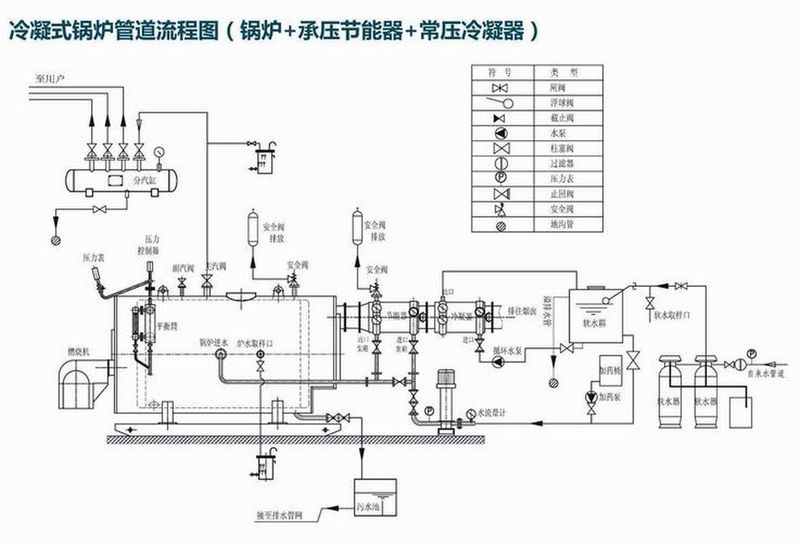
When the boiler is operated, the water is treated with water and deoxygenized, the pump is pumped with pressure and flowed through the pressurized heater and enters the container at the entrance to the utility. In general, water is heated to saturated water in a coal utility. In practice, however, different boilers differ. For example, low-pressure small-scale industrial boilers using found iron and coal can generally not heat up water to saturate water; for medium-pressure boilers, there may be a requirement to save the mass of the tank for export; for boilers above subcritical pressure, there may also be a requirement to save the mass of unsaturated water for the container for export. In the process, the work is carried out under the mandatory operation of the pumps. The work that goes into the bag follows the drop pipe and goes down to the water cold wall and joins it, and it is distributed to the water cold wall tube (i. E. The lifting tube) into the furnace to heat it and form a soda mixture to return the pack. The movement in this sector is sustained by the density difference of the soda mixture in the drop and lifting tubes. When the soda mixture returns to the pack, it is separated by the soda separation unit in the pack, the vapour is concentrated in the first half of the vapour space of the pack, and the water enters the water space of the lower half of the bag and begins new natural circulation. For high-pressure boilers, water generally evaporates as saturated steam every cycle。
The saturation vapour in the pack is separated and the heat is introduced into the heater through the catheter. When the superheated steam is heated to a rated temperature, it is transported to the engine for work. The boiler in the system, which is equipped with a reheater in the pipe. The steam exported from the engine's high-pressure tank is drawn to the reheat for reheating. When the required temperature is reached, the reheated steam is re-introduced by re-heated steam exports into the medium- and low-pressure cylinders of the engine。
Gas hot boiler reports
The running water enters from cold water pipes, which contain cold hydromagnetic valves, one-way valves, lock valves and side valves. The role of the cold hydro-magnetic valves is to automatically control cold water, which passes through the pipeline into the gas boiler when the cold hydro-magnetic valves are opened; when the cold hydro-magnetic valves are closed, the pipe is closed and the cold water ceases to flow. The function of a one-way valve is to prevent a mixture of hot and cold water. The bypass valve is used as a back-up channel for temporary cold water when cold hydro-magnetic valves fail。
Gas channel system reporting
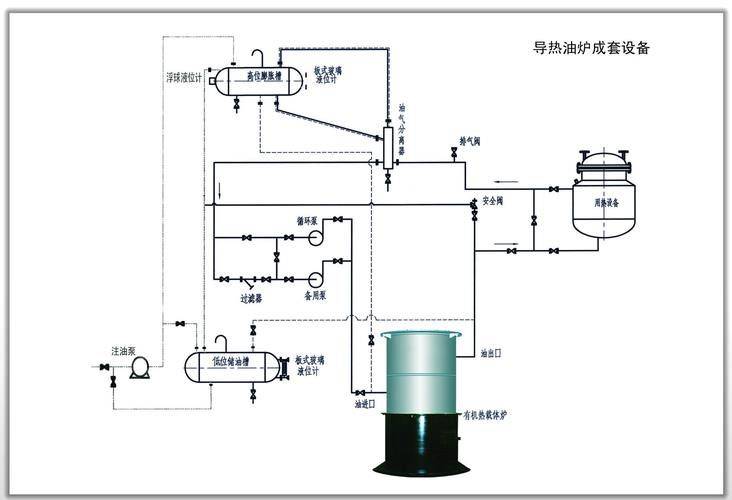
Gas channels have pressure meters, ball valves, filters, pressure reduction valves, flow meters, burner valves, etc. Gas is used as a fuel for combustion engines, fuel is burned in the oven of the gas boiler, high-temperature flue gas follows the oven's urchins and then goes to the first pipe, then turns 180° to the second pipe through the pressurized front-box, then then turns to the second pipe, and then turns to the tail pipe through the flue. The maximum difference between the constant pressure water boiler and the high pressure boiler is that it is equipped with an air-connected vent without any pressure. When hot water is burned to the established temperature, the cold hydromagnetic valve is opened and the hot water that is burned inside the boiler is pressed through the upper circulatory tube to the warmer tank using the pressure of cold water. While hot water flows from the gas boiler to the hot tank, cold water is re-inflated from the cold pipe. Hot water is provided by a hot water pipeline with a hot hydro-magnetic valve on it, the function of which is to provide time-selective water supply to users. The side valve next to the electromagnetic valve can skip the heat hydro-magnetic valve and connect directly to the pipe as a long-term water supply. The water tank is equipped with a liquid spot and the boiler automatically stops burning when the water tank is filled. The water tank is equipped with a temperature probe, and when the water temperature drops to a given temperature, the hot water is pumped into the boiler by a circulation pump from the lower circulation tube。
The gas boiler uses an automated control system, which is the control hub for the entire gas hot boiler system, and users regulate the operation of the hot boiler system through an automated control system。
The electric boiler
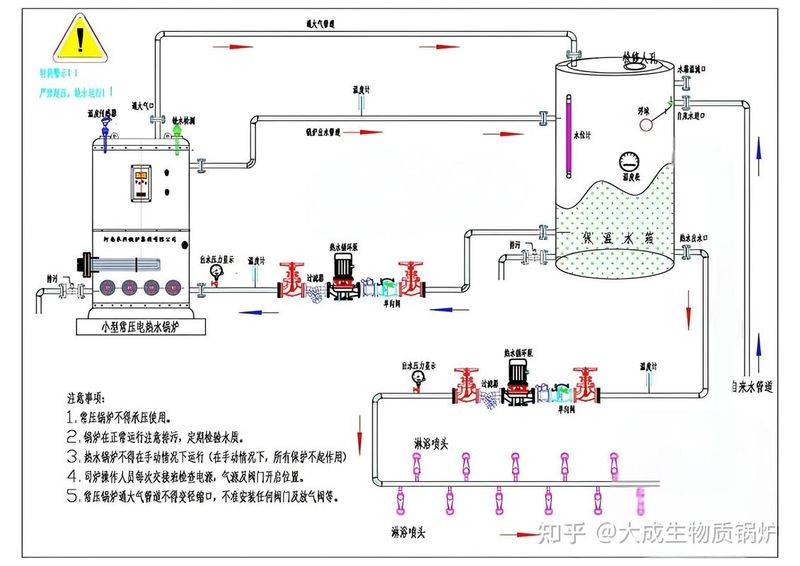
When the electric boiler reaches the heating point, the recharge valve will be opened, the hot tank will begin to recharge, and when the water level reaches the intended high level, the recharge valve will be self-activated. When the temperature of the hot tank reaches the pre-set temperature or the heating period is over, the electric boiler ceases to function, and after a minute, the cycle pressurized pump begins to run, the cycle pressurized pump operates at the established frequency, and after 30 seconds the electric boiler functions to start heating。
Open water power valves, turn off the thermal power valves, start the cycle pressurized pump to provide water by constant pressure at modulus, and start the electric boiler in about 30 seconds, so that the water is provided to the user on a direct supply basis. At the end of the water supply, the circulation of the pressurized pump is stopped and the electric boiler is stopped after 60 seconds。
When the water supply time is reached, the electric valves of the electric boiler are activated, the thermal power valves are shut down, the boiler is not operational and the cycle-pressure pump is converted to constant pressure. The recharge valves for the water supply of electric boilers remain closed and do not perform water recharge operations to prevent the supply of cold water to users. If the temperature of the tank is below the established temperature of 5 °c during the heating period, the cycle pressurized pump is again operational and the electric boiler starts in 30 seconds。