As a result of the rise in temperature during the “lysummer” period, spring and summer were times of intense skin loss, according to past clinical experience, and “scattering” was one of the most important concerns of skin patients during that period. A lot of patients come to consult, and the spots on their faces can be removed by lasers。
There are many types of facial “specks”, but the reasons for their formation vary from treatment to treatment. Many pathological diseases are at low risk and have little impact on life, but affect the appearance and, consequently, the mood. Today, let's say what is common in the face, and if you're suffering from it, you can take a seat at the same table and see how to solve the skin problem。
Brown
"the king in the spot" can't cure the recurrence
Brown spots are a common acquisition symmetrical plaster that can be light or dark brown, sometimes grey or blue. The good hair is in the cheeks, forehead, upper lip, nasal and hips and can be shown in a "flash" distribution。
Most of these are found in adolescent women and pregnant women, and sometimes also in men, and are generally not self-conscious, as shown by changes in colour. Darkness is associated with such factors as sun, season and endocrine, increased spring and summer, reduced autumn and winter and, in some cases, the mental state of the patient, which can be exacerbated by nighttime and fatigue。
Overall, brown spots are the most common for people with darker skin colours and for people living in areas with strong sun. It has a serious impact on beauty and a considerable psychological burden, with a clear impact on emotional health, social life and leisure activities。
Treatment
It is difficult to cure the yellow tan with the title “the king in the shading”, because the disease is chronic and recurring. Current treatments include skin whites, chemical stripping, laser therapy and phototherapy. In the absence of any treatment proven to be effective for all chromatic patients, a combination of medications and treatments is usually used in clinical settings, especially for difficult cases. The use of facial sunscreen during and after treatment is very important, including the avoidance of sunlight exposure, the wearing of broad caps and the use of broad spectrum sunscreen. Because of ultraviolet light, it can lead to increased verbide, colour sank, and the recurrence of vermin。
Freckles
It's genetics and sun
Freckles tend to be found in women's faces, especially in the nose and eyes of the eye, often at the age of 3-5 years, where damage increases with age, colour increases, and adolescence is most visible. Typical skin loss is light brown to light black spots, needle to the size of rice grains, round or ovulation, isolated and unintegrated, disjointed, and symmetrical distributions vary in number。
Freckles are mainly associated with genetic factors and ultraviolet light. It usually increases in spring and summer and decreases in autumn and winter. Following exposure to ultraviolet light, skin damage can increase in size, colour and number。
Treatment
Freckles should avoid sunburning and short-term therapeutic effects can be obtained from external hydrogen frosts. Experience has shown that qs emerald lasers, qs rubies lasers and powerful pulse flashlights are effective in treating freckles。
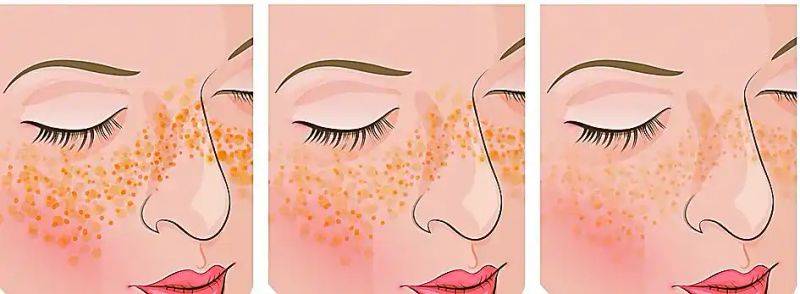
Freckles of varying degrees
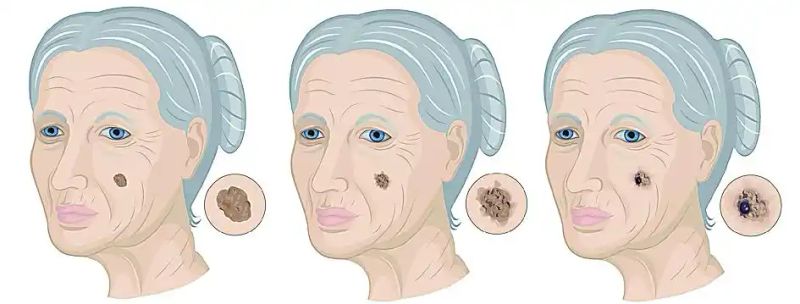
Malignant melanoma
Age spots
Possible confusion with malignant neoplasms
Leather agglomeration, also known as “geriatric plasters”, may be associated with family genetics, long-term sun suns, skin aging, better than those over 50 years of age, and younger people may suffer from the disease。
Such tissues, which look like things glued to the skin, are light brown, brown or black, can draw out the skin or be in line with it, vary in size, have circular, elliptical or irregular shapes, generally without visible symptoms, but can sometimes cause itching. Leather damage is benign, with very few malformations, but some dermal lesions are not easily distinguished from malignant tumours, such as base cell cancer. If new tissues are found on the skin, medical examinations should be conducted in order to identify the bad side。
Treatment
Most geriatrics do not require treatment, and appropriate treatment is available to patients who consider beauty effects。
1. Liquid nitrogen refrigeration: this is a special liquid of very low temperature that, after treatment, leaves a light-coloured skin area in the gerontology stove。
2. Co2 laser therapy: carbide treatment of local areas after impregnation
3. Surgical removal: after anaesthesia of skin, removal with a surgical knife or other small instrument。
Milk and coffee
More than six babies and young children must be warned
Milky coffee bands are diseased with unbridled colours, similar to the colour of the mix of coffee and milk, which may appear at birth or early in childhood, often first discovered after sunbath. It occurs in any part of the body, small millimetres, large or more than 15 cm, and increases in proportion as children grow. The colour varies from tan to dark brown, which is usually more uniform, but in some cases there is a visible decrease in the chromosomal content of the pelvis or some darker colours。
This is often isolated skin and usually has no clinical significance. However, multiple milk coffee spots may be a skin mark of underlying genetic diseases, such as type 1 neurofibromas and mccune-albright syndrome (a clinical syndrome of congenital endocrine disorders). Thus, infants and young children in six milk and coffee plasters should be consulted promptly in dermatology to assess whether there are anomalies。
Treatment
If milk and coffee spots are treated for cosmetic purposes with colour-specific lasers, they are usually required several times. Treatment effects vary, relapses are more common and there is a risk of side effects, such as a persistent obscurantism or a decrease in obscurantism。
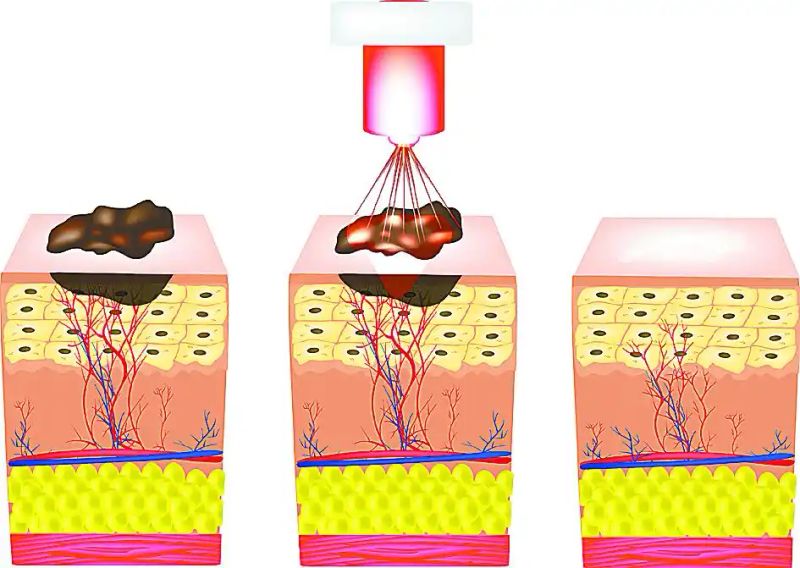
Laser scab map
Riehl black disease
We need to find and avoid allergies
Riehl's (ler's) disease is mostly among middle-aged women, and skin damage occurs mainly in the face. Based on the pathogen, the depth of pigmentation and the skin colour of the patient, the pathological skin can be brown, brown or blue grey. There are usually minor red spots and itchromes before permutation or hysteresis occurs。
The causes of the disease are complex and the mechanisms for its occurrence are not sufficiently clear. Most patients have a history of exposure to light-sensitive substances (e. G., kerosene in industrial processes, certain cosmetics, etc.), exposure to sunlight can also occur in exposed areas, as can oral contraceptives and drugs such as chlorpropam。
Treatment
Black disease can be diagnosed on the basis of clinical performance and history of cosmetic use. Standard series, cosmetic series, fragrance series sticker tests, as well as sticker tests for other components of the patient's personal product, may help to identify the pathogen. The treatment is mainly directed towards the complete avoidance of suspected allergies. In addition, sun-proofing measures, skin whites and chemical detachants accelerate the decline of sunscreen。
Ota mole
Very few malign but tired and eye-to-eye consultations
Ota moles (brown tan moles in the eye) are a form of hysteresis, giving priority to the first and second neurodynamic regions of the trident nerve, which are common in asia, with the ratio of females to males at around 4:1. More than half of the cases are colored at birth or within one year of birth, while the remaining cases become apparent around adolescence. In both cases, the skin damage will persist。
Injecting moles are usually integrated by spot sizes ranging from a point of needle to a few millimetres, with single spots in circular, elliptical or irregular shapes, while the entire skin-colored boundary is irregular and uneven. The skin colours are light brown, gray, blue, black and purple. Two thirds of the patients are excruciatingly excruciating in the oscillation, and can also be accompanied by iris nipple formation and glaucoma, although the eyesight is largely intact。
The range of ota moles has expanded over time and has been sustainable for life, with light colours that can change, but rarely with bad change。
Treatment
Ota moles are commonly treated with lasers, usually on several occasions, and generally perform well. When oeda moles and eyes are tired, an eye check-up is required to monitor them closely。
Color mole
Most people can stay healthy for life
Color moles, commonly known as “twistles”, have diverse clinical manifestations and are sometimes mistaken for freckles. However, in contrast to freckles, pigments are the benign growth of a group of melanoid cells (i. E. Mole cells), which tend to be 6 mm in diameter, with an even symmetry of the surface, a flatness of the pigments, a round or egg, a pattern of shape and clear boundaries. Colour moles can occur in any part of the body, especially in the face and body cadres exposed to sunlight。
Treatment
Most pigments can remain benign for life and do not require treatment other than observation. Smaller pigments (not exceeding 3 mm) are selected for laser removal if treated for beauty needs, while larger pigments typically require surgical removal。
The above-mentioned skin problems are generally not harmful to health, and the treatment depends on the individual's will. However, there are still malignant swellings in the face that can be confused with "coloured" and that must be surgically removed from pathological examinations, such as malignant melanoma (horrid freckle moles). Malignant melanoma is the most “odious” tumor in the skin, originating in melanoid cells, and has the effect of tanning on the face and neck of older persons. It is manifested in irregular shapes, uneven colours and varying sizes, and advances with the risk of an invasive freckle plaster (lmm) of 5-20 per cent. Colors deepen, borders become clearer, skin damage rises or the presence of knots is a clinical sign of disease progress, which requires expanded surgical removal after diagnosis。
In the light of the above, facial limit color change can be the expression of a variety of diseases, whether removed from a health or aesthetic point of view, and should first be treated in the formal dermatology, after the type of disease has been identified。