Brown spots are recognized as “the kings of the bands”, and their treatment is varied. Among them, colour-based lasers consist mainly of trans-q lasers and skin-second lasers. Due to the high market heat of leather-second lasers, the trans-q lasers appear to be obsolete laser equipment. So, in clinical practice, should the treatment of vermin be the choice of leather-second lasers? What's the advantage of a q laser for brown spots? How do we choose the right wavelength? Let's talk about it together
The properties and advantages of leather-second lasers
The skin seconds refer to the "pulse width" of the laser launch, i. E. The pulse duration. The q (q switch) laser has a pulsary width of " ns" level. Both types of laser belong to the "coloural type laser" primarily for color therapy. We know that beauty lasers play a therapeutic role primarily through the principle of “selective light heat”. In fact, however, lasers can also function as "photo-mechanical" (photo-sound), "photochemical" and "photo-bioregulating" in skin tissues。
For colorous lasers, when they act in the skin, they can act as both “light heat” and “light sound”. In general, nanosecond q, light thermal. And the skin-second laser, on the other hand, is photosound. In the case of millisecond lasers or strong pulses, there is no photomechanical action。
Theoretically, the vibration wave that transmits the laser energy of the skin-second laser to the pigmentary particles for a short period of time can cause the particles to break smaller and reduce thermal damage to the surrounding tissue. This advantage is reflected mainly in the use of short wavelengths (e. G., 532 nm) for blasting skin marks or tattoos. So, does a leather-second laser have a better advantage in the treatment of brown spots
It's not
The principles and methods of q-laser treatment for brown spots
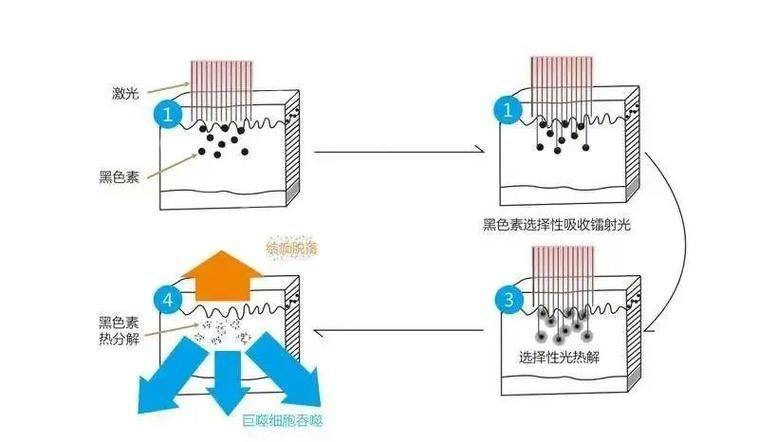
At present, the “high-light spots, low-energy, long-wave-length tuning q lasers” are still recommended internationally as the preferred colour type lasers for the treatment of chromatic spots. (doctor's note: attention is to be drawn to the preferred colour type of laser rather than the preferred type of laser, which is actually based on a new understanding of the mechanism of tan-breathing, a growing number of experts are of the opinion that colour-based lasers should not be preferred to tan-blanc). “big light spots, low energy, long wavelength q lasers” are also referred to as “net lasers”, or “net skin patterns”. The use of this model for the treatment of chromatoma is largely based on the “subcellular selective photothermal effects” proposed by korean scholars around 2010。
"subcellular selective photothermal activation" means a large light spot, low energy pattern
We know that the black cells of the tan strip are active and highly susceptible to hormonal causes of increase and anti-black. If more wavelengths (e. G. 532 nm) are absorbed with medium, high energy or melanone use, there will be too much "photothermal activity" at a time when the probability of provoking the melanoid cell to increase the colour is almost 100%. Since the introduction of “subcellular selective photothermal effects”, the pattern of large light spots and low energy has been very low
Parameters and principles of large light spots, low energy toq lasers
1 preferred 1064 nm wavelength: due to the low absorption of laser melanol at a short wavelength (532 nm, 755 nm) of 1064 nm, excessive heat provoking of melancholy cells can be avoided. In addition, as most of the chromatic spots are “mixed brown spots” of the true cortical pigmentation. The shorter wavelength of 1064 nm will penetrate deeper and will theoretically have a better effect on the molane in the deep sediment of the real skin。
2. Large flare: means 6-10 mm. We know that the bigger the light, the deeper it penetrates. This will also help to remove the black in the skin. In addition, some laser equipment (e. G. Picosure nest skin seconds) regulates energy by adjusting the light spots. The greater the light, the lower the energy。
3 low energy: <3j/cm2 energy density. Of course, specific energy needs to be judged by end-point reaction. However, there is no uniform criterion for end-point response. This large, low-energy net laser model has been applied to clinically for more than a decade. It was found that, while the reduction of tan spots had a relatively good effect, the proportion of colored insinuation exceeded 60 per cent. The previous endpoint reflects a slight red stain on the skin around the coloured skin. However, to achieve this end-point response, it is usually repeated over and over again, with light spots usually at 1500-2000. In fact, it is this excessive scanning that accumulates energy, leading to the stagnating and even a small number of reports of color erosion。
At present, scholars have proposed new operational methods for your information。
1 it is recommended that only one sweep be undertaken and that multiple multiple scans be avoided。
2 light spots ≤1,000。
End 3 response: delayed red spots. That is, no visible red spots are visible immediately after laser surgery. But this end-point reaction is difficult to grasp. Personally, it is advisable to operate without visible red spots, especially for people of dark skin。
Can a leather-second laser be used to treat tan spots
Currently, in the vast majority of health-care establishments in the country, the preferred equipment for the treatment of various colours is leather-second lasers. Leather-second lasers became representative equipment for technically upgraded colour-based lasers. Both inside and outside the country, platinum lasers have also begun to be used to treat brown spots. However, in the light of domestic and international experience, it has not been found that leather-second lasers are superior to q-modified lasers in the treatment of chromatic spots。
As we can see from the following, leather-second lasers do not have advantages, although they can treat brown spots。
1 large luminous, low-energy net skin model lasers are derived from clinical observations of q-modified lasers. And the "subcellular selective photothermal effects" are also proposed for the q lasers. This “subcellular selective photothermal activity” is not validated on the skin-second laser at the cell study level。
The current domestic use of leather-second lasers is mainly picoway (1064 nm, also known as ultra-skinseconds) and picosure (755 nm, also known as hive-skin seconds). Skin-second lasers, although shorter, are theoretically less luminous than the same wavelength q-modern lasers. However, the leather-second lasers in the chinese market are generally high in energy. In other words, when the power of the skin-second laser is kept to a minimum, the energy remains high. This high energy is actually not weak. When we need to use lower energy intensity to treat tumble spots, the range of energy can be moved on the q lasers. For some patients, the use of leather-second lasers, when the minimum energy is red spots, does not allow for milder treatment by lowering the energy。
There is a general consensus among national and international academics on colorous laser treatment of tans:
Single, repeated pv treatments are prone to pigmentation, color loss/loss and relapse, and are therefore not recommended as the preferred treatment for tan spots. It is suggested that if other methods do not work, another attempt be made to treat brown spots with colour lasers。
Summary
1. The broad-based “high light spots, low energy 1064 nm” laser model is derived from cytological and clinical studies of q-modulated lasers and is based on the theory of “subcellular selective photothermal activity”。
2. Although picoway hyperseconds also have 1064 nm wavelengths and more than 6 mm of light, “subcellular selective photothermal” is not verified on skinsecond lasers. Moreover, hyperskinsecond energy is high, and light heat is not weaker than the q-modified laser. And the q laser energy is much wider. Therefore, platinum laser treatment does not have the advantage of tuning q lasers. Nor have clinical studies abroad found that the treatment of tan spots by leather-second lasers is better than the adjustment of q lasers。
Of course, the use of leather-second lasers may not be allowed in the absence of q lasers or when a patient requests the use of leather-second lasers for the treatment of flown spots。
When using leather-second lasers for the treatment of chromatoma, it is recommended to operate according to the suggested parameters of foreign experts as described above, such as the use of a minimum energy level, which should be flattened only, and the absence of visible red spots。