Service survey centre, national statistics office
China logistics and procurement federation
I. Performance of china's manufacturing procurement manager index
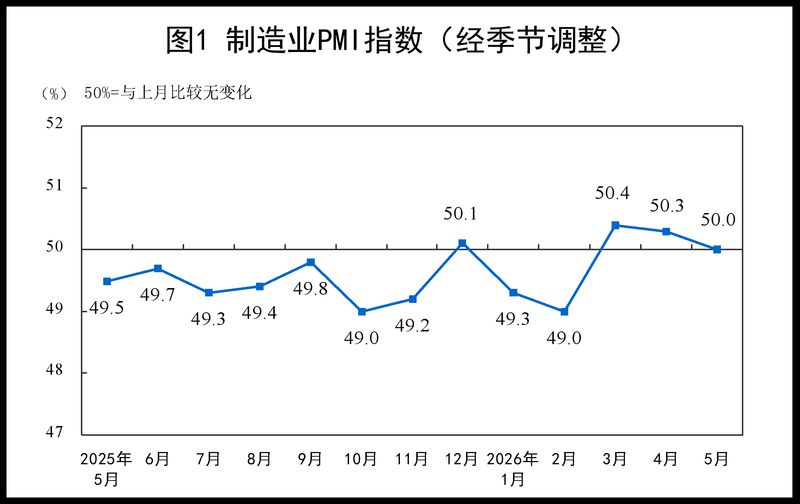
In may, the manufacturing procurement manager index (pmi) stood at 50. 0 per cent, a decrease of 0. 3 percentage points from the previous month, at a critical point。
In terms of the size of the enterprise, the large enterprises pmi was 51. 1 per cent, an increase of 0. 9 percentage points over the previous month and above the threshold; the small and medium-sized enterprises pmis were 48. 6 per cent and 48. 5 per cent, respectively, down 1. 9 percentage points from the previous month and 1. 6 percentage points below the threshold。
According to the classification index, of the five classification indices that make up the pmi in manufacturing, the production index is above the threshold and the new orders index, the raw materials inventory index, the practitioner index and the supplier distribution time index are below the threshold。
The production index was 51. 2 per cent, a decrease of 0. 3 percentage points from the previous month and still above the threshold, indicating continued expansion of manufacturing production。
The new order index was 49. 9 per cent, a decrease of 0. 7 percentage points from last month, indicating a fall in demand levels in manufacturing markets。
The raw materials inventory index was 48. 6 per cent, a decrease of 0. 7 percentage points from the previous month, indicating a decrease in the stock of primary raw materials in manufacturing。
The employment index was 48. 6 per cent, a decrease of 0. 2 percentage points from the previous month, indicating a decline in the level of employment in manufacturing enterprises。
The supplier distribution time index was 49. 2 per cent, a decrease of 0. 3 percentage points from the previous month, indicating that delivery times by suppliers of raw materials for manufacturing continued to increase over the previous month。
Table 1
Click to download: relevant data sheets
Table 2 status of other relevant indicators for chinese manufacturing, pmi (seasonally adjusted)
Ii. Performance index of non-manufacturing procurement managers in china
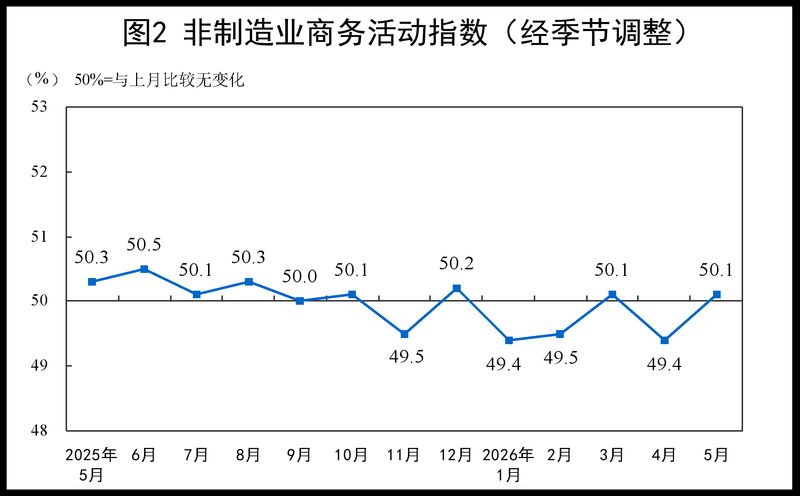
In may, the non-manufacturing business activity index stood at 50. 1 per cent, an increase of 0. 7 percentage points over the previous month, and the level of non-manufacturing activity recovered。
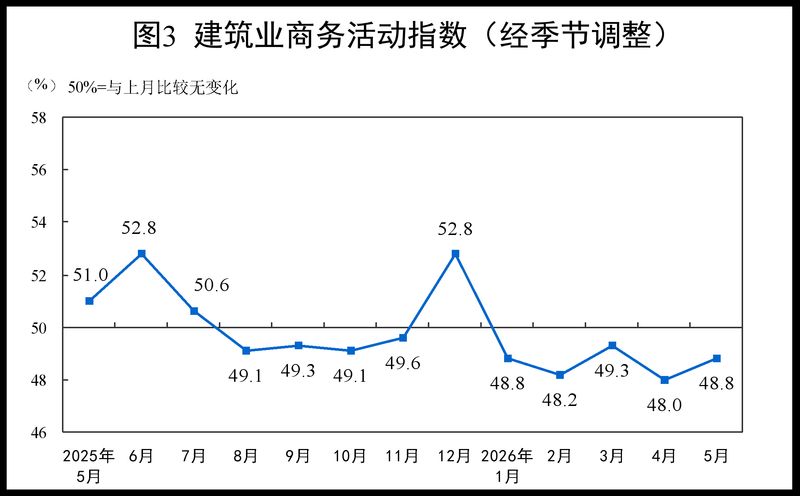
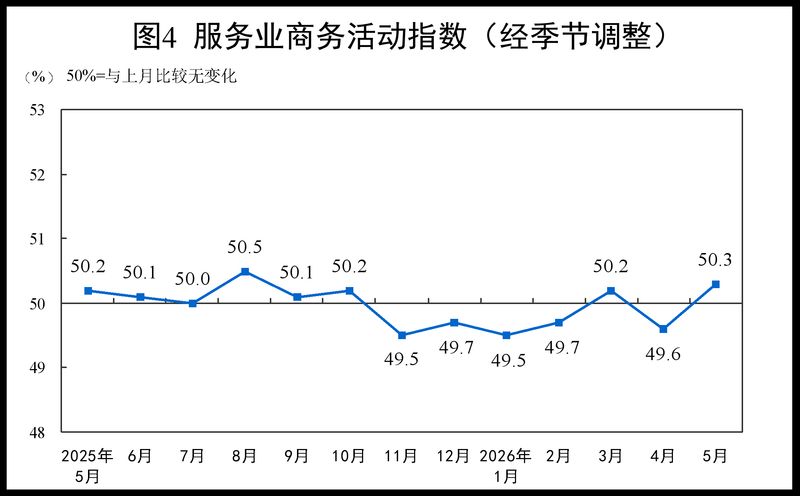
By industry, the construction industry business activity index was 48. 8 per cent, an increase of 0. 8 percentage points over the previous month; and the services business activity index was 50. 3 per cent, an increase of 0. 7 percentage points over the previous month. In the services sector, the index of business activity in rail transport, telecommunications radio and television and satellite transmission services, insurance, etc., is above 55. 0 per cent in the higher range; the index of business activity in the air transport and real estate sectors is below the threshold。
The new order index was 45. 0 per cent, an increase of 0. 7 percentage points over the previous month, indicating a recovery in demand levels in non-manufacturing markets. By industry, the construction sector has a new order index of 43. 5 per cent, an increase of 1. 9 percentage points over the previous month, and services 45. 3 per cent, an increase of 0. 5 percentage points over the previous month。
The input price index stood at 52. 2 per cent, an increase of 0. 5 percentage points over the previous month, indicating that the overall price of inputs used by non-manufacturing enterprises for operating activities continued to rise. By industry, the price index for construction inputs was 53. 7 per cent, a 1. 2 percentage point decrease from the previous month; and the price index for services inputs was 52. 0 per cent, an increase of 0. 8 percentage points from the previous month。
The sales price index was 48. 8 per cent, an increase of 0. 7 percentage points over the previous month, indicating a narrowing of the overall level of sales prices for non-manufacturing enterprises. By industry, the price index for construction sales was 48. 6 per cent, a decrease of 0. 4 percentage points compared to the previous month, and the price index for services sales was 48. 9 per cent, an increase of 1. 0 percentage points compared with the previous month。
The employment index stood at 45. 6 per cent, an increase of 0. 1 percentage points over the previous month, indicating a slight improvement in the performance of non-manufacturing enterprises. By industry, the construction industry employment index was 41. 4 per cent, an increase of 1. 8 percentage points over the previous month; and the service sector employment index was 46. 4 per cent, a decrease of 0. 1 percentage points from the previous month。
The expected operational activity index is 54. 8 per cent, an increase of 0. 1 percentage points over the previous month, indicating increased confidence in market development among non-manufacturing enterprises. By industry, the expected index for construction operations is 51. 5 per cent, an increase of 1. 0 percentage points from the previous month; and 55. 4 per cent for services, which is the same as last month。
Table 3 china's main non-manufacturing classification index (seasonally adjusted)
Table 4 china's non-manufacturing other classification index (seasonally adjusted)
Iii. Performance of the china integrated pmi output index
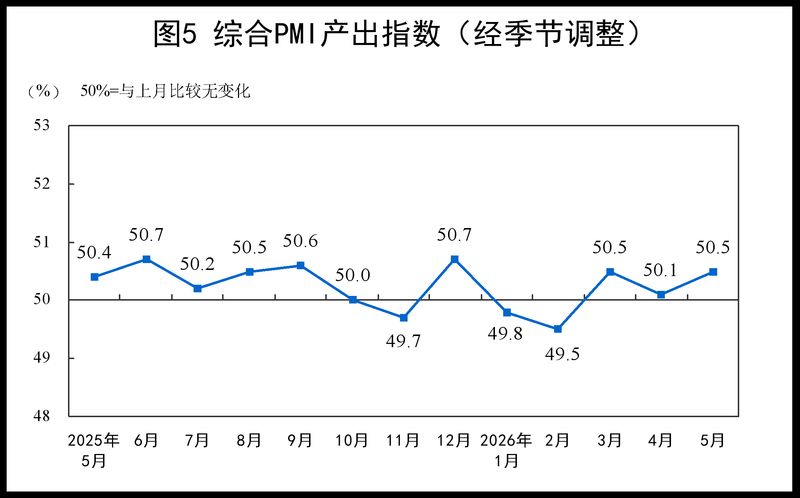
In may, the composite pmi output index stood at 50. 5 per cent, an increase of 0. 4 percentage points over the previous month, indicating the overall expansion of the country's productive activities。
Notes
1. Explanation of key indicators
The procurement managers index (pmi), an index developed through the statistical compilation and compilation of the monthly survey results of an enterprise's procurement managers, covers all aspects of enterprise procurement, production and circulation, including manufacturing and non-manufacturing areas, and is one of the internationally common proximate indicators for monitoring macroeconomic trends, with strong forecasting and early warning. The composite pmi output index is the composite index of the pmi indicator system reflecting changes in industry-wide (manufacturing and non-manufacturing) output during the period. When pmi is above 50 per cent, it reflects an overall expansion of the economy over the previous month; less than 50 per cent reflects an overall contraction of the economy over the previous month。
Scope of the investigation
31 major industry groups, 3200 sample surveys related to manufacturing in the national economic industry classification (gb/t 4754-2017); 43 large industry groups, 4,300 sample surveys in non-manufacturing industries。
Methodology of the investigation
Pps (probability production) for procurement manager surveyNal to size) sampling method, which is based on a broad category of manufacturing or non-manufacturing industry, where the volume of the sample is distributed according to its value added as a proportion of the total manufacturing or non-manufacturing value added, and within which the sample is extracted using a probability proportional to the income of the enterprise's main business。
The survey is carried out by specific organizations of the national statistical office's immediate survey team, using the national networking networking networking networking system to conduct monthly questionnaires for enterprise procurement managers。
Method of calculation
(1) method of calculation of the classification index. The system of indicators for surveying manufacturing procurement managers includes 13 disaggregated indicators, such as production, new orders, new export orders, on-the-job orders, inventory of finished products, volume of purchases, imports, prices of main raw materials purchased, factory prices, inventory of raw materials, practitioners, distribution times for suppliers, and expected production operations. The non-manufacturing procurement manager survey indicator system includes 10 disaggregated indicators for business activities, new orders, new export orders, hand-held orders, inventory, input prices, sales prices, practitioners, supplier distribution times, business expectations, etc. The classification index is calculated using the diffusion index, i. E., the percentage of the number of enterprises responding to the questionnaire plus half of the percentage of the answers remaining unchanged. Since there is no synthetic index for non-manufacturing, business activity indicators are commonly used internationally to reflect overall changes in non-manufacturing economic development。
(2) method of calculating the pmi index for manufacturing. Manufacturing pmi is weighted by five diffusion indices (segment indices). The five classification indices and their weights are based on the degree of their impact on the economy. These include: a new order index of 30 per cent weight; a production index of 25 per cent weight; a practitioner index of 20 per cent weight; a supplier distribution time index of 15 per cent weight; and a raw materials inventory index of 10 per cent weight. Of these, the supplier distribution time index is a negative index, which is applied in reverse at the time of the synthetic manufacturing pmi index。
(3) methodology for calculating the composite pmi output index. The composite pmi output index is weighted by the manufacturing production index and the non-manufacturing business activity index, with weights as a share of manufacturing and non-manufacturing GDP, respectively。
5. Seasonal adjustments
The procurement manager survey is a monthly survey, influenced by seasonal factors and with high data volatility. All the indicators published are seasonally adjusted。