Treatment and analysis of crane wheel-cutting tracks
Summary of on-orbit cranes: 32/5t., 22 m across, work level a6, workshop orbital length 264 m*2; orbital type p43。
This is a total of three cranes。
One on the west is work level a6, 20/5t; and on the east, work level a5, 32/5t。
The station is used in the middle, mainly for steel rolls, which is said to be the most frequent and loaded crane used by your company, in addition to the fact that the crane is operated mainly in the north, with long-term deviations from the medium and relatively long operating distance (more than 100 metres is common) and greater problems with the track tracks (the main problem is that it is not consistent with the standard, that it is overlined and that it is vulnerable to disfigurement due to the inappropriate processing of convulsions), with the exception of problems related to changes in the fineness of the assembly of the wheel because of the partial deformation of the end beam as a result of frequent collisions, which have resulted in frequent replacements in recent years by large wheels due to excessive wear and wear of the chewing track。
The gravity of the seven-day lifetime of the wheel at the height of the gnawing can be seen。
In march 2015, on the basis of a contract with your company, our company provided four wheels (in two cases, the owner and the passive wheel) to be assembled by your company using other spare parts to be assembled and hanged onto the bridge. After processing the main problems in the main tracks, our company adjusted the accuracy of the installation of the wheels, which, after completion on 16 march, were accepted by both parties and were free from abnormal noise and gnawing and concluded that the trip was normal。
It is worth mentioning that several serious problems were identified that could not be addressed during the wheeling and positioning process。
The first issue is that the right-side (south-south) active wheel group should move 12 mm to the outer side of the margin, and that only 7 mm was moved after a combination of considerations, due to concerns that excessive deviation from the centre of the beam caused the transformation of the beam and affected the accuracy of the gear axis, resulting in an error of 5 mm in the position of the wheel (standard <2) and an increase of 5 mm in the relative difference between the active and passive sides。
Another problem is that the end-side of the wheel was significantly outpaced; the national standard provides <0. 18 mm, measured at 2. 6 mm, and exceeded the standard by a factor of 13. 4. Because there were no excess wheels at the time and there were no excess wheels, it was only possible to continue the construction work. These two problems posed considerable difficulties in measuring the accuracy of the geometric accuracy of the horizontal and vertical tilts of the wheel group, which basically ensured the performance of the large vehicle operating agency following special technical measures。
It will be operational until the end of june 2015。
Note 1: our company provided written explanations for the problems of the wheeling group in its report on trans-orbiting and crane adjustments to the smoky-thai-tai-tai-tun。
The crane began to experience severe trajectories at the end of june 2015, with a few days ( said to be around 7 days) when the outer edge of the active beam on the north side of the wheel and the outer edge of the passive wheel, respectively, were worn down by 50 per cent and had been severely deformed and reached the end-of-life limit of the wheel。
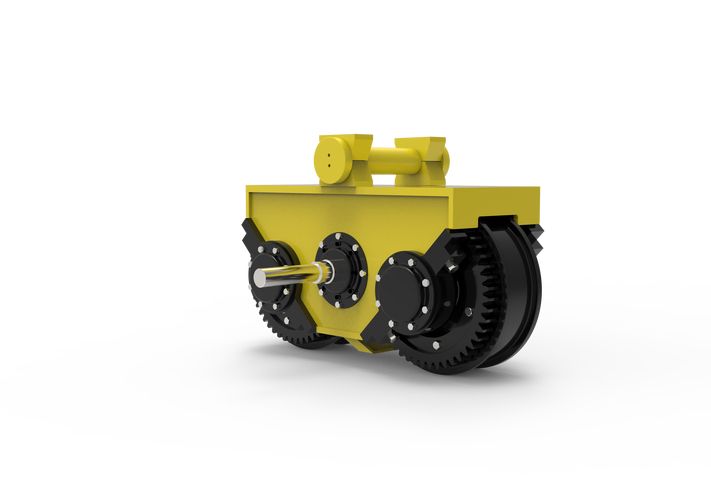
My company was informed by telephone on 9 july after several unsuccessful adjustments by your maintenance staff。
On 13-14 july (two), 23 july (two), 15-19 august (two), 5-6 september (two), and four back-to-back work days (for which your company has contributed)
Increased investment in human and material resources to address this issue。
During this period, the wheels were replaced, excluding a number of factors, such as the failure of an end-end electrical, speed-reducing or brake damage. Repeated adjustments to the wheels failed to achieve the intended purpose — the crane was never functioning properly, and the main problem was the lack of synchronization between the two sides of the cranes, which caused gnawing orbits and produced severe, high-frequency and low-frequency noises at any time。
My company analyses this as follows:
1. Deposition of the northern side led to the destruction of the accuracy of the installation of the gear axis and, when the accuracy of the installation differs significantly from that of the southern end of the axis, to the failure to synchronize and thus to cause the chewing track。
From the wear and tear of the wheel — the outer edge of the active beam in the north and the internal edge of the passive wheel — this may be the main factor in the severe gnawing of the wheel at the end of june。
Note: the end of the wheel group is a 2. 6 mm jump, which is the main factor in deformation。
2. Change in the diameter of the wheel is a normal phenomenon as a result of the friction of wheels and orbits, but is a serious defect that can cause gnawing and noise when the degree of wear and tear causes a discrepancy in diameter that cannot be measured accurately。
The analysis estimates that the crane currently suffers from this deficiency - the difference in diameter between two left beams near the end of life of the wheel is quite serious and the current adjustments to the accuracy of the wheel have a significant impact。
3. Parts of the wheels, such as axle bearings, bearings, etc., have been in use for more than 10 years, and the wear and tear of the gears of the axes, brakes, etc., are more severe, a factor that may be the main cause of the acousticity of the operation。
4. High orbital markers, orbital straightness, which were one of the factors that gave rise to the wheel-feeding orbits, were observed to cause a marked level of bending (unsatisfactory line level) due to the inappropriate tailoring of the orbit, although they were processed in march。
Note: the gap calculation for the sutures in the orbit is more complex, except for the g514 atlas, for which no better solutions are known and where our company has no mature experience。
The adjustment of our company to this crane wheel has been made in strict compliance with the indicators and test methods set out in the crane quality assurance manual for the installation of quality control points for the operation of cranes (see annex 2 for further details). The individual indicators are more stringent than national standards, but, subject to field conditions, individual indicators are less capable of measuring and control such as large wheel support points, which have a greater impact on the performance of the operation, and the reason why wear and tear on both sides of the passive wheel at the right end of the crane has been largely invisible since june。
6. The buffers on the four corners of the crane are often collided with the adjacent crane, with visible signs of impact, deformation, repair and reinforcement; the driver's room itself has been distorted, completely tilted and deformed by a more severe impact at the end of the room; and the base of the two end beams on the bridge is also severely deformed by the long-term pressure of the jack, all of which have somewhat affected the accuracy of the operating agency。
In july and march, during the positioning of the wheel, it was discovered that there was an error in the range of the crane bridge and the side of the wheel, which was less active than approximately 18 mm on the side of the wheel, which was also a serious flaw in the crane。
Limited by other factors
This deficiency was not thoroughly addressed。
Note: the bridge is the sum of the parts of the steel structure, such as the main beam, the end beam, the walker, and the small vehicle tracks。
8. For the reasons mentioned above, the difference between the wheel of the right beam of the crane remains unsatisfactory at 5 mm
On the other hand, the incompetence of this indicator has always influenced accurate measurements of the wheel's horizontal slopes - - wheel-level slash is the most important indicator for wheeling adjustments, which are required by the national standard test protocol to be measured using longitude and inner diameter percentages, with a precision of 0. 02 mm, and can only be measured in the field with the highest precision using tractors and junctions
0. 05; lower or very lower accuracy when the wheel is above standard, which is also the difficulty of operating the crane
One of the main factors that has been serious in controlling and eating the orbits。
9 . Two bends at the right end of the beam active wheel have an approximately 4. 5 mm homogeneity
This error is likely to result in an increase in the number of wheel-adjusted gaskets, the generation of welding indentations and the gradual distortion of the operating process; attention is paid to the control of later re-wheeling, i. E., the elimination of errors when wheeling is replaced in order to avoid an increase in the number of wheel-adjusted gaskets。
Note: during the 15-19 august adjustment period, it was found that the number of adjustment pads was as high as seven。
The installation of the crane operator is the most important and difficult to control at all stages of the crane quality assurance system and in the various processes, so it is particularly difficult to establish a quality control point in the manufacturing process, and to fully meet the requirements of the quality control point at the site operating at high altitude。
In the light of the above, it is almost impossible to deal with all the problems on the ground at high altitude, and it is too costly or ineffective to continue with the tests or waste the resources. The feasible technical measure is to lift the crane to the ground to remove all parts of the operating body (wheel, electric, speed-reducing), to overhaul the bridge and then to replace all the wheels and to re-install the operating body。
Questions listed above may be identified correctly, and questions may be explored if there is no objection that can be taken into account in the maintenance and renovation process。
This report
Qingzhou triple heavy machinery ltd
6 september 2015
Annex 1. Report on the adjustment of finer and cranes across orbit by tantai tung sea plate limited
Annex 2. Quality control points for crane operator installation
Other issues to be considered:
1. Treatment of orbital stretches。
2. Orbital straightness measurements and adjustments。
3. Repair of structures installed in the driver's room or not。
4. Speed-reducing machines, electric generators, brakes and all associated substrates and adjustment pads are removed and repaired; the cut marks are removed, the floors and mats are reconstructed for assembly and installation。