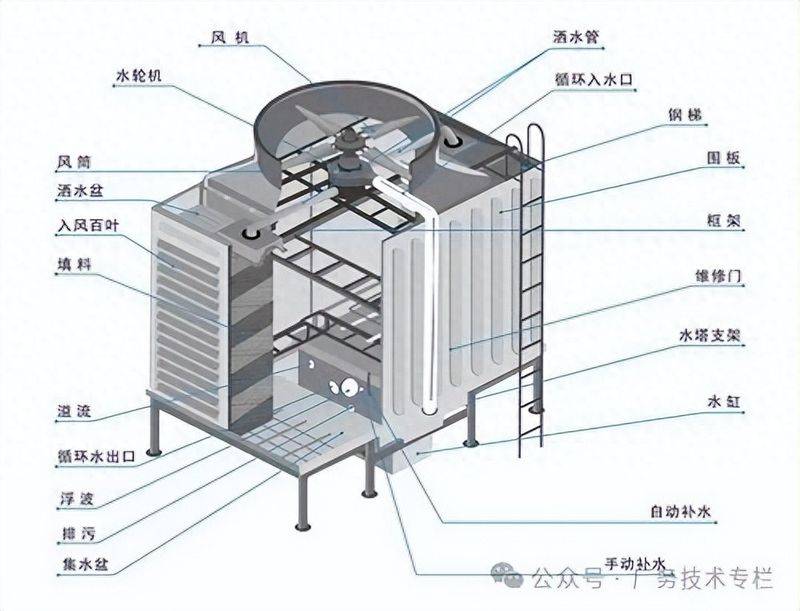
Reason analysis: low water level in cooling towers; poor heat spread in cooling towers
Solutions: low water level of cooling towers (checking for normality of automatic recharge floats and normal adjustment of float heights; check for leaks due to the loss of pipes from spills; check for normality of sewage valves); cooling towers dissipation (checking for normal operation of cooling tower wind units; check for alien congestion in vents, such as dust-proof nets installed in response to the willows season; check for normality of dispersed water, for a relatively small dispersion of water, for dispersion or replacement, as appropriate)
Reason analysis: fracking of cooling towers; excessive liquid levels of cooling towers
Solutions: fragmentation of cooling towers (checking cooling tower leaks, typically at the bottom of the tower or at the french interface where the tower is connected to the pipe, needing to repair the leaks caused by the breakout and, as appropriate, to analyse the stress of the leaks, and to support them by strengthening them as appropriate; water spills caused by leaks outside the breakout also need to be repaired to control the fluid height of the slides, depending on the circumstances; cold tower fluids are too high (checking whether the flounder valves have failed automatic recharge functions due to the drop of the ball and the automatic recharge has been filling water; checking whether there is a single spill of the missing position due to the absence of the cold tower shield; checking whether the fillings are missing or damaged, resulting in a single-position spilling water; and, in the case of multiple towers, whether there is a balance between the towers caused by adjustments to the opening of the water valves)
Reason analysis: battery congestion; filling congestion
Solutions: dispersing pipes and filling congestion can lead to uneven water spills and need to be analysed on a case-by-case basis. Drain congestion (by climbing to the top of the tower to check the spilling of the sprinklers with safety ensured by closing the fans, normally with water flowing evenly from the spill points of the sprinklers, generally excluding the spilling pipes, and then inspecting the fillings, whether to continue after cleaning or to replace them directly depending on the circumstances); and filling congestion (e. G., steps to check the spilling pipes)
Reason analysis: cooling tower wind failure; cooling tower brake failure; cooling tower fan failure; cooling tower body shock failure
Solutions: check the operation of wind machines in power outages and determine the noise and sources of vibration. Faults of the chilling towers (checking for damage to the bearings, lack of oil, bedding of the bearings or replacement of the bearings); malfunctions of the chilling towers (checking for damage to, lack of oil in the bearings of the brakes, butter injection of the bearings or replacement of the bearings of the generator); malfunctions of the chilling towers (checking for damage to the blades and replacement of damaged leaves); failure of the cooling tower towers (checking for laxation of the fittings of the towers, checking for movement of the towers, strengthening of the defrosts that have occurred, re-positioning and installation of limit devices)
Faults and inspections of cooling towers need to be analysed on a case-by-case basis. The frequency of cooling tower failure can only be effectively reduced if routine maintenance of the cooling tower is performed and routine inspections are increased. To ensure the safe and stable operation of the equipment, and to do its utmost to serve its production and manufacture。