In everyday life, as light spreads along straight lines, we cannot observe scenes outside sight (non-visual domain), such as objects hidden behind the corner, barriers, etc。
In recent years, the emerging technology of non-visual domain imaging (nominal interpretation) has broken this restriction, allowing the non-visual domain to “show into the curtains”, and our vision has expanded to an unprecedented extent。
The technique “turns” the light by firing lasers at the middle surface of the field of view (as in the wall in figure 1), photons in the middle surface (the first time), the non-visible target surface (as in the rabbit in figure 1), the middle surface (the second time), in turn, with a perforation signal collected by the detector, and the reconstruction of the non-visual scene through advanced algorithms。
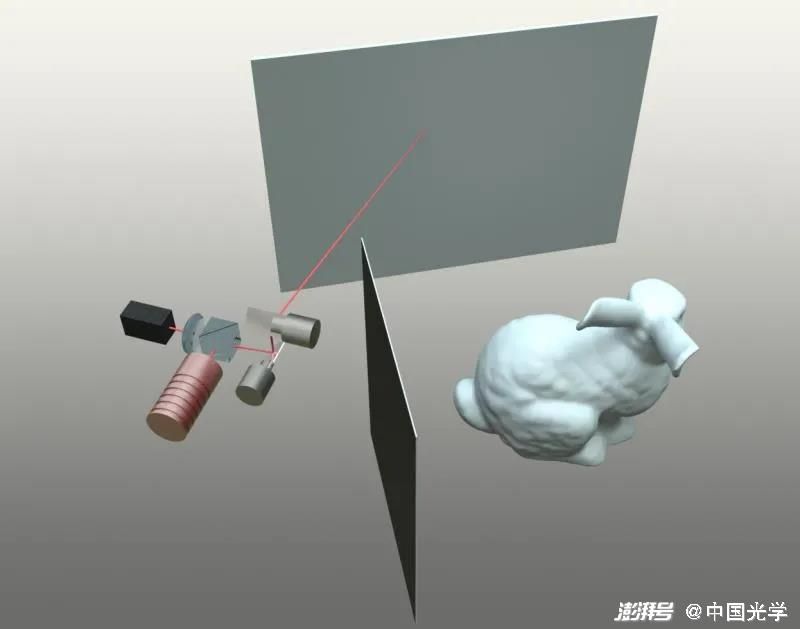
Figure 1
The revolutionary technology of invisibility has important applications in areas such as automatic driving, disaster relief, counter-terrorism and remote sensing. However, in the process of invisibility, the backwaves of the lasers after multiple long reflections are extremely weak (only for photons) and the cell noise ratio is extremely low, while the problem of invisibility is multidimensional and seriously affects the image quality. In particular, for fast-detection scenarios, existing algorithms often rebuild objects with very vague boundaries, accompanied by strong noise, and pose significant challenges to the development and future application of invisibility detection techniques。
In view of this, a research team from the qinghua university's mathematics centre, the qinghua university, has proposed a method of non-visual reconstruction based on signal-object unionization (socr)。
Outcome by “non-line-of-sight reco“light: science & applications”。
The methodology is based on the following assumptions:
(1) reconstructing the curve is thin within the resolution area。
(2) the local structure of the object to be measured is repeated repeatedly throughout the target。
(3) the ideal echo signal is smooth。
By solving the problem of optimization, the new algorithm is able to obtain two-dimensional information on the objective of the non-visual domain at the same time: reflectivity, surface direction。
Using two dictionaries based on goal self-adaptation learning (nounary >>>), authors paint the local structure of objects separately for non-local relevance, and the object characteristics extracted can be used for further intelligent identification and classification. Figure 2 shows the results of the reconstruction of the algorithm framework and the reflection rate of the pyramid。
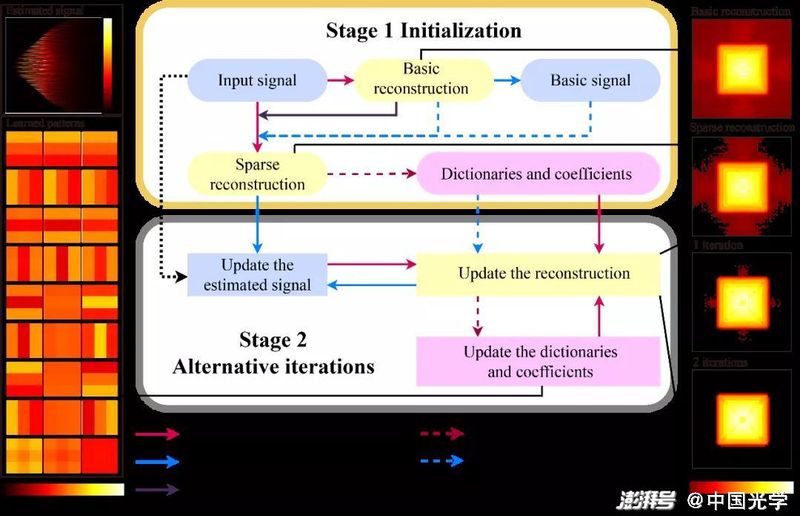
Figure 2 algorithmic flow diagram the left side shows the local structure of the object estimated in the pyramid example for signal and dictionary learning, the right side shows the initial decomposition of the reflection rate, thin dissipation and final reconstruction results。
In photographs “taken” by the new methodology, non-visual objects have clear local details and boundary profiles and have little background noise in the imaging area. In indoor/outdoor co-focal/non-coording, long/short time and multi-scale reconstruction experiments with multiple/minor measurement points, high precision and high resolution results were obtained (see figure 3). In addition, the framework is compatible and can be combined with other non-visual field detection physics models to meet the needs of different imaging missions。
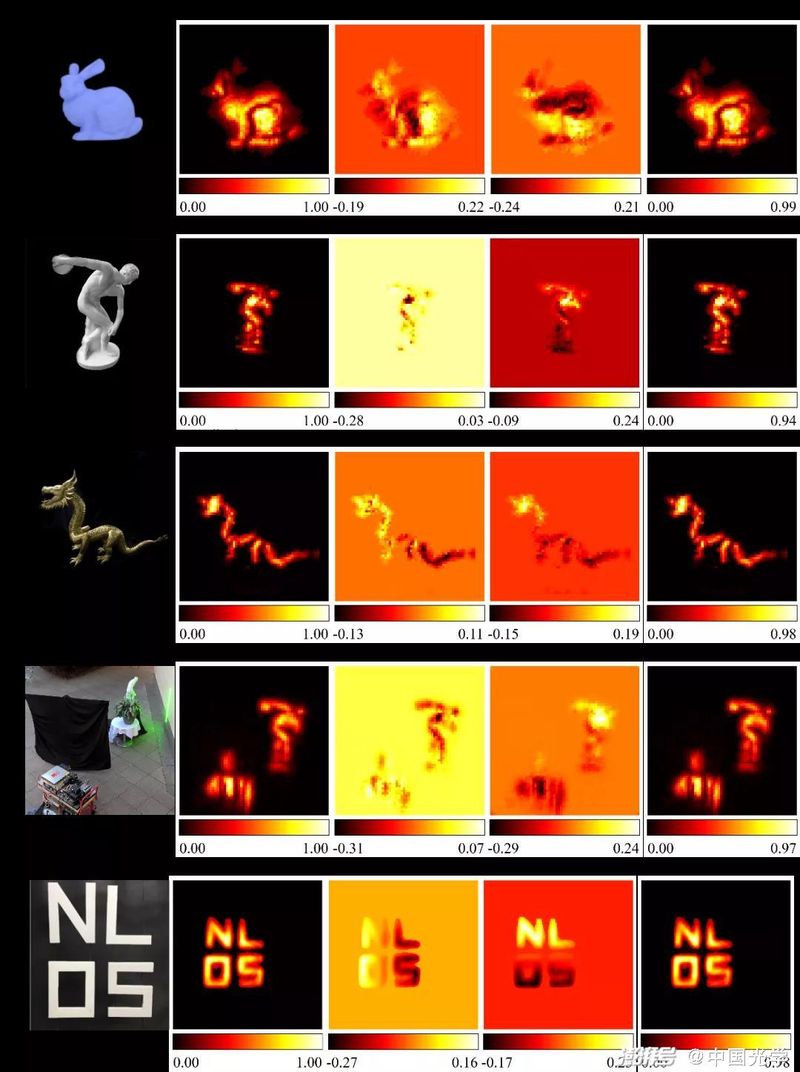
Figure 3. Figure 3。
This method not only allows for “high-resolution” photographs, but also has a clear advantage over existing methods in terms of error control. Figure 4 compares the sucr approach presented in this paper with the reconstruction error of the previous mainstream approach (d-lct), in which the white areas are producing deformed pixels. As a result, the number of false pixels in the new methodology has been significantly reduced by 85 per cent, the average error in the direction of depth by 41 per cent, the maximum error in the angle by 56 per cent and the average error in the angle by 44 per cent。
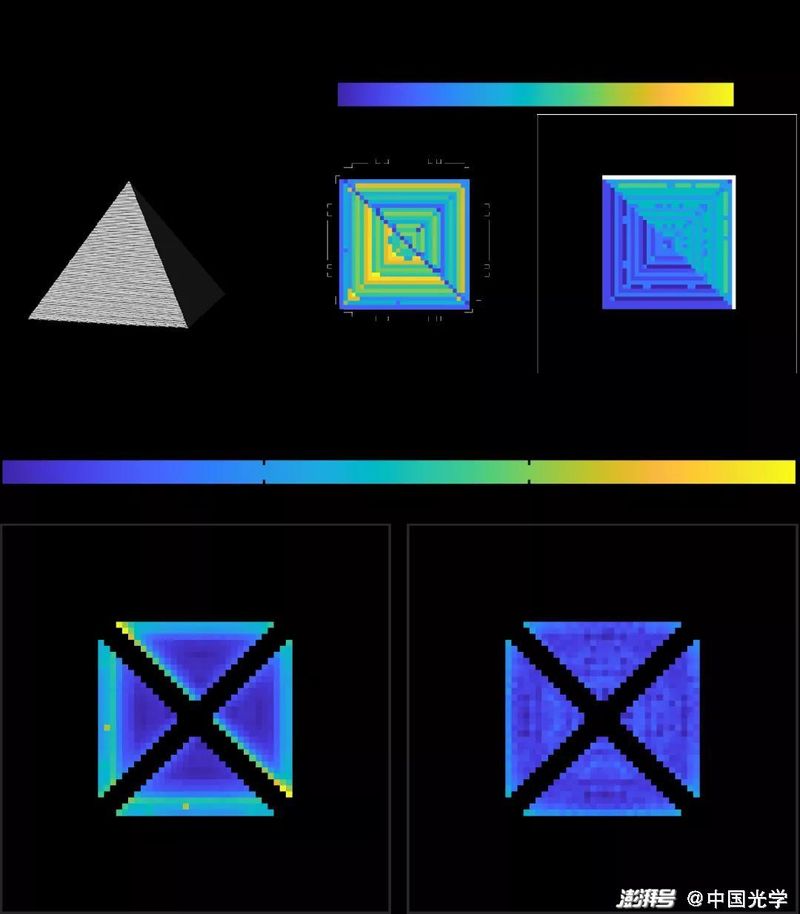
Figure 4
In response to the current problem of the high impact of observational signal noise on the quality of reconstruction, which is prevalent in non-visible domain imaging, this paper proposes an innovative approach to reconstruction based on a combination of signal and detection targets, with significant breakthroughs in the reflection rate of non-visible targets, surface law-to-information reconstruction quality through a combination of dilution, non-local similarities and signal slurability, which significantly enhances the profile of non-visible targets, reconstruction depths, and legal angle accuracy, especially for detection scenarios with strong background light interference。
The utility and compatibility of the “high-resolution” approach to reconstruction of the non-visual domain as proposed in this paper is expected to accelerate the practical application and diffusion of non-visual imaging technologies in areas such as automatic driving, disaster rescue, counter-terrorism and remote sensing surveillance
Thesis information:
Liu, x., wang, j., li, z. Et alLight sci appl 10, 198 (2021).
The author of this newsletter is associate professor of stars and assistant professor qiu ling yun, university of tsinghua mathematics science center, department of fine arts, department of photon surveying and control, department of education. The first authors of this paper are dr. Liu xinjiang and wang ken yu, students of qinghua university. The project is supported by the national natural science foundation。