On the afternoon of 15 november, local time, the super-calculable application of the international gordon bell award nomination was “2. 5 million-atom ab initio electronic-structitude of complex mEtallic heterostroctures with dgdft, participated in the online defence of the global supercalculations congress (sc22) held in dallas, texas, united states, and reported that the first megamaterial simulation of 2. 5 million atomicly complex metallic isomers (sithium sodium metal alloy) was achieved by the dgdft of china, using low-scale, high-precision first-performance computational software on a new-generation supercomputer, and that this was the second nomination by the china congress as the first complete unit to enter the gord bell prize。
The gordon bell prize, the highest international academic award in the field of high-performance computing applications, is hailed as the “nobel award for supercalculations”, which is annually selected and awarded by the acm (american computer institute) for work with outstanding achievements in the field of high-performance computing applications and has great international impact. This was done by the team hu wei, a team of students of the yang jinlong national research centre for fertilizing micro-specific materials, in close collaboration with professor anhon, faculty of computer sciences and technology, and in close collaboration with the relevant researchers of the xianshan laboratory (formerly the pilot national laboratory for marine science and technology in qingdao), the chinese academy of sciences institute of computing technology, the university of beijing, the chinese academy of sciences institute of software, the zilu university of industry, and the national parallel centre for technical research in computer engineering。
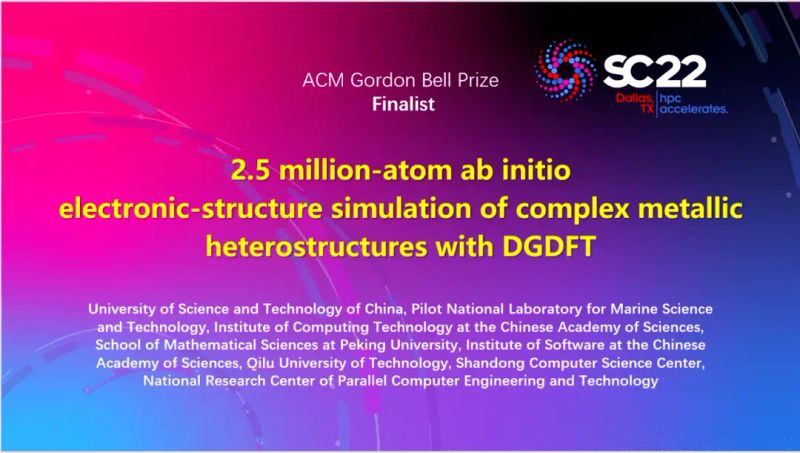
Figure 1 acmgordonbell nominations
Advanced materials are the cornerstone of the national economy and an important basis for the transformation of manufacturing. Owing to the difficulty of developing new materials, physical experiments designed to validate their nature are complex and costly. The emergence of quantum mechanics and high-performance computing techniques has fundamentally changed this situation. By entering structural information on the material, calculations using the first principle of quantum mechanics allow for more accurate predictions of the base-state structure and underlying physico-chemical properties of the known material and for precision control at the atomic level. This is the most competitive and technical way to solve theoretical problems of experimentation and predict the structural performance of new materials in the twenty-first century. Such an approach, which does not require real experiments, would not only significantly reduce the cost of experiments, shorten the development cycle of new materials, but also provide effective theoretical guidance on the preparation and modification of materials, the development of new materials and research into the nature of materials in extreme environments。
In 1933, shertingham and dillach received the nobel prize in physics for developing the shertingz-dilach equation of quantum mechanics. Although delaco predicted that the search for basic laws of physics and chemistry had largely been accomplished at the time of quantum mechanics. However, since the equation that describes these basic patterns is too complex to solve, it remains very difficult to use the rationale to solve practical problems. Until the 1960s, when high-performance calculations (hpcs) emerged, we had to decipher the equation of xeroxing, with dozens of atoms, which was far from a truly complex system。
In 1998, kohn and sham developed the density panoramic theory (dft) based on the kohn-sham equation, which reduced the 3n-width function to a three-dimensional particle density problem, thereby reducing the computational complexity of the first-calculation electron structure simulation to o (n^3), and received the nobel prize for chemistry. In 2013, three chemists, martin karplus, michael levitt and ariel warshel received the nobel prize for chemistry for developing multiscale modelling methods for complex systems on modern supercomputers. The kohn-sham equation introduced quantum mechanics for the first time into a truly complex system containing thousands of atoms. However, as the computational complexity of the simulation of the first principle material increases dramatically with the scale of the simulation material, the demand for software performance and computing resources among researchers is increasing。
The rapid development of supercomputers and high-performance computing technologies provides an opportunity for the development of first-performance calculations to play an increasingly important role in the research fields of condensation physics, chemistry, materials and biology. In the post-moor era, the first-ever simulation of electronic structures became the only way to understand modern information technology. Full quantum mechanics simulations are essential for the design of the next generation field effect transistors below 10 nm, but require the scale of simulations to reach at least hundreds of thousands of atoms. For nearly three decades, modern high-performance computing techniques have moved from first-guess modelling to the real physical world. This capacity is important in most scientific and engineering fields, such as energy, materials, biomedical, catalytic response and powerful physics。
So, in today's state-of-the-art supercomputers, how much scale can we simulate with the kohn-sham equation? There are three main methods of calculation to achieve large-scale run-down electronic structure simulations: linear scale algorithms, artificial intelligence algorithms and generic cube scale algorithms. Research using all three algorithms has been nominated for the gordon bell prize or the gordon bell prize. The simulation of molecules, semiconductors and insulations by linear scale algorithms and artificial intelligence algorithms is overly dependent on approximation principles and therefore cannot be applied to complex metal systems. In contrast, the current state-of-the-art dft-fe software, using a common cube scale algorithm, can only simulate 11k atoms of solid material by 2019, much smaller than linear scale and artificial intelligence algorithms。
The use of the base group discrete kohn-sham equation is the basis for the calculation of the electronic structure of the principle of primaryity. The simulation of materials based on the first principle of the traditional flat-base group has a third-tier computational complexity and is difficult to apply to complex large systems through large-scale parallel acceleration. Linear scale algorithms based on local atomic orbital base groups allow large-scale simulations, but are often insufficiently precise and difficult to apply to metal systems, and face the difficulty of achieving high parallel calculations in non-ruled thin matrices. A completely new self-adaptive local base group (adaptivelocalbasis, alb), which is strictly cut and traverse in real space, combines the respective advantages of a plane wave (positive completeness) and a numerical atomic orbit (locality), with high accuracy comparable to a plane wave and the ability to use linear scale algorithms suitable for large scale calculations. Moreover, the hamilton matrix, constructed from the alb base group, has a fixed three-blank block-like thinness and is suitable for achieving high parallelity。
In cooperation with the central school of accounting and the central college of sciences, china has developed the first principle computational software, dgdft (disco), based on the alb base group and the intersectional gaclin limited-utility methodologyIt's not your faultNalthery), combined with multi-stage, parallel optimization design and the state-of-the-art rare matrix solver pexsi low-scale diagonal algorithms, a series of key technological innovations in numerical algorithms, thin matrix parallels and data communication, using the dgdft software, which was designed autonomously on a new generation of supercomputers, for the first time achieved a high-precision first-performance electronic structure simulation of 2. 5 million atoms for a complex metal system, reaching the media scale (>100nm) and could be used to design a new generation of electronic transistors based on two-dimensional materials。
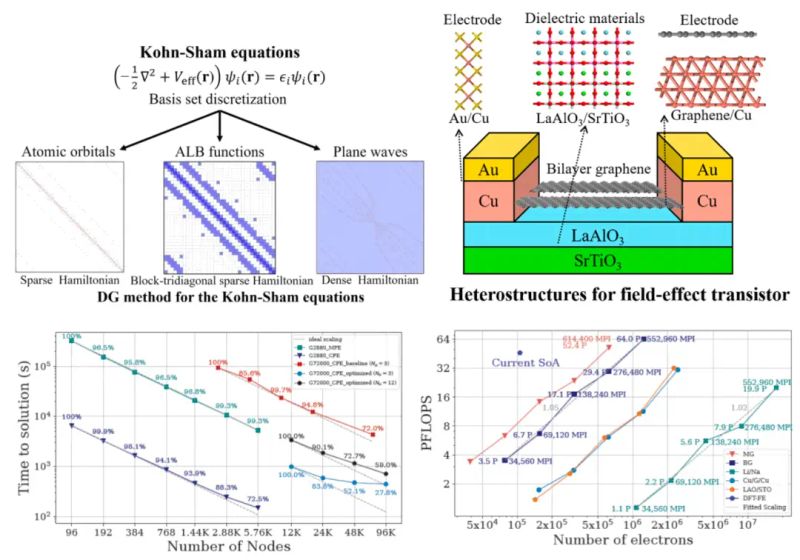
Figure 2 base group discrete kohn-sham equations, field effect tube heterogeneity, solver time and performance
The advanced nature of the dgdft software is reflected in: (1) the low-scale, high-precision and high-parallel scalability advantages of the dgdft software compared to the international first-class calculation software, overcoming the difficulties of conventional dft methods in applying to complex metal systems, poor parallel extension of thin arrays, etc., which have been plaguing material modelling and high performance computing. (2) despite the extensive application of the intermittent gacling method to the solution of differential equations, only the dgdft software currently uses this method to solve the kohn-sham equation. (3) through the separated matrix of the alb base group, which has a fixed format of trigonometry, the relevant research is still very advanced and there is no international software for the same first principle. (4) the low-scale pexsi algorithm is suitable for metal systems and has a 1. 5-time computational complexity for a quasi-two-dimensional system. The pexsi algorithm, after team optimization, achieves a peak of 64 pflops and 5 per cent in a new generation of supercalculations, well above the current record of the first hpcg thin matrix performance tests (16 pflops, 2. 9 pflops and 5. 9 pflops, corresponding to 3. 6, 1. 5 and 0. 5 per cent peaks)。
Thanks to these innovations, the scale of dgdft simulations is 175 times higher than the current state-of-the-art high-scale dft-fe software (using 23 k gpus to simulate 11k atoms), the scale of simulations of atoms is far higher than that of the same software (for example, the most popular vasp can only simulate 1k atoms), and 2. 5 million metal systems can be simulated with the assurance of chemical precision; at the same time, dgdft has a very fast rate of calculation, 2054 times faster than dft-fe. Compared to the electronic structural properties of the two-dimensional metallic graphite system of approximately 10,000 carbon atoms (science bulletin, 2021, vol. 66, issue 2) that the project team published in 2021, the simulation scale on the new generation of wonders is 250 times higher than the previous simulation。
In the future, as supercomputer algorithms reach level 10e, the high scalability of the dgdft software can further upgrade the system of simulations by extending first-performance material simulations further to macro scales (>1000nm), thus enabling simulations of real materials and devices, paving the way for industrial applications of first-performance material simulations of integrated software and hardware。
Prof. Anjoon, associate researcher of jia wei løl, and prof. Yang jinlong were co-authors of the newsletter; the co-authors were hu wei researchers, dr. Guo zhou qiang and kang qing chong chong, and the associate researchers of qin xin ming. The research was co-financed by the national fund for natural sciences, the national priority research and development programme, the research fund for the “standing engineering” programme of the chinese university of science and technology and the strategic priority research programme of the chinese academy of science and technology. At the same time, the sunsan laboratory, the china university of science and technology super-calculations centre and the national super-calculations chinan centre provided overcalculable resources to support the project。
Related links:
Https://www. Computer. Org/csdl/proceedings-article/sc/202/544400a0448/1i0bskxvg7m
Https://www. Sciencedirect. Com/science/article/pii/s2095927320304230
Report of the national natural science foundation
Https://nsfc. Gov. Cn/public/portal0/tab448/info78199. Htm
Chinese science report
Http://news. Sciencenet. Cn/sbHTMLnews-2020/7/356267shtm
Cctv news feed and east time and space features
Https://tv. Ctv. Com/2021/05/17/videav0wrxi93dta7qakbm7y210517. SHTML? Spm=c31267. Pfsksakh6qc. S71105. 12
One of the 10 new representative outcomes in our strategic high-tech field
Http://m. Cnr. Cn/news/20210528/t20210528 525498856. HTML
(academy of computer science and technology, national research centre for fertilizing microscale materials, ministry of scientific research)