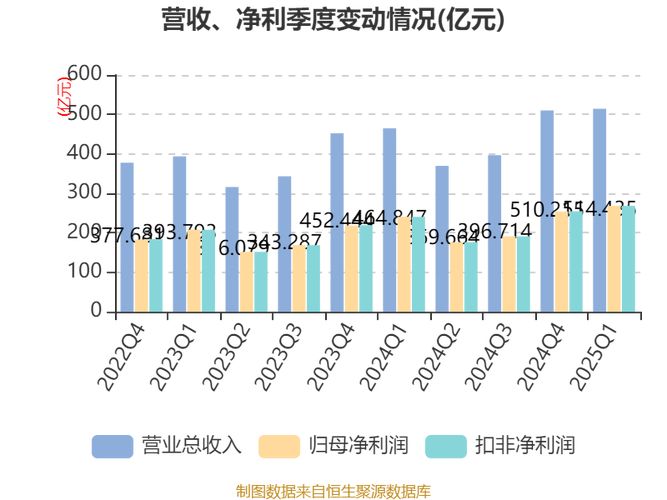
> in the first quarter of 2026, 20 listed white wine companies in shares a together achieved a total operating income of $13,2. 633 billion, or a decrease of 0. 7 per cent over the same period, and net profits to mothers of $5. 219 billion, or a decrease of 1. 75 per cent over the same period. Industry is still in a deep adjustment period, but there's a set of data to be noted - against the backdrop of a decline in the profitability of more than 86 per cent of businesses, ** only four companies ** from guizhou, five grains of liquid, ingest and old white wine ** achieved double growth in earnings and net profits. # four liquor companies are downgraded, and mao's profit is close to half-industry, first looking at the core financial data of these four enterprises. ** total collection and **27. 243 million * *the net profit from the return to the mother increased by 6. 34 per cent and 1. 47 per cent, respectively, over the same period. Its net profits already account for **52. 3 per cent of the total net profits of 20 listed liquor companies ($5,219 million).** (blockview://markdown-image-tos-cn-i-t/20f617530f5e45a5862eb4d0a4b7bd3) the most rapid increase was in five grain fluids, with a profit of **22. 838 billion dollars** (+33. 67 per cent) and net profit to the mother**80. 63 billion** (+82. 57 per cent). The regional wine company received **2. 230 billion yuan** (+8. 91 per cent) and net profit to the mother** 835 million yuan** (+0. 73 per cent), but the net interest rate reached **37. 44 per cent**, leading the regional wine company. The old white barracks received **1. 220 billion yuan** (+4. 49 per cent) and net profit to the mother **165 million yuan** (+8. 55 per cent), resulting in modest growth. # the industry's “triple contraction”, and the marginal improvement signals are now showing that the “double increase” of the four enterprises is more difficult in the industry landscape. The mid-term study of the white wine market in china, 2026, published on 18 june by the chinese liquor industry association, states that the white wine industry is experiencing a “triple contraction” in sales volume, sales volume and profit margin**. According to research data, over 65 per cent of enterprises have seen their white liquor sales and sales fall by the same year, with over 86 per cent of enterprises showing a decline in their profitability; and the channel ends have experienced the largest contraction, 61. 9 per cent, and the number of dealers has fallen by 57 per cent. At the consumer level, there has also been a structural reshaping: 86. 4 per cent of businesses have observed an absolute mainstream of “rationalization, priority of value for money”, a decrease in the commercial gift scene **82. 8 per cent** and a shift in the motivation of consumption from social drive to self-favourable experience. However, the decline in industry in the first quarter was almost even as compared to the same period in 2025,** which represents a small marginal improvement. The csi analysis suggests that the leading liquor company has shown signs of bottom contact, and that the firm's price is the core anchor for the expected contraction of the industrial chain. #i-tai-tai-tai-tai-tai-tai-tai-tai-tai-tai-tai-tai-tai-tai-tai-tai-tai-tai-tai-tai-tai. #i-tai-tai-tai-tai-tai-tai-tai-tai-tai-tai-tai-tai-tai-tai-tai-tai-tai-tai-tai-tai-tai-tai-tai-t-tai-tai-t-tai-t-tai-t-tai-t-tai-t-t-tai-t-tai-t-tai-t-tai-t-t-tai-t-tai-t-tai-t-t-t-tai-t-t-t-t-t-t-t-t-t-t-t-t-t-t-t-t-t-t-t-t- in the first quarter of 2026, the direct sales income of mao tsai ** $29,504 million** represented an increase of 27 per cent over the same period, representing a first breakthrough of 50 per cent** and 54. 73 per cent. The core growth engine is the digitized platform i. During the first quarter, the platform achieved tax-free revenue ** $21. 55 billion**, an increase of **267. 2 per cent** over the same period, representing almost 40 per cent of the total collection of the hut. As of 31 may, the cumulative number of users registered in the i-mai station stood at **96. 15 million**, with an increase of approximately 1. 667 million in 2026, with an average life expectancy of about 9. 56 million per month. “i shao-tai is an important vehicle for digital transformation and market-based marketing reform.” wang li, general manager of mao-tai, was so defined at the 11 june shareholders meeting. This round of change began at the beginning of this year, with the core logic of “right to property” — full replacement of non-specified products, and no more cut-off goods and only commission for services based on sales. The result is that the plant has the initiative to place its supply and price regulation. The price of the fly-away station has stabilized at **1700-1750**, and channel confidence has gradually recovered. # the number of distributors has decreased by 255, and the continued direct marketing expansion of channels means that the traditional distribution system has contracted. By the end of the first quarter, the number of domestic dealers in maotai, guizhou, was **,2098**, an increase of 6 during the period, but a decrease of 261,** a net decrease of 255**. Revenues from traditional wholesale agencies declined to 24. 382 billion yuan per year, while direct distribution was overstretched. The management stressed that the self-employed channel was the market's “balancemaker and stabilizer”, while the distributor acted as the market's “memplifier” and “translator”. Wang li responded at the shareholders' meeting that “sao tai and various sources have never been competitive or alternative to each other”. # it's not that there's nothing to worry about # the card of potential pressure in the back. # in the first quarter of 2026, revenues from the pail ** $4. 6105 billion**, an increase of 5. 62 per cent over the same period, but the sustainability of other products, such as the series, and the sustainability of the pail's performance under the high-frequency consumption scenario, are subject to subsequent data validation. In terms of the industry as a whole, 68. 5 per cent of the enterprises interviewed had a pessimistic expectation for the second half of 2026 that the industry would continue to adjust downwards. Powder prices are considered to be the leading sign of bottom-up repair in the industry - once the prices have stabilized, the pessimism of the industrial chain is expected to begin to shrink. But it remains dependent on the pace of macroeconomic recovery and the rate of recovery of consumer confidence。