"the renminbi is really sorry for the chinese." in an interview with a foreign-language channel, citizens expressed their dissatisfaction with the speed of price increases. This discontent is reflecting the structural problems of monetary and economic growth over the past several years。
$100 for rice is equal to 57 years ago
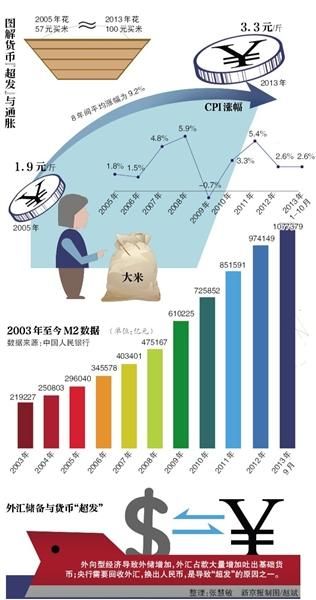
Before “the renminbi is really sorry for the chinese”, one of the examples cited in the media was also widely noted: mrs. Lee went to the market to buy rice and found that a variety of rice had risen to 3. 3 pounds in 2013, and she remembered that the price of such rice in 2005 was 1. 9 pounds。
On this basis, the average price of the rice increased by 9. 2 per cent over the eight-year period and the currency depreciated if the renminbi was fully used to buy rice. The purchasing power of $100 in 2013 was equivalent to $57 in 2005。
But the market is not just rice, but the prices of other commodities, such as cars, digital products and communications services, are falling. The cpi is a comprehensive measure。
Official data indicate that since 2005, some years have seen an increase of more than 5 per cent in the cpi and, after almost two years of falling, the increase in the cpi was 2. 6 per cent in 2012。
Inflation under “super-floating” currency
At the same time, the relationship between the supply of money and inflation is of concern to investors and scholars。
In 2005, our broad monetary stock (m2) was less than rmb 30 trillion, and in april 2013 this figure reached the threshold of rmb 1 trillion. At the end of september, the m2 balance had reached $10. 774 trillion, an increase of more than three times。
Starting in 2010, there has been an increasing number of criticisms in domestic markets about the inflation caused by currency excesses。
The economist zhong wei once noted that, if the time is lengthened, the “overhead” of the currency has not been the case in recent years, but has actually existed since the late 1980s。
Zhou zhou, a former member of the central bank's monetary policy committee, also believed that the currency was “overloaded”。
In his speeches and interviews, central bank president zhou xiaochuan argued that china’s currency issuance matched or slightly increased the nominal rate of GDP growth, which was the result of a period of market transformation in china, where the m2-GDP ratio was high, and was due to the excessive share of indirect financing at a higher level of savings。
But the recent speech by prime minister li keqiang demonstrates the government’s cautious approach to monetary stimulus。
Prime minister li keqiang, published in the workers’ daily newspaper, said: “in monetary terms, the balance of m2 in our broad currency supply exceeded rmb 10 trillion at the end of march, twice the GDP. In other words, the amount of money in the pool is already high, and more invoices could lead to inflation. It is well known that hyperinflation not only disrupts or destroys markets, but also causes enormous side effects and pressures on people's lives, and even panic.”
The rmb “import depreciation”
At the same time as the domestic purchasing power of the renminbi depreciated, the exchange rate of the renminbi rose rapidly, with its appreciation against the dollar exceeding 34 per cent over the past eight years。
“inside denigration” became a unique “situation” of the renminbi since 2005. According to the ppp theory, the appreciation of the currency should be accompanied by a simultaneous decline in domestic prices, but not in china。
Some export-oriented small businesses are more sensitive to this point than those who buy food。
One lee, who had processed the christmas tree in shenzhen, said that he had thought he had found a good industry, but that currency appreciation and increased competition had quickly wiped out the industry's profits。
Many economists argue that past outward-oriented economies and distorted factor prices are just one reason for rapid monetary growth。
Economists with balance-of-payments doctrines believe that trade imbalances and inflows of foreign capital are driving exchange rate movements。
Trade imbalances and surpluses under capital projects led to china's global top foreign exchange reserves. While absorbing foreign exchange, central banks need to issue rmb to hedge against domestic enterprises and residents, which leads to an increase in monetary size。
Can central banks manage the pace of currency transfers? Zhou xiaochuan believed that it was possible, as foreign exchange reserves would not continue to grow indefinitely. But in the outside world, the “transfer” of the past was too loose. (reporter wu min)