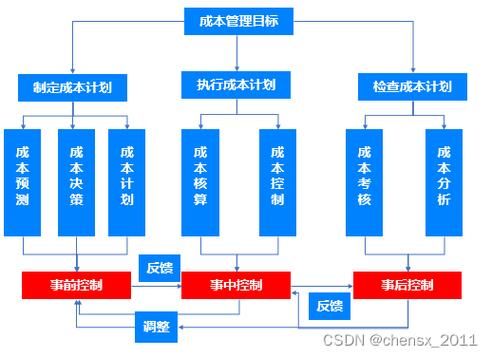
The enterprise applies a cost-management tool approach, generally based on procedures such as ex ante management, in-the-fact management, ex post management, in which the ex ante cost-management phase consists mainly of forecasting and planning of future cost levels and their trends, generally including such steps as cost forecasting, cost decision-making and cost planning; the in-the-fact cost-management phase, in which costs incurred in the course of operations are monitored and controlled, with the necessary modifications to the cost budget, i. E., cost-control steps, depending on the actual situation; and the ex post-cost management phase, in which accounting, analysis and validation take place mainly after the cost has been incurred, typically includes such steps as cost accounting, cost analysis and cost evaluation. Thus, cost management specifically includes seven elements: cost forecasting, cost decision-making, cost planning, cost control, cost accounting, cost analysis and cost evaluation。
(i) cost projections
Cost projections are premised on existing conditions, based on historical cost information, using scientific methods to describe and judge future cost levels and trends based on potential future changes。
Cost forecasting is the first step towards cost management and a prerequisite for organizational cost decision-making and preparation of cost plans. Through cost projections, mastering future cost levels and trends in their evolution can help transform unknown factors into known factors, help managers to become less targeted, provide a comprehensive and systematic analysis of the advantages and disadvantages that may arise from operations, and avoid the partiality and limitations of cost decisions。
(ii) cost-setting

Cost decision-making is based on a combination of economic efficiency, quality, efficiency and scale indicators based on cost projections and related cost information, using qualitative and quantitative methods to analyse cost options and select cost management activities for the best. Cost decision-making is not only an important function of cost management, but also an important component of an enterprise's operating decision-making system。
Moreover, since cost decisions take into account value issues and, more specifically, the economic reasonableness of financial costs, cost decisions are more integrated and serve as guidance and constraints to other operational decisions。
(iii) cost plan
The cost plan is based on a transportation plan and related cost data and information, based on the objectives set for cost decision-making, using procedures and methods to manage binding cost-financing activities for the production costs and cost levels of the planned enterprise. Cost plans, which are cost ex ante management, are an important part of the management of the enterprise's operations and contribute to enterprise development by planning and controlling costs, analysing the differences between actual and planned costs, and identifying areas for strengthening control and improvement, thereby evaluating the performance of the sector concerned and promoting savings in production。
(iv) cost control
Cost control is the exercise of proactive influence or intervention by the cost manager in relation to the intended objective, the process in which costs are incurred and formed, as well as the various factors affecting costs, and the control of actual costs within the intended objective. The key to cost control is to select the cost control method applicable to the enterprise, which determines the effect of cost control. Traditional cost controls are largely based on economic instruments and are carried out through a gap analysis between actual and standard costs, such as the standard cost method; modern cost controls transcend economic instruments and use all possible controls, including technical and organizational instruments, such as target cost methods, operational cost methods and liability cost methods。
(v) cost accounting
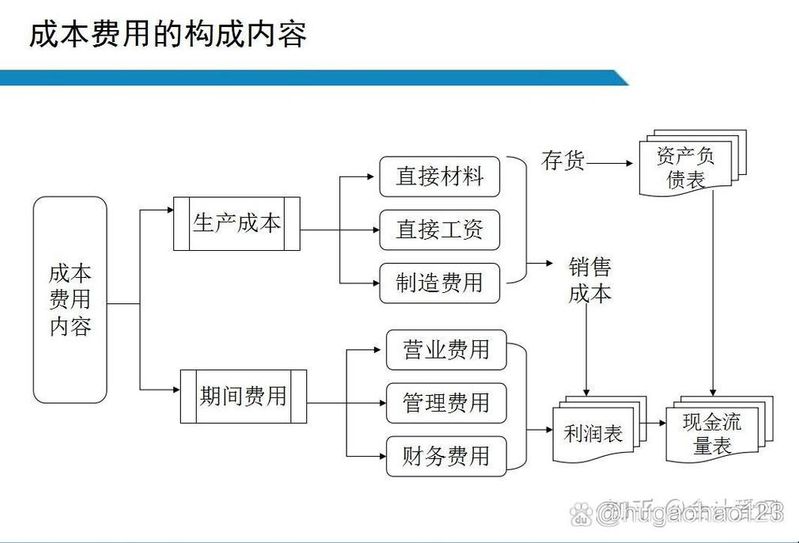
Cost accounting is organized, distributed and carried over the various cost-consuming items actually incurred in the course of operations, based on cost-accounting objects, in accordance with national uniform accounting systems and enterprise management requirements, to capture the total cost and unit cost of different cost-accounting objects, and to provide cost information to the relevant users。
Cost accounting is divided into financial and management cost accounting. Financial cost accounting is measured at historical cost, while management cost accounting can be both historical and present or future costs. The key to cost accounting is the choice of accounting methods. The method of accounting for financial costs includes basic methods such as variety and other supporting methods, which are flexible for enterprises to choose; management of cost accounting can take advantage of the results of accounting for financial costs directly, or choose methods such as variable cost methods, operational cost methods, etc. At present, the information provided by both models of accounting is relatively large in relation to the needs of enterprise management. In addition, the accuracy of cost accounting is linked to the enterprise development strategy, and cost-leading strategies require greater accuracy than differentiated strategies。
(vi) cost analysis
Cost analysis is an important component of cost management, using cost information provided by cost accounting and other relevant information, analysing changes in cost levels and composition, identifying factors and causes that influence cost change, and taking effective measures to control cost management activities. The cost analysis provides insight into the patterns of cost change, seeks ways to reduce costs and provides a basis for cost planning and business decisions。
The methodology for cost analysis consists mainly of comparative analysis, chain substitution and related analysis. Among them, the comparative analysis method is a comparison of data on cost indicators over time (or in different situations) to reveal contradictions, including in particular the three forms of absolute comparison, increase or decrease comparison and index comparison: the serial substitution method is a method for determining the degree of impact of the factors that cause a change in an economic indicator, and applies to situations where a child's interrelated factors together influence an indicator; the relevant analysis is based on a mathematical approach to relevant analyses of various indicators that are dependent, with a view to identifying regular linkages between the relevant economic indicators。
(vii) cost assessment
The cost appraisal is a periodic stocktaking and evaluation of the actual completion of the cost plan and its related indicators, as well as corresponding incentives and penalties, based on the implementation of the results and accountability, to monitor and promote cost-management activities by enterprises to enhance their cost-management accountability and increase the level of cost management. The aim is to improve pre-existing cost-control activities and to stimulate cost behaviour that binds employees and groups, better discharge economic responsibilities and increase the level of cost management of enterprises. The key to cost evaluation is to evaluate the selection of an indicator system and the interface between evaluation findings and binding incentives. Performance indicators can be financial or non-financial. For example, enterprises that implement cost-leading strategies should primarily select financial indicators, while enterprises that implement differentiated strategies mostly choose non-financial indicators。