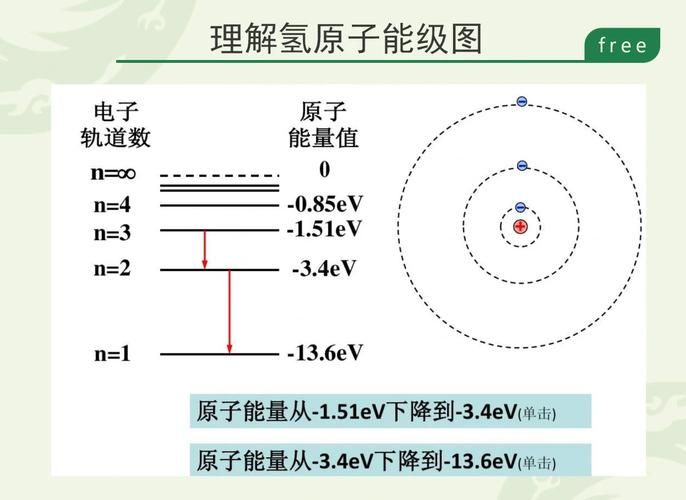
There are two ways to move hydrogen atoms from low-energy to high-energy levels: one with photons and the other with physical particles. What is the difference between the two approaches? Many students wonder whether this paper will explore the possibility of leapfrogging after the effects of photons, electrons, atoms, etc. On the hydrogen atoms of the basic state. According to photons, photons are a share, their energy is a share, and each photon's energy is eh , and cannot be divided. The essence of the atomic leap with light exposure is achieved through resonance, and the frequency of incoming light meets the principle of selectivity: to resonate, the photons must have a frequency equal to n-e-e-h-e-e-e-e-e-e-e-e-e-e-e-e-e-e-e-e-e-e-e-e-e-e-e-e-e-e-e-e. It should be noted, however, that if electronics are given a certain amount of energy and are completely free of the atomic nucleus, this is called ionizing, and the energy required is called ionizing energy. When ionizing, it is not subject to the conditions of nmee h h , because once the atom is ionized, the atomic structure is destroyed and the structural theory of the atom is no longer respected. Physical particles make atom leaps not through resonance but through collisions. If, at the time of the collision of the two particles, a fraction of the flat energy is converted into internal energy, which triggers the atom, it is called a “non-flexible collision”. And we know that all collisions must be conducted in accordance with the law of energy and the law of kinetics, and that it is impossible to break one of them. That is, the collision of two particles cannot transform their total kinetic energy into internal energy, as a portion of kinetic energy must be retained to satisfy kinetic constantity. The mass of hydrogen atoms is m, the mass of physical particles is m, to simplify the problem: it may be assumed that hydrogen atoms were in a static state. Physical particles collide with the eccentricity of hydrogen atoms at zero and v, respectively; physical particles collide at zero and v, respectively. As a system of physical particles and hydrogen atoms, there should be: 2 2 20 01 1 mv mv mv mv mv mv 2 e as an increase in internal energy, i. E. Part of the energy lost by the non-resilient collision of physical particles with hydrogen atoms, converted into internal energy of hydrogen atoms, resulting in a leap away from hydrogen atoms. Removed from the two equations above v: 2 20 m m m v 2m v m m m m v 2m e0 this is a one-dollar binary equation for v, so that the equation factor should be satisfied: 2 20 0 (2 v) 4 m m m
M m m v 2m e
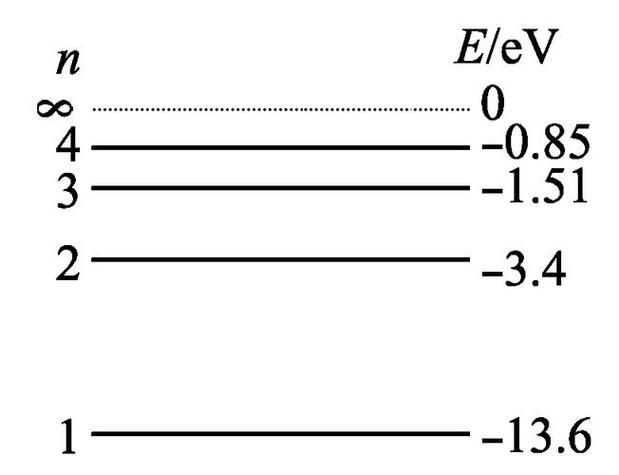
0? M 201 mv 1 m/ m e2 = 201 mv2 in the formula is the kinetic energy of an alien physical particle, expressed in 0e, and is: 0 mmeem () 2 in the simplified calculation of the energy loss extreme value me , the maximum energy loss in a completely non-resilient collision (i. E., when the physical particles are at the same speed as hydrogen atoms), the maximum energy loss in the system is called "energy loss extreme value me ". The mass of the physical particles is m, the kinetic energy is 0e and the input speed is 0v; hydrogen original