The axis parts are rotary parts of a length greater than the diameter and are usually composed of the outer cylindrical, conical, inner, screwdriver and corresponding end. The axle also tends to have flowers, keys, horizontal holes, ditches, etc. Depending on the function and structure shape, the axes are supported, directed and isolated in a variety of shapes, such as light, hollow, half-axis, steps, key axes, curves, cam axes, etc。
1. View expression
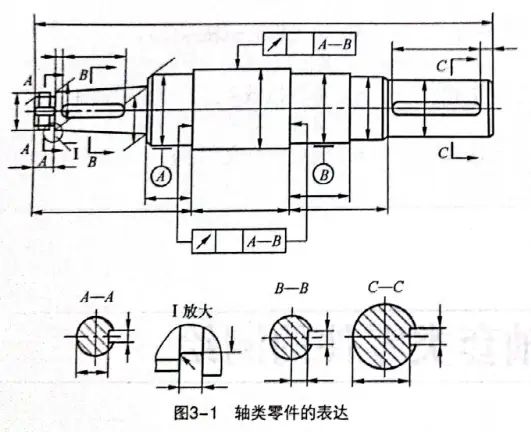
1) axial parts are mainly revolving and are generally processed on the floor, on the grinding bed, often using a basic view expression, horizontal placement of axes and the placement of small heads on the right, easy to process。
2) the single-key slot on the axis should preferably be full-faced。
3) for structures such as upper axle holes, key slots, etc., they are generally expressed in local sections or profiles. The moving profiles in the profiles, in addition to presenting the structure shape clearly, can easily indicate the size and shape of the structure。
4) small structures such as retorts, round corners, etc. Are presented in local magnification maps, as shown。
2. Size description
1) the main benchmark for the length direction is the main end of the installation (axis shoulder). Both ends of the axis are generally used as a measurement baseline, and the axis is generally used as a trajectory baseline。
2) the main dimensions shall be noted first, and the remaining multiple lengths shall be indicated in the order in which the car was slashed. The local structure on the axis, most of which is in proximity to the shoulder。
3) in order to be clear and easy to view, it is advisable to separate the internal and external dimensions of the profile and the dimensions of the different processes, such as the car, the swirl and the drill。
4) structures such as plating on axes, back angles, retorts, sand wheel troughs, key slots, central hole, etc., shall be marked after consulting the size of the relevant technical information。
3. Materials for axial parts
1, axle parts are commonly used in high-quality carbon-structured steels of 35, 45, 50, which are most widely applied in 45 steels, and are generally modulated to 230-260 hbs hard。
Carbon-based steel, such as q255, q275, may be used for less important or smaller axes。
3. Axes with high stress and high intensity can be processed with 40cr steel decomposition, with a hardness of 230-240hbs or a hardness of 35-42hrc。
In the case of axle parts working under high-speed, heavy-load conditions, select alloys such as 20cr, 20crmnti, 20mn2b or 38crmoaia. These steels not only have a high surface hardness but also a significant increase in the strength of their heart, as a result of cascading carbon fires or nitrogen seepage, but also have the performance of better grinding, shock resilience and fatigue。
5. Spherical ink cast iron and high-strength cast iron are often used for the manufacture of complex axes of outer structure because of their excellent casting performance and their vibration properties. In particular, our rare earth, a magnesium ball ink cast, which is resilient to shocks, has the advantage of de-sorting, with low responsiveness, and has been applied to vehicles, tractors and important axis parts on machine beds。
6. 45 and 50 carbon steels with a high hardness without final heat treatment are generally available for tensile strength of not less than 600 mpa. Line bars for precision machine beds may be made of carbon-tool steel t10, t12. The hardness of 50 to 56 hrcs is guaranteed when it is made from crwmn or crmn steel, obtained through final heat treatment。
Technical requirements for axial parts
(1) size precision
The major axle neck diameter size is typically it6-it9 and the exact it5. The length of steps on the steps on the steps of the steps is subject to the use requirement, or the distribution is required by the assembly size chain。
(2) geometric precision
Axes are usually supported by two axe necks, which are the assembly benchmarks for the axis. The geometric precision (round, cylindrical) of the neck supporting the axis should generally be required. Axial geometry of accuracy should be limited to a diameter mass, i. E., the inclusion requirement should be followed by an e and, if the requirement is higher, its permissible public margin (i. E., the box should be followed by a public difference of its shape)。
(3) mutual position precision
The co-axis of the axle parts (the necks of the axes equipped with the moving gear) are the general requirement for the accuracy of their respective positions in relation to the contours of the support axis neck. Owing to the ease of measurement, it is common to indicate a round beat. The routing of the general axle to the support neck is typically 0. 01 to 0. 03 mm and the high axle to 0. 001 to 0. 005 mm. In addition, the verticality of the axis to the positioning end and the axis line is required。
(4) surface roughness
In general, the surfaces supporting the necks of the axes are rough from 0. 16 to 0. 63um and the surfaces of the necks of the axes from 0. 63 to 2. 5um. For general parts and typical parts, the tables and information are generally available。