Since march, the global stock market, large commodities, and the interlocking effects of the multiple black swan events, have seen an unprecedented shock, with the largest single-day fall in international oil prices since the gulf war, the united states share triggering the second break in history, and a record low in return for us debt. The global panic has intensified under the fermentation of the epidemic, and the cboe volatility rate (the panic epidemic index) has touched 61. 62, which is 11 years high。
At the “opec+” meeting held on 6 march, negotiations on a cut-off agreement broke down, and russia stated that “as of 1 april, we would begin to work without taking into account previous quotas or reductions”, and that saudi arabia would soon announce an increase in production and a price reduction plan that would open a price war, and that international oil prices would fall in a negative way (see figure 1)。
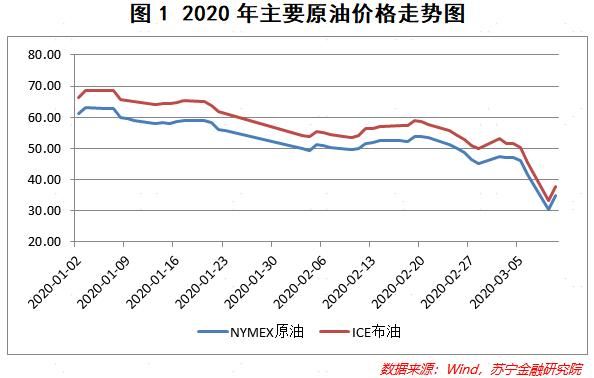
Since the beginning of the year, the prices of the main crude oil have been almost flat, and the current low price of oil has seen a situation of “water over oil”. The crude oil price was approximately $1. 53 per litre, based on the prices of $35/bunk brent crude oil futures, 158. 98 litres of international drums and $6,9612/l。
Follow-up analysis of oil prices
The main driver of oil prices is the expected changing trends in supply and demand in future markets。
In recent years, in the context of the global macroeconomic downturn, demand for oil has continued to shrink and international oil prices have continued to decline. Since the beginning of this year, the new coronary epidemic has spread globally, with the expected macroeconomic impact having grown from short-term to more and more countries joining in regulation, weak industrial chain transmission will lead to supply-side setbacks, global oil demand is likely to contract further, and the international energy agency (iea) reduced global demand prospects by 1. 1 million barrels per day on 9 march。
Following the collapse of the current round of output reduction agreements aimed at stabilizing oil prices, saudi and russian production is expected to increase significantly and the supply side will be under pressure. The double pressure on supply and demand has worsened oil prices, and the launching of price wars could further exacerbate supply-demand relations。
Follow-up on international oil price trends will require sustained attention in three areas:
The first is the development of a new global epidemic. In the medium to long term, if the epidemic continues to fertilize overseas, the possibility of a global blockade will increase, leading to a simultaneous and sustained decline in the supply and demand sides of crude oil, while the failure of the production end will lead to a significant decline in oil demand。
The second is negotiations among the major oil-producing countries. The russian federation was reluctant to make concessions on the reduction of production because of domestic political and economic pressures, and affirmed that it would be able to withstand oil prices at the level of $25-30 per barrel for six to 10 years, but that, following the breakdown of the negotiations, the russian rouble exchange rate had depreciated by 9. 5 per cent against the united states dollar and the parties still had the incentive to return to the negotiating table。
Third is the attitude of other oil-producing countries. At present, saudi and russian needles are not aligned with maiman, and other oil-producing countries have issued increased production expectations, which could trigger an oil price crisis if other major oil-producing countries join the price war。
As science and technology progress, major oil-producing countries have low mining costs, major oil-producing countries such as saudi arabia have less than $10 per barrel, russia has around $17 per barrel, the united states has around $36 per barrel, and china currently has relatively high oil production costs between $45-53 per barrel. Based on the extraction cost advantage, saudi arabia dared to press other oil-producing countries to reduce prices or to compete for crude oil market shares in exchange for prices。
In sum, however, this round of price wars has a greater impact on resource countries. As a traditional resource-based country, saudi arabia has not carried out rational industrialization and economic diversification, with oil revenues accounting for over 80 per cent of fiscal revenues. According to estimates by the international monetary fund (imf), oil prices would reach us$ 84 per barrel in order for saudi finances to reach balance of payments. Saudi arabia is currently easing domestic fiscal pressures through such initiatives as cutting state spending and increasing tax revenues, while a sharp drop in oil prices will make its fiscal position even more critical。
Following a strong russian statement, the russian ruble depreciated sharply against the united states dollar, at its lowest level in four years. Russian oil exports, which accounted for about 60 per cent of total exports, were more vulnerable to the economic sanctions imposed by the united states and europe, as was the current high level of military spending, which was reflected in economic pressure。
Looking back at the previous round of crude oil price wars, the revolutionary changes at the oil supply end in 2014 as a result of the technological innovation in shale oil in the united states, the continued decline in crude oil prices from historical highs of around $110, and the start of price wars in saudi and other countries, forcing united states shale oil companies to reduce their production. The fall in the price of crude oil in 2014 and the depreciation of the russian ruble by 54. 58 per cent against the united states dollar, as well as russia's use of $4. 3 billion in gold reserves to stabilize the exchange rate from 5 to 11 december and increase the benchmark interest rate to 17 per cent, suggest that the fall in oil prices could suffocate the country's economic development。
The sharp fall in traditional oil prices will affect the sale of shale oil in the united states, where the two largest shale oil producers, chevron and eogresources, cost nearly $50 per barrel per barrel in 2018 (us$ 49. 72 per barrel and us$ 48. 39 per barrel, respectively). Following the start of the current round of price wars, the major shale oil producers in the united states have begun an initial reduction in production in response to the fall in oil prices. With a daily average of 2. 98 million barrels of crude oil exported by the united states in 2019, which is of great importance to the united states economy, saudi arabia's massive increase in production has had a significant impact on united states crude oil exports. Trump has used his good offices to ease the tensions among the major oil-producing countries, thereby stabilizing oil prices and safeguarding the interests of domestic shale oil producers。
Thus, from the point of view of national fiscal pressures and the current geopolitical perspective, the price battles for crude oil are not an effective way to solve the problem, but are merely an initiative to exert pressure or show hard-line attitudes, and the follow-up rate would presumably resolve the current oil price dilemma through negotiations. On 18 march, the joint technical committee “opec+” would be reconvened and the outcome of the negotiations would have a stronger impact on short-term oil prices。
Investment opportunities in declining oil prices
Oil is known as “industrial blood”, and china, as an industrialized country, has become the largest consumer of crude oil, relying as much as 70 per cent on oil imports. Declines in international oil prices would reduce the cost of upstream raw materials, which in turn would be transmitted through industrial chains, contributing to lower prices for industrial goods and downstream consumer goods。
As an important component of the cpi, the fall in oil prices will drive inflation downwards, and if the price of pork drops in the later stages, it is likely that the cci will continue to fall in the future. At the same time, the interest rates of major foreign central banks have fallen, and our monetary policy space will increase and our bonds will improve。
Specifically, the effects of the fall in oil prices include, inter alia:
(1) transport. In the case of the aviation industry, for example, fuel expenditure accounts for about 30 per cent of the total cost of the airline, and the profitability of the airline will be enhanced as fuel costs decline. There are, however, two areas that still require attention: first, the impact of the new epidemic, the sharp decline in demand in the air transport industry, the effective control of the domestic epidemic and the large-scale spread abroad, suggesting that attention be given to airlines whose main route is domestic; and second, whether airlines are hedged fuel prices。
(2) new energy industries. The world is currently developing new sources of energy, aiming to achieve a clean-energy-to-one alternative, and developed countries, led by oecd, are increasingly focusing on energy efficiency, and china is rapidly declining its dependence on energy in its transition to the tertiary sector. The fall in the price of crude oil, on the other hand, would have some deterrent effect on the development of new energy sources。
(3) petrochemical industry. The fall in crude oil prices will bring down the cost of petrochemical-related raw materials, which will benefit plastics, rubber, tyres, etc. In the downstream chemical industry chain。
Impact of falling oil prices on livelihoods
Will the volatility of international oil prices affect our lives
In addition to the importance of oil in industrial production, the greatest impact on life is in the use of oil for transportation, which has already accounted for more than 57 per cent of our total demand for oil. With the proliferation of private cars, there were 348 million motor vehicles in 2019, and the impact of oil prices on our movement was greater。
Under the oil price management scheme issued in 2016, we found a smoothing mechanism for the domestic price of finished oil (oil and diesel) which, when crude oil prices are too high, sets a ceiling on the price of finished oil in order to ease the pressure on downstream consumption; and when crude oil prices are too low (below $40/bbl), in order to motivate petrochemical enterprises to produce, sets a lower limit on the price of finished oil, and the potential excess profits at the end of the refinery will charge a risk reserve, which will be charged by the ministry of finance and by local enterprises (see table 1)。
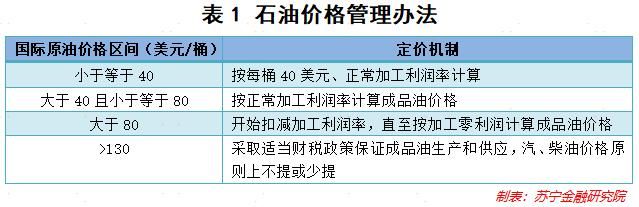
The reason for this is that if oil prices are too low, the costs of oil imports and supplies can be reduced in the short term, leading to a contraction in domestic crude oil production capacity and a weakening of oil self-sufficiency, which is not conducive to energy security. The price of domestic gas and diesel oil will be adjusted every 10 working days in line with the changes in crude oil prices on the international market at 2400 hours on the date of the price adjustment, and no adjustment will be made when the adjustment is less than $50 per ton, to be added to or offset when the next adjustment is included, that is, when the price of oil changes are small。
Recalls that since 2014, when international oil prices were above $80 per barrel, domestic oil prices (in the case of gasoline 92) were flat, while domestic oil prices were generally flat when international oil prices were below $40 per barrel (see figure 3). At 2400 hours on 13 january 2016, the price of domestic finished oil was revised downwards, followed by a fall in international oil prices of $40 and no subsequent adjustment in domestic finished oil prices was made until 26 april 2016, when the price of petrol and diesel was increased by 2400 hours after the international price of oil exceeded $40。
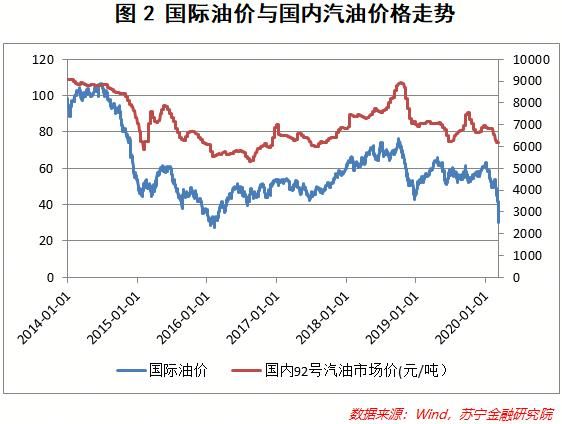
If future price battles persist, there will be a floor for domestic price adjustments for finished products, which will provide some support for industrial prices. At present, the next window of adjustment for domestic finished oils is set at 2400 hours on 17 march, in accordance with the rule that domestic oil prices be adjusted every 10 working days. On the other hand, a 22 per cent drop from $40 per barrel, based on a collection price of $51. 6 for brent oil on 3 march, would result in a substantial reduction in the price of domestic finished oil。
In particular, the sunning financial research institute, in conjunction with today's headlines, launched the white paper on finance 2019, with 30,000 words in full, and readers can reply to the white paper in the back of the "sunning wealth information" public counter, by accessing web links and extract codes。