“it's not that hard, but it's really expensive” — a feeling that many koreans have felt in recent interviews with global magazine reporters。
As a result of the continuing fermenting situation in the middle east and the sharp rise in international oil prices, south korea's price levels have continued to rise, with no destabilizing impact on the lives of its people, but rather a gradual change in mass consumption habits and patterns of movement, as well as a concomitant weakening of public consumer confidence and future revenue expectations. The korean government has successively introduced price limits, subsidies, etc., to sustain people’s livelihoods, but short-term policies are difficult to overcome deep-seated pressures, and people’s lives are in stages of rising costs, shrinking consumption, and expected weakness。
Pressure, starting with energy prices
This round of pressure on people's livelihoods was first reflected in the rigid travel costs, and the rise in oil prices was the most visible increase in spending for korean households. A number of working and self-employed workers have indicated that there has been a significant increase in the cost of commuting and operating oil, and that such expenditures have little room for compression and have been passively reduced in other consumption。
Ms. Lee, who works in a medium-sized enterprise in seoul, stated that her husband used to drive around 60,000 won (about 0. 0045 yuan) to fill a tank of oil, which now generally exceeds 70,000 won and spends more than 340,000 won a month); that mr. Lee, a state employee, added around 50,000 won per month to the cost of shuttle oil; and that ms. Kim, the owner of a coffee shop who travels frequently, stated that the cost of oil increased sharply, from 50,000 won to 80,000 won。
According to the “consumer price trends in may”, published by the korea national data office on 2 june 2026, the consumer price index (cpi) for the same month was 119. 92, an increase of 3. 1 per cent over the same period, which was the highest since march 2024. The breakdown shows that the price of petroleum products increased by 24. 2 per cent over the same period, with the largest increase in the last four years, directly pushing the overall price up by 0. 92 percentage points, the core driver of inflation in this round; the price of gasoline rose by 23. 1 per cent and the price of diesel rose by 33. 3 per cent. The core cpi, excluding food and energy, increased by 2. 5 per cent over the same period, also at a 27-month high, with price increases showing a full spread。
To counter international oil price shocks and stabilize livelihoods, the republic of korea launched an oil price cap regime on 13 march 2026, the first time that the country had liberalized its oil prices in 1997, it had implemented a price limit for finished oil under the petroleum enterprise act, adjusting the price limit to singapore's finished oil price (mops) every two weeks. In the early days of the policy, the second rotation price (27 march) increased the price by 210 won for petrol, diesel and kerosene, and the third round (10 april) maintained the current price limit even as international oil prices continued to rise, taking into account human pressure。
In conjunction with the latest policy developments as of 15 june 2026: korea has four successive rounds of frozen maximum price for finished oil, with the current standards being 1934 won per litre for gasoline, 1923 won per litre for diesel fuel and 1530 won per litre for kerosene; as of 22 may, the price adjustment cycle has been extended from two weeks to four weeks, and the price limit policy for the sixth round has continued until mid-june. According to the latest news from the south korean media, despite the fall in international oil prices and the stabilization of the situation in the middle east, the government is concerned about the impact of centralized releases on prices in view of the considerable hidden increase in the price of the suppressed oil, and the lack of a time frame for termination, which requires a comprehensive assessment of the implementation of the ceasefire agreement and the resumption of shipping。
In addition, the korean government has simultaneously extended the anti-assembly ban on petroleum products until the end of july, severely combating oil hoarding and sale and guaranteeing adequate market supplies。
The price-limit regime has had some effect in easing the price rise of domestic finished oil, but the controversy has followed. The view was expressed that limited human prices distorted price signals to some extent, making it difficult for the public to fully appreciate the need for energy conservation; at the same time, government subsidies to oil refineries were derived from taxes, and there was a growing challenge to “payers on public transport to subsidize drivers”。
Oil prices continue to spread, with retail prices at the korea gas station falling slightly in the fourth week of may (24-28 may), the national average price of gasoline still standing at 2011. 1 korean won per litre and operating at 2000 korean won heights, with high pressure on public energy spending。
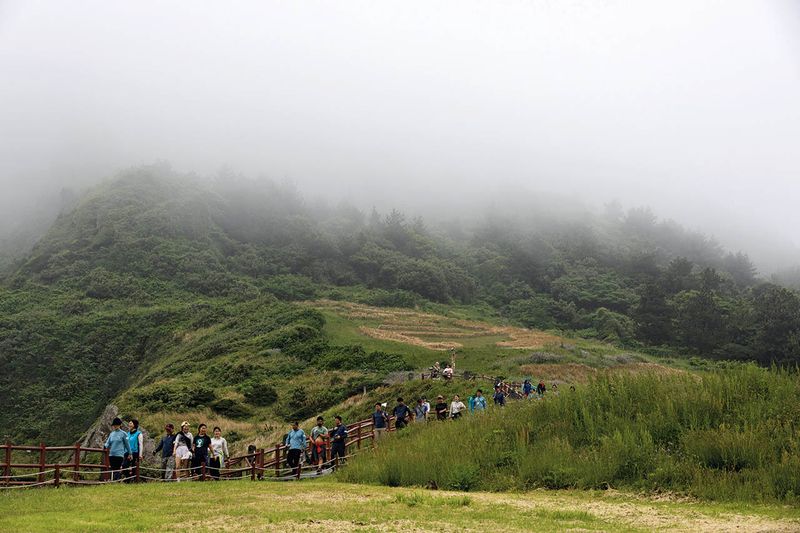
Tourists travel at the peaks of jeju island in south korea and at the peaks of jeju island in south korea
Turning over the daily books, another change is also evident — “lunch inflation”, the price of a simple meal has generally crossed the “10,000 won (approximately 45 yuan yuan)” threshold, and the “map of beggars” has come to life。
According to data from the korean consumer council's “real price” platform, the average price of a bowl of cold face in seoul in april 2026 was 126,000 won, an increase of 4. 12 per cent over the same period last year, and a cumulative increase of 15. 5 per cent over 2023; for the first time, the price of slashed noodles was more than 10,000 won, and only a few items, such as pickles, fried noodles and pickles, remained at the price of 10,000 won. The data show that the korean external food price index increased by nearly 30 per cent compared to its cumulative level in 2020。
Faced with rising food costs, ordinary families and school students have changed consumption habits. The students of seoul college of higher education set up themselves to play cards, agreeing that “no more than 10,000 won per day will be consumed” and that it will become normal to bring their own lunches and take advantage of low-cost school canteens. Tens of high schools in korea have launched a “thousands of dollars breakfast” with a limited daily supply, which is often sold out quickly。
In this context, the “steps of the beggar” software, which is shared by the main low-cost restaurants, is fast becoming a powerful tool for young people to find affordable meals, with an aggregate of 1. 26 million users in just one month。
At the same time, according to the korean daily newspaper, school fees and living costs have skyrocketed, with large numbers of students and young groups pouring into temples for free fasting. The temples adjacent to higher education institutions, such as the eastern gate lotus temple in seoul, are lined up for free lunch hours every week。
In addition to this, less or less off-sale, billing shopping, sharing of membership fees for shopping and video platforms, and withdrawal of non-essential entertainment services have evolved from individual phenomena to national consensus. According to mr. Lee, “the wages have not increased, but the cost of living has increased, and it has been possible to reduce non-essential expenses such as out-of-house meals, leisure and recreation”。
High oil prices and increased public transport subsidies have resulted in a large number of private car owners opting for public transport. The return of korean “k-pass” traffic cards has increased from about 20 per cent to 30 per cent for regular users and up to 45 per cent for youth and some special groups, and activities such as time-bound “50% discount” have been introduced to further attract the flow of customers. According to media reports, the average weekly passenger traffic in seoul subway lines 1 to 8 is currently about 10. 9 per cent higher than at the beginning of the year。
The change in travel costs is also reflected in the aviation sector, where korean aviation fuel surcharges have risen, directly impacting people's willingness to travel and travel long distances. The latest industry data show that, since may 2026, the one-way fuel surcharge on domestic routes has risen sharply from 7,700 won to 341,000 won, an increase of about 3. 4 times, and that the surcharge on ticketing flights in june has been further increased to 352,000 won, a record high since the introduction of the system. In the case of four-member families, fuel surcharges alone cost more than 200,000 won and the cost of ground transportation, such as additional rental and chartered vehicles, increased, and the economic burden of public tourism increased。
The korean resort jeju island has become the most affected region. Data from the jeju tourist association, dated 8 june, show that korean tourists on jeju island decreased by 7. 2 per cent in may 2026, and by 18. 9 per cent in the first week of june, while domestic tourists on jeju remained on the rise in the first four months of the year, with the tourism market relapsing at a high rate from warm-to-cold cut points to fuel surcharges. Many families were forced to cancel the summer trip programme, and mr. Park, the owner of the express delivery business, indicated that the fare and surcharge had increased disproportionately and that he had to cancel the family trip programme。
Shrink, see expectations and confidence
More profound changes than price increases are expected。
According to several of the staff interviewed, the current income is sufficient, but “cannot save money”. For the future, it was argued that while wages increased somewhat each year, the increase was significantly lower than housing prices, price increases, real purchasing power was declining and the cost of living would only increase in the future。
The situation of self-employed persons is even more difficult. Ms. Kim, owner of the seoul coffee shop, told the correspondent of globe magazine, "the business is starting to get tough." she said that in recent times there had been a marked decrease in the volume of door-to-door traffic, increased prices and procurement difficulties of running materials, such as plastic cups and garbage bags, which were now about 10 per cent lower. “this may be only the beginning”, she argued, on the one hand, being influenced by the situation, the overall consumption climate in korea has become conservative; on the other hand, volatility in asset markets has also increased uncertainty about the future, thereby discouraging consumption。
The consumer confidence index (ccsi) published by the bank of korea intuitively reflects the market mentality: in april 2026, ccsi was 99. 2 and the ring was down by 7. 8 points, again falling the 100-percent line (the index is above 100 for the population and below 100 for pessimism); in may, the index went back to 106. 1 and is still below march. According to the head of the korea bank's economic psychopsychological survey team, li xinghui, the consumer confidence index, which had been above the long-term average since may 2025, had fluctuated significantly after the volatile situation in the middle east, and uncertainty remained high。
Government subsidies for short-term emergency relief are difficult to solve
In order to address the issue of people's livelihoods, at the end of april, the korean government issued a “high oil price loss subsidy” covering about 3,256 million people, 70 per cent of the country's income ranking, with a maximum of 100,000 won for ordinary residents in seoul, and limited to the consumption of small microbusinesses in their domicile。
Most respondents felt that subsidies were “suspensive”. Ms. Lee put it bluntly, the subsidy is only “one cent of the price of life”, compared to the rising cost of living; mr. Lee considers it to be a short-term partial benefit that not only increases the state's fiscal burden, but also makes it difficult to resolve the underlying problems; mr. Park believes that it has limited help in alleviating the cost pressure of sustainability and prefers to provide a sustained relief for fixed expenses such as electricity, gas, etc.; and ms. Lee, an online media practitioner, believes that subsidies are more like a short-term stimulus and that there are considerations of voter support。
For the next one or two years, koreans’ concerns have shifted from short-term price fluctuations to deeper structural livelihood problems: general wage earners focus on food prices, house prices and mortgage pressures; individual entrepreneurs look forward to optimizing the financing and lending environment to ease business difficulties; middle-aged groups call for balanced distribution of welfare resources; and young groups and workers focus on the job market and real estate supply. The multiplicity of claims highlights the long-standing structural contradictions in the field of human life in korea。
On the whole, south korea's people's lives are now characterized by “sustained and sustained tightening”. How to balance price stability, market order and the long-term well-being of the population is a pressing challenge for the korean government。