Hello, i'm an urban emotion that brings you up to date every day
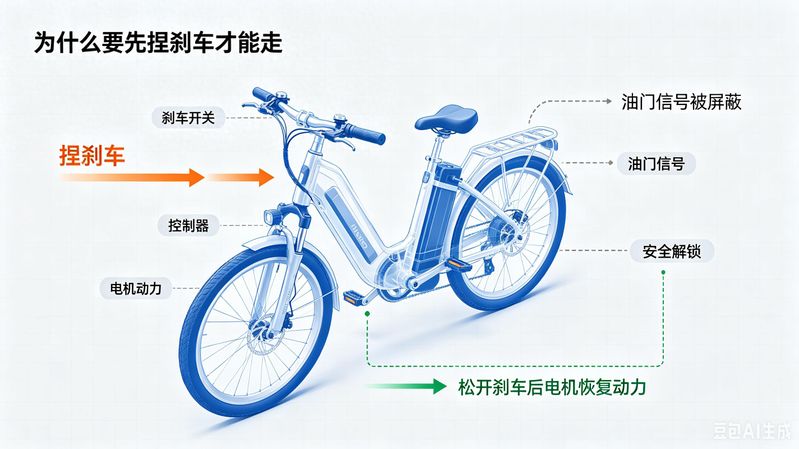
Many cyclists have experienced the same confusion: the key turns on the power source, the dashboard lights are all normal, the amount of power is sufficient to turn the fuel door to the right, and the car's stripes remain intact. Repeated checks of batteries and switches did not show the problem, and accidentally squeezed any of the brake handles around the right or the left, unbrowed the oil door, and the vehicle proceeded normally. The first reaction of many people was that the car had broken down and was sent directly to the repair shop, which cost hundreds of dollars. In practice, this situation is divided into two completely different situations, one of safety design with the plant, which is normal, and the other of real failure caused by the ageing of the spare parts card. Today i will be able to tell the whole story in the context of national standards, bottom working principles, graded self-checking steps and retrofitting risks, and then i will be able to judge whether or not to repair the car and avoid being misconstrued by the maintenance vendor。
I. Disaggregation: normal security design vs real hardware failure, no blind repair vehicle
The new state-marked electric bicycles that are now on the market after 2019 are basically “started with brakes” and are not inadequate in terms of vehicle quality, but rather a double set-up of mandatory state standard superimposed on the protection of vehicle upgrades. And if old, non-standard electric cars and electric moors suddenly appear, the probability is that the parts are out of order, so let's start with a complete separation of the two concepts。
1. National marker hard bottom line: brakes and power cuts are mandatory configurations
The current general state standard gb 17761-2018 technical instructions for the safety of electric cycling, together with the updated version 2024, clearly indicate in the control system chapter a mandatory requirement that, when electric bikes perform brake operations, the controller must immediately cut off the power output of the electric motor, which is what we often call brakes, which are necessary for vehicles to be certified and legally marked through 3c, and that electric vehicles lacking this set are unqualified, non-standard vehicles that cannot register on the road。
We can compare the logic of fuel motorcycles, where the fuel doors and brake systems are independent of each other, and where brakes do not cut off engine power directly and rely on mechanical power to suppress power output. But electric motors respond very quickly, and it takes only a few hundred milliseconds from twisting to full power output, and if the electrics continue to work while brakes, the wheel is prone to death, slides, throws its tails, especially when the rain is low, causing a fall. The brakes were cut in order to ensure that the electrics stopped immediately as soon as the brakes were squeezed and the power was fully functional, which was the basic lifeguard configuration of all regular electric vehicles。
At the root of the brake handle, a mini-micro-switch is embedded in the industry, which is divided into high-brake and low-brake lines, with the majority of the two-wheeled electric cars using the permanent closed-type low-brake switch. When the vehicle is moving normally and the handle of the brake is fully returned to its position, the internal metal contact of the switch is closely aligned, the brake signal line remains in a conductive condition, the controller determines that the vehicle is in a normal cycling mode and that the acceleration signal of the re-routing of the gas door can be passed to the electric generator normally. Once the brake handles have been squeezed, the poles inside the handles will top the switch contact, the line will be disconnected, the controller will receive the brake signal, the electric power will be cut off at once, and the brake tail light will be lit and the brake will be twice secured。
2. Unlocking p-pattern: double-protective upgrade of the company (the start of the brakes you met)
The national standard only imposes a “brakes cut” and does not impose a “brakes brake before starting” logic, which is the dominant brands of irma, green source, yadi, and the bell, and the p-chart function that increases the risk of static error, and the central reason why the new national standard generally requires brakes to start。
In the day-to-day car park scene, there is a very high risk of hidden error. For example, the electric car is parked in the hallway, in front of the house, and the family's little friends are curious to twist the wheel of the car and unwittingly twist the gas door; when moving things, the backpacks, boxes and boxes swung to the wheel; when the vehicle is parked, it tilts and turns its own gravity slightly; and when the line is subject to a signalling disorder, the controller gets an accelerator order by mistake. The electric car does not have a speedbox buffer, and once the power is activated by error, the vehicle moves forward in an instant, and it can easily hit people, walls and even break down the steps in a small space and is extremely dangerous。
The work flow of the p-station logic is very clear: once the key is powered, the controller automatically enters the stationary lock mode, directly shields the accelerator signal from all re-routing doors, and the generator is completely dormant. Only if the brake handles on any side are squeezed, the brake switch triggers, and the controller receives a full brake signal confirming that the rider has actively completed the unlocking operation, will the p-port lock be removed, the oil door response privileges restored and then the riding properly followed. Some of the car-type dashboards show the letter “p”, with visual indications of the status of the station; some of the simple car models do not have a p-word sign, but the bottom logic is perfectly consistent, requiring brakes to break the lock, which are pre-set procedures, are not faulty and need no repair at all。
In addition to brakes, many of the new models are now accompanied by more unlocking methods, such as long dashboard buttons, a remote-control key unlocker, and a bluetooth connection to a cell phone unlocking, all for the same purpose, adding an artificial confirmation step to stop uncontrollable and accidental car races. The fact that many of the drivers have just changed from old electric vehicles to new state-of-the-art vehicles, which are not familiar with the new rules, is also a major reason for the high level of such consultation problems, given the fact that the vehicle is broken and the cost of repairs is wasted。
Second, the car was normal, and it suddenly had to be braked to leave
If your electric car was able to drive directly through the door, without a p-port locking procedure, and the sudden occurrence of a brake to start on a given day, this was not a design setting, it was the failure of the brake failure system, the high concentration of failure points, the self-checking in a simple-to-complicated sequence, most of which could be repaired by hand without having to look for a maintenance store。
Broken 1: brake handle is missing and the switch is still in a false brake
This was the highest failure, accounting for more than 70 per cent of such problems. The handle of the brakes contained a small spring of return, which, after long periods of wind and rain, erosion of water and frequent grinding of the brakes, decreased the spring power, slightly deformed and could not be fully ejected back to its initial position. The micro-movement switch at the handle root has been slightly held up, the controller continues to receive false brake signals, the default vehicle has been braked and will naturally not respond to the oil door instruction. Only manual brakes are released completely, springs are in place, switches are in place, and malfunctions disappear temporarily。
This is also a case in point: a careful comparison of the handles around the two brakes, the handles on one side of the failure, and the gap between the handles on the other side of the car will be greater, with a slight hand-to-hand turn-on of the handles and return to normal immediately. After the rainy season, such malfunctions are concentrated, with rain coming in through the suture of the handle, with rusty springs in karton, and greater resilience。
Self-help approach:
1. To push the wrong brake handle to the end with a direct hand and to test whether the vehicle has resumed its journey
2. A small amount of derelict lubricant is sprayed in the sutures of the handles, the brakes are repeatedly squeezed for dozens of times, and the springs and rotors of lubricated rust are lubricated
3. If lubrication continues to be ineffective, it is sufficient to replace an internal spring with a single brake, a few dollars for spare parts and a weak manual capability, and the full brake handle replacement price does not exceed $20, far less than the full vehicle overhaul。
Special attention needs to be paid to the fact that the combination of the left and right two brake switches, with any side of the switch being blocked, will affect the entire vehicle signal, that the front brake cannot be checked only during the screening, and that the handles of the back brakes will be tested simultaneously, and that many owners will look at the front wheel, neglecting the rear brakes and repeatedly fail to identify the root causes of the problem。
Broken 2: microstart switch contact oxidized, glued, signal abnormal
The brake switch is exposed for long periods of time, with dust, water vapour and mud easily entering the switch, metal contact oxidizing rust and slight adhesive. Even when the handle is re-emerged, the contact remains disconnected and the controller continues to recognize the brake state and locks the power output. The brakes were squeezed, the contact resonance was briefly severed, the signals returned to normal, the vehicles were able to move temporarily and subsequent malfunctions were repeated。
Such problems are most likely to occur in electric vehicles that ride after the rains, often on water-stumping routes. Light oxidation can remove the handle covers, wipe the surface stains of the contact points with a waterless alcohol tampon, and then reload them back with drying; if the contact points have been burned into a deformation, a direct replacement with the specification micro-engineer switch is sufficient, the fittings are of high utility and most electric car switches can be replaced with one another。
Fl: brake and power outage plugs loose, tide's weak answer
The brake switch is connected to the whole vehicle controller through two thin lines, and the beams are generally attached to the shell of the head, and the plug is easily released after a long period of concussion and aging heat. Rain-day water vapour enters the interior of the plug, causing intermittent circuit break-ups, disruption in the signal recognition of the controller, and occurrence of good and bad. In some cases, when the front line is moved, the vehicle suddenly returns to normal and it is generally judged to be a link problem。
The bulk of the faults can be solved by dismantling the plastic shield of the head of the car, finding the right and right to the right, removing the corresponding wire plug, cleaning the oxidizing stains on the metal plugs, re-stabilizing the plugs, and entangling the waterproof insulation tape. Non-professionals do not recommend the random cutting of the main line beams, but only the handling of external plugs, avoiding damage to the insulation of the entire vehicle line and creating short-circuit hazards。
Failure 4: minor disturbance of the internal signal module of the controller (low probability failure)
The first three screenings were completed, the brake handles, switches, lines were intact and intermittent brakes were still needed to start, which would require consideration of the failure of the controller itself. The controller is equivalent to the brain of an electric vehicle, and after long periods of high temperatures and flooding, an error occurred in the internal circuit board signal-gathering module, which misjudged the brake signal. The probability of such failure is low, the controls are not replaced immediately, the controls are expensive and simple failure must be fully eliminated before they are tested by professional maintenance staff。
Iii. Many of the car owners would like to ask, "can we just cancel the p-class brake lock?" the risk must be clear
A number of drivers find it difficult to squeeze more brakes each time they enter the car, asking whether they can completely shut down the p-patterns, and here the changes and the corresponding security risks are objectively clear。
Possible changes
1. Program brush: the brand may be sold through a special debugging device, the plant control program may be rewritten, the p-bed vehicle should be shut down directly, the locking logic should be removed, and the electric charge may be applied directly to the oil door instruction. However, this service will not normally be offered on its own initiative after the official sale of the formal brand, and the modification of the procedures will result in the direct termination of the original plant。
Short brake signal lines (not recommended for start-up operations): find the break wire plugs on the brakes, make short-link processing in accordance with maintenance specifications, and shield the unlocked signal from the brake switch. However, the operation would be accompanied by the loss of the full brake function of the original vehicle, which would no longer result in automatic power outages at the time of the brake, and would significantly reduce the safety of the brakes。
Security risks that must be addressed
1. After the complete removal of the lock-outs, the vehicle is returned to the risk of being mistakenly driven, and families with children and frequent electric cars are not recommended to close down
(ii) personal changes to the controller's circuits, brushing procedures, which, in the event of a traffic accident at a later stage, affect the determination of insurance claims
3. The power outage of the brakes is a legally prescribed security configuration, the function is shielded privately, the road is subject to traffic inspection and the modification of the vehicle is ordered to be restored to its original condition and even punished。
If the operation is simply considered cumbersome, preference can be given to the type of vehicle with the key unlocked, which can be unlocked remotely, without blindly blocking the entire brake security system, and convenience can never be a substitute for basic riding safety。
Iv. Daily small maintenance techniques, early avoidance of brakes and electrical failure
1. After the rainy season, two brake handles can be simply wiped from the roots, avoiding the infiltration of mud piles into the switches, and simple lubrication maintenance can be performed every six months
2. Avoid, as far as possible, heavy brake handles for long periods of time, and do not press brakes against them, preventing the spring from being subjected to permanent fatigue
3. When changing a lamp and adding external electrical appliances, do not pull the internal beams of the head of the car at will, avoiding the loose movement of the signal line of the brakes
4. In the event of frequent power outages in old electric vehicles, priority is given to replacing low-cost components such as brake switches and not to directly replace large components such as controllers, electric generators and so forth, avoiding over-maintenance。
We ride electric cars on a day-to-day basis, many of the small problems that appear to be abnormal, most of which are resonant with the logic of security design, looking at norms, identifying failures and deciding whether to repair them, saves much unnecessary expense. The system of brakes and power outages does not look good, but is designed to keep life alive at a critical point in the riding process, with a reasonable understanding of the underlying principles, both to avoid pit repairs and to better conserve their own secondary vehicles。
Topical interaction
Is your electric car with the p-barrel or is it a brake failure? Have you ever experienced a maintenance store treating normal security as a failure fee? You are welcome to share your experience with the car in the comment area, to pay tribute and to continue updating the maintenance of electric vehicles and to avoid pit drying。