Summary
Quantum computing is expected to be a destabilizing force in addressing the ac bottlenecks. Quantification can bring greater parallel computing capacity and lower energy consumption than traditional calculations, while the computational capacity of quantum calculations has greater potential in the ai area, based on the growth of the quantum bits of volume index. While overseas technology giants drive the development of quantum computing industries, companies such as ibm, microsoft, google and others publish a road map for quantum computing, the gap between domestic quantum computing industries and overseas technology giants is narrowing。
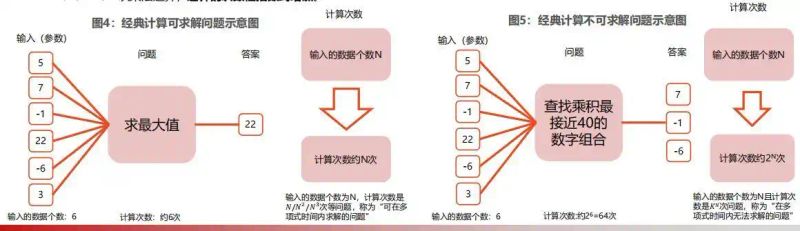
Quantification is a calculation based on quantum mechanics, which is fundamentally different from traditional classical calculations. It uses quantum bits to replace classical bits, which can achieve more efficient parallel calculations, and its computational capacity increases exponentially as the number of quantum bits increases. This calculation shows the potential to go beyond traditional computers when dealing with certain specific types of issues, such as large integer disaggregation, search problems and analogue quantum systems。
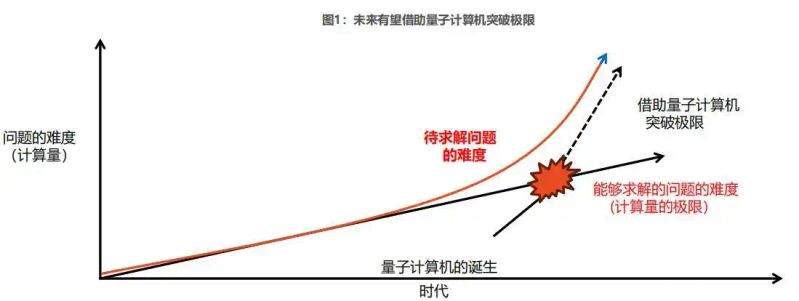
The core principles of quantum calculations include the following:
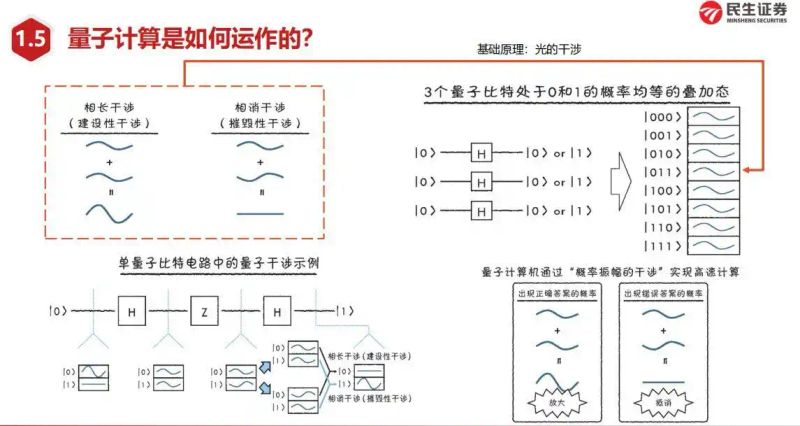
Quantum superimposement: quantum bits can be in a 0-to-1 superimpose state at the same time, which means that they can represent multiple combinations at the same time, rather than a state of zero or one, as is the case with classic bits. This superimposed state greatly increases the ability of quantum computers to process information。
Quantum entanglement: quantum entanglement is another key concept in quantum computing, which describes a special connection between two or more quantum bits, even if they are far apart, and the change in the status of one quantum bit immediately affects other tangled quantum bits。
Quantum door operations: in quantum calculations, quantum door is the basic logical unit for operating quantum bits, similar to the logical door in classical calculations. Quantum doors perform computational tasks by altering the superimposed and tangled state of quantum bits. Quantum doors are right, that is, they are reversible。
Quantities reversibility: the operation in quantum calculations is reversible, which means that input can be derived accurately from the output, unlike traditional classical calculations, which in some cases cannot extrapolate the only input from the output。
Quantum algorithms: quantum algorithms are algorithms designed for quantum computers that use quantum supersing and quantum entanglement to perform computational tasks. Prominent quantum algorithms include shor's algorithm (for large integer breakdown) and grover's algorithm (for database search), which theoretically show performance faster than the corresponding classic algorithm。
Quantum back-linking and quantum error: quantum systems are very fragile and vulnerable to interference from the external environment and lose their quantum properties, a process called quantum back-linking. To achieve practical quantum calculations, quantum correction techniques are needed to protect quantum information from interference。
Hardware for quantum calculations is achieved in a variety of ways, including superconductive circuits, ions, photoquantities, semiconductor quantum points, nitrogen spot centres for diamonds, and porcelain quantum beats. Each approach has its particular advantages and challenges, such as the ability of superconductor circuits to achieve high integration levels, while photoquent computing is well compatible with existing fibre-optic communication technologies。
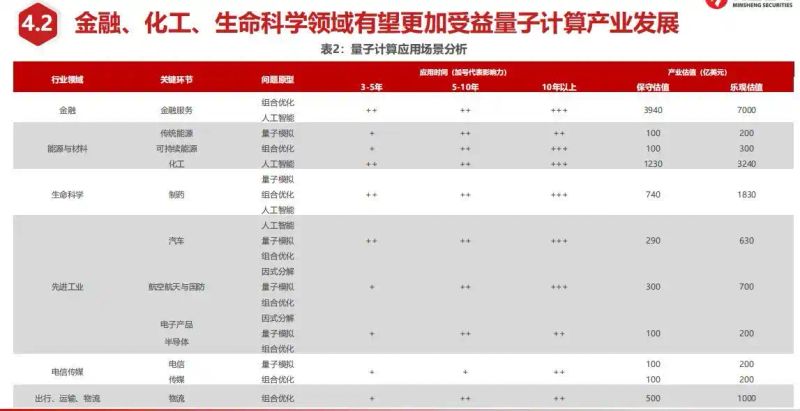
The commercialization and application of quantum calculations is promising, with a projected global market size of over $800 billion by 2035. Financial, chemical and life sciences areas are expected to benefit greatly from the development of quantum computing. However, the development of quantum computing technologies continues to face many challenges, including risks of falling short of expectations, increased competition in industries and market failures. Nevertheless, the potential of quantum computing and its impact on future technological developments cannot be ignored, and it is expected to become a destabilizing force in addressing the ac bottleneck and usher in a new era of productivity development。
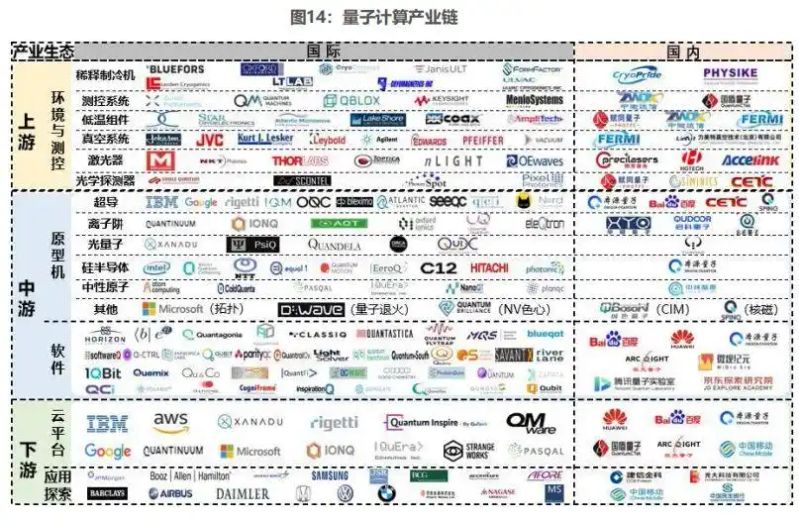
Detailed quantum computing chain
1 quantum computing software and hardware systems are already in place. Form
Upstream of the quantum computing industry, which consists mainly of environmental support systems, monitoring and control systems, various types of critical equipment components and metallurgical devices, is a necessary safeguard for the development of the quantum calculator prototype, and the current fragmentation of the upstream supply chain, owing, inter alia, to the lack of technology routes and the high demand for personalization of hardware, has limited the ability to break through each of these barriers, to some extent limiting the development of upstream enterprises。
Quantum computing industry ecological mid-roads are mainly concerned with quantum calculators and software, of which prototype machines are a core part of the industrial ecology. Technical routes such as superconductor, ions, photoquantum, silicon semiconductor and neutral atoms are now developing more rapidly. Superconductive routes are favoured, ions, photoquantities and neutral atoms are receiving greater attention from starters, and prototype machine development and software development in the united states have a certain advantage。
The downstream of the quantum computing industry, which mainly covers quantum cloud platforms and industrial applications, is at an early stage of development, and in recent years dozens of companies and research institutions around the world have introduced different types of quantum cloud platforms to actively compete for industrial ecological status. The current applications in quantum computing are being explored in such areas as finance, chemicals, artificial intelligence, medicine, automobiles, energy, etc. The advantages of foreign quantum cloud platforms are reflected in back-end hardware performance, the degree of synergy between soft and hardware, and business service models。
Quantum computations are expected to give it a great deal of power
The global quantum market was estimated at $4. 7 billion in 2023 and is expected to exceed $800 billion in 2035. According to icv, with the evolution of quantum computing techniques and rapid developments in areas such as ai, the application boundaries of quantum computing have been expanded, with the global quantum industry reaching $4. 7 billion in 2023 and the average annual growth rate (cagr) between 2023 and 2028 reaching 44. 8 per cent; in 2027, dedicated quantum computers are expected to achieve performance breaking, move the whole market model to $10. 54 billion, the reference ibm 2023 volume road map, 2028 volume gates, and error correction techniques will reach a more mature stage, and market size will continue to expand rapidly between 2028 and 2035, benefiting from technological advances in universal quantum computers and the extensive application of dedicated quantum computers in specific areas, with a total market size expected to reach $8117 billion by 2035。
Investment recommendations
Quantum computing is expected to subvert the classical computing architecture, become a subversive force to address the ac bottlenecks, or become an important player in the development of new quality productivity. It is recommended that attention be paid to the relevant subject matter of quantum computing, such as quantum, zhejiang east, shinzhou information, kohua data, china's great wall, shino-ray technology, etc., as well as to the quantified communication marks of electrical network ann, ji dijheng yuan, gyal software, zhejiang east, and henton light。
This is an extract from the report, which reads as follows:
Information technology - industry in-depth study: one language understanding quantum calculations - human security
Thank you for coming
- 2024,0520