Quo monyi
The cost of shared bicycles has risen again。
In july 2026, the american bike, the hallo, the oranges started at a near-synchronous pace, sending the old rule of “$1. 5 for 30 minutes”。
The three rivals who competed for a subway parking space on a day-to-day basis seemed to have moved forward in the case of higher prices。
Over the past decade, the price of shared bicycles has risen from five to nearly two cents, but the industry has not been able to recover from its overall loss, and the money burned in the last 10 years can feed several entrepreneurial outlets。
The mobai sellers, ofo, died of a broken financial chain, and blue was taken over by dripping... Players on the field changed round after round, and the books were kept in deficit。
Today, they account for more than 85 per cent of the three major players in the market, and none of them can achieve steady profits from the bicycle business itself。
Ten years, why is the shared bike still a lost business? Now that the price has been raised to fill the gap, why are the giants still dying
The cost of riding a shared bike is enough to buy a used car
In the morning of july 2026, zhang wei cleaned a united states bike outside the national metro station and a line appeared on the screen of his mobile phone: the start-up price was adjusted to 1. 88/60 minutes。
She stunned and remembered that she had been riding for 14 minutes at the midday festival last month and had been withheld for 2. 5 dollars, and had sent out a circle of friends: “blue, how did your price rise?”。
The same day, hallo had just changed the holiday price from $1. 5 to $2. 5, and now it's up。
In july 2026, american bicycles, drops of oranges, and halo bicycles updated the pricing rules in beijing, nanjing, chengdu and zhengzhou。
Unlike previous price increases, this time the platform changed its algorithm and the most common short-distance users felt “the pain of cutting their skin”。
Previously, the rule for many years was “30 minutes on a $1. 50 ride with extra hours”. The start-up price is now set at $1. 88 and 1. 99 for oranges and harold. The chief of the basic ride was unified to 60 minutes。
The start-up price was 40 cents and the length doubled from five cents to three cents per minute, equivalent to a six-off. The longer you ride, the cheaper it is, it really looks like it's a "no plus."。
But most users do not use this "plus". Statistics from the china cycling association for 2025 show an average of 2. 7 km per bicycle and 13. 7 minutes per cycling。
For most people, cycling is the 10-minute journey to the company. It is precisely this group that is the most direct contributor to the cost of the rotation。
For example, the cost of riding a 10-minute short-distance user increased from $1. 5 to $1. 88, an increase of about 25 per cent, and the short-distance increase of haroo and oranges reached 33 per cent. For users who ride for more than 45 minutes, the cost has instead been reduced from the $3 added over time to the start-up price。
However, the proportion of users on one-way riding at an early peak of more than 45 minutes is negligible. The existence of this preferential condition is more like a rhetoric that makes it seem reasonable to raise prices。
Putting this rotation price in the price curve of a calendar year is not a surprise。
When shared bicycles emerged in 2016, with 50 cents riding one time, more than 20 brands crammed into the streets, and when subsidized wars hit hardest, they even made zero。
By 2019, mobai was taken over by the united states corps, and the market turned from 20 mixed battles to 3-fold battles, with the financial chain falling apart, taking over blue and putting out oranges, with the ali family at its back。
The pattern of competition has stabilized and prices have for the first time been harmonized: 1. 5/30 minutes, a standard that has been maintained for more than three years。
Until 2022, the price increases turned to high frequency users. Hallo took the lead in raising the prices of the weekly, monthly and deka cards, followed by the united states after a few months when the 90-day card rose from $60 to $90, a 50 per cent increase。
The price increases became more “hidden” in the following two years。
In 2023, the group would start from 30 minutes to 15 minutes in some cities; harold and orange would then compress that figure to 10 minutes. Today, the start-up price for shared bicycles is nearly $2, almost triple in 10 years。
The reasons for each increase are similar: “increased operating costs”, “in order to provide better services”. But the user felt that the price went up and the experience did not keep up。
On the social platform, "who can put down the price of shared bicycles" and "who can buy a second-hand bike for 80 bucks" complains。
Some netizens say that it's all hallo and hallo and all american cars that have to drive to make sure they can ride every day. Good cars have to be robbed, bad cars make up half, and parking spaces are becoming increasingly remote。
Prices have gone up and cars are getting harder to ride. What's wrong with sharing the bike business
Ten years, why share the bike or lose the money
Since the day of its birth, shared bicycles have been the business of a door that “can't count”。
Read the books first。
The annual report of the united states of america for 2025 showed a net loss of approximately $10. 1 billion for the year in sharing the new operating plates belonging to the bicycle. A total of $22. 67 billion was collected throughout 2025, resulting in a loss of $2. 63 billion as a result of the restructuring of innovative operations, including orange bicycles, autopilots and co-cities。
According to a 2021 disclosure book, between 2018 and 2020, companies had accumulated losses of over $4. 8 billion. Of these, shared two-wheel operations (bicycle + tram) contributed 91 per cent of the revenue, but the māori rate was only 6. 7 per cent, with limited support for overall profitability。
None of the three giants can make a steady profit from the bicycle business itself。
The root cause is the cost structure of the business。
The manufacturing cost of a shared bicycle was between $700 and $1300, and the daily depreciation cost of a single vehicle was between $0. 5 and $0. 8 on the basis of a useful life of two to three years. Operating costs, such as additional maintenance, cleaning and maintenance of electronic fences, are estimated at approximately $2 per day for each vehicle。
But this is still only static costs, and the most difficult issue for sharing bicycles is movement control。
At early peaks, vehicles flow from residential areas to metro stations and writing buildings; at late peaks, they flow back to residential areas. This tidal effect means that the platform has to invest a significant amount of manpower in cross-regional handling。
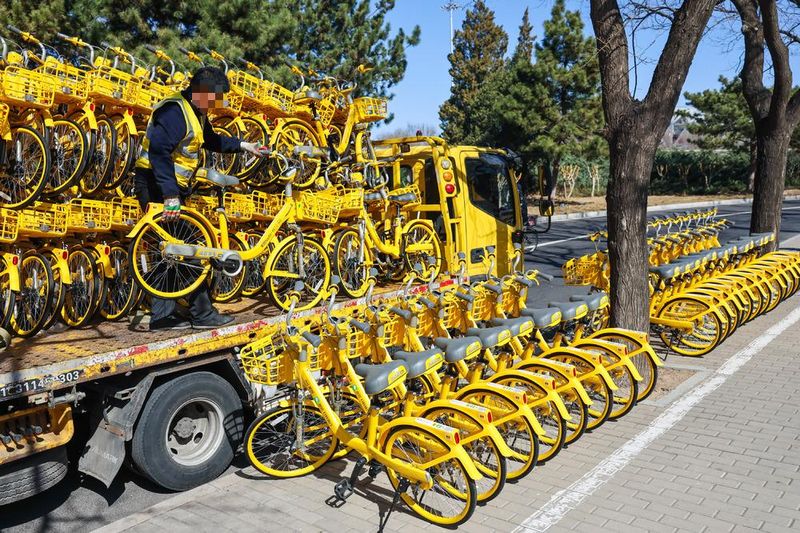
In beijing, for example, in 2025 there were 3,116,000 rides per day throughout the city and 2,940 man-days of transport and 2,384 man-loads of transport by operators。
The cost is an extra cent per transfer. The fixed costs of depreciation, insurance, transportation, etc. Are almost constant, and income is 100-fold different。
The income end ceiling is also visible。
According to data from the beijing city transport commission, the average daily turnover rate for shared bicycles in beijing was 3. 67 in 2025. On the basis of 1. 5 yuan/minus of the price increase, a car earns about $5. 5 per day and $3. 5 per day。
That figure seems to be valid, but it is ideal。
Income from shared bicycles is highly dependent on weather and season. In winter, the number of ridings fell sharply in northern cities, with high summer temperatures affecting the frequency of vehicle use as well, while extreme weather events such as heavy rains, wind, hail and so forth contributed to almost zero turnover on that day。
Moreover, outdoor parking also means that vehicles are exposed to the weather and the frequency of maintenance and end-of-life rates remain high. With hidden costs such as early end-of-life of vehicles and penalties for non-compliance, the rates of gross pay for bicycles will only be lower。
Government regulation has further reduced the profitability of the business。
Municipalities have a rigorous assessment of the total volume of inputs, parking areas and quality of services. In 2025, 16 cases were opened in shanghai city against shared bicycle businesses for failing to clean up irregular parking in a timely manner, with a fine of $158,000。
More crucial is the introduction of quotas. The national total of shared bicycles has stabilized at about 18. 2 million, with a significant slowdown to 1. 7 per cent。
Of these, the total amount dropped in central beijing was between 670,000 and 740,000, not more than 1. 1 million in shanghai, and guangzhou reduced the city's size from 600,000 to 800,000 to 480,000 in 2025。
The cost is rigid, while the income depends on the sky for food and the total amount invested is locked to death. “small for profit” — a veritable growth formula — has completely failed in shared bicycles。
The big hole of loss has been running, and the platform has not stopped. There are two directions: throttle and open source。
The conservation effort is based on fine-tuning operations, such as optimizing the movement route, reducing vehicle idleness, extending the vehicle's useful life and so on, in an attempt to lower the cost line for the hard-on。
On the open source side, price increases are the most immediate response。
However, as we mentioned earlier, the price increase has already caused complaints from a large number of users. The platform has also tried to introduce newer models with higher configurations and has tried to offer better experience in exchange for higher unit prices。
However, the delivery of new vehicles is far less than that of ordinary bicycles, and prices are much higher. As a result, most of the users commuting are still ordinary yellow, blue and green。
The real “killing” is actually membership。
All three platforms are filled with cycling holocaust entrances, time-limited, 90-day smooth-riding cards, one-day-pack cards, and varied。
In the case of harold, a monthly card actually paid $17. 99 and a continuation fee of $20. On the basis of 22 working days per month for users, two rides per day are calculated, at a cost of approximately 0. 4 dollars per ride, which is nearly less than a single fee。
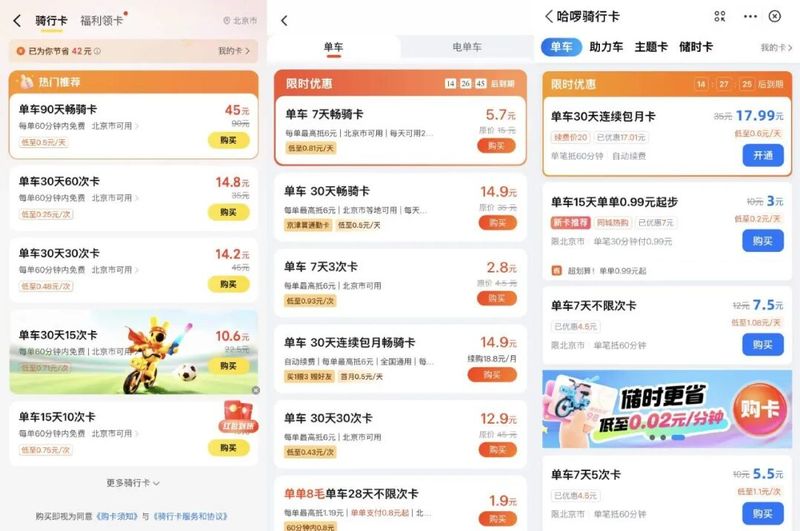
With this amount, there is little reason why hf users should not do the cards。
The platform wants that effect. Hf user circles through one monthly card, allowing them to contribute to a stable cash flow; users will naturally give preference to those who have a card in order to “go back” and consumer habits shift from multi-platform prices to single platform consumption。
But can membership fundamentally change the financial structure of the bicycle business? The answer is: it's easy, but it's hard to cure。
The structural dilemma of shared bicycle operations remains there, with rigid costs, income elasticity, government regulation, each of which is hard bones。
The membership system can cushion losses on the books, but the depreciation of a vehicle will not be reduced by the user's monthly card. On the contrary, high-frequency cycling accelerates vehicle wear and tear and increases costs for replacement and maintenance。
Thus, even when the price rises, the number of members continues to climb, and shared bicycles are at best maintained as “less than less” rather than “big profit”。
It's the cheapest commercial. Cards
Since the only way to stop the bleeding is to do so, why are the giants still dying in this business
The answer may not be in the bicycle business itself, but outside it。
Shared bicycles are typical high frequency, fresh demand, and offline scenes. Users have to ride every day, open app every time. This “opening rate” is a dream for any internet platform。
Users are willing to open aps, scan them and complete a real trip, each of which is contributing real and geographically labelled user behaviour data. This flow of home-grown scenes is hardly available from external advertising。
So where did this flow of assets end up
Hello's share book provides a very convincing figure: by the end of december 2020, 34 per cent of hallow users had used two or more of the company's services. This means that every third person riding a shared bicycle has one other business that tries the platform。
This is not unique to hallo. Every time a user opens the ap scan, the platform is given an opportunity to present other services to the user. The newly required high-frequency riding scene provides a natural route for low-frequency but high-value business transformation。
There's a focus on each other。
Hello called this road a "flyer model". High-frequency (hf) operations such as shared bicycles and trams are used to drive low-frequency high-value operations such as windmills, taxis and rentals。
Its book shows that the proportion of shared bicycle users migrating to other operations is considerable, with 40 to 60 per cent of the new users of handicars, windmills and electric cars coming from the original bicycle users。
In 2020, the total value of the halo windmill trade reached 7 billion yuan, making it china's second largest windmill trading platform, exceeding the value of $5. 8 billion in shared business. The per capita turnover of the same users also increased from $13. 1 in 2017 to $70. 6 in 2020。
The logic is equally clear for the mission. When they acquired mobai in 2018, the american ceo wang xing made it clear that mobai was a “flow pull” and would be the best link between the group's shop, home and travel。
The entrance to the ride is embedded in the american corps app, and a person who rides to eat with a restaurant coupon recommended by the app, shares the “last three kilometres” of coverage of the bicycle and directly joins the catering, business, entertainment, etc。
For dripping, the strategic role of the orange bike is to complete the last link of the “one-stop trip”. Together, the network covers more than three kilometres of travel and the last one to three kilometres of work on bicycles, improving the closed loop of user travel needs。
In 2025, with the upgrading of the drip membership system, v8 members are entitled to 60 free orange bicycles per month. The miles accumulated by the user in a drip can also be converted into free riding entitlements for oranges. The success of the membership system has made the transition between two and four smoother。
The halo model, the mission's traffic portal, the drop-out loop, and the shared bicycle business play different roles in each platform's ecology, but its importance remains irreplaceable。
It's a business that doesn't have to make money, but it can't be without it. The 18. 2 million bicycles are on the streets of the city, and american yellow, harald blue and orange green themselves are the most sustained and cost-effective billboards of the three platforms。