In semiconductors, 2d materials and equipment cryogenic electrons, the 78k liquid nitrogen temperature zone is the standard low temperature zone most commonly used in laboratories, as well as the core working hot zone for various high-temperature vacuum probes。
A central concern of many r & d researchers in their selection and experiments is: at 78k, what is the temperature stability of the vacuum probe? It's not warm, it's even
Today, we take as an example the industry-dominated series of high-temperature vacuum probes of the ctgpx series, which generally and comprehensively dismantles 78k cryogenic temperature-control realities, variations in the accuracy of different versions, and key core factors that really affect temperature stability。
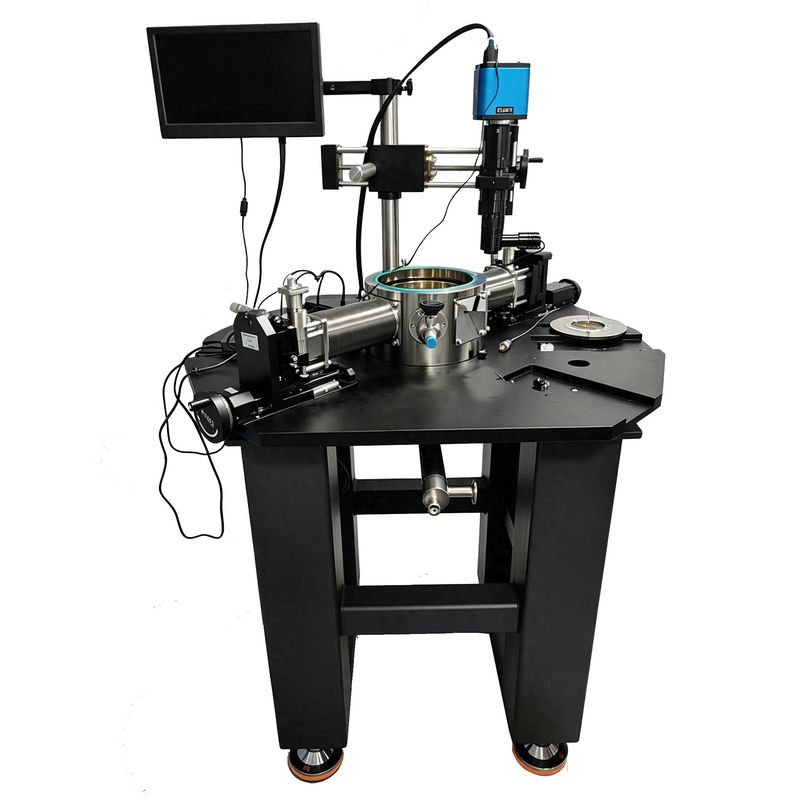
I. Cgpx 78k temperature performance: 3 sets of accuracy fully covered
Sen dongbao 77k-675k wide-temperature vacuum probe, which fully covers 78k low temperature test scenes, is based on a three-phase configuration of economics, standard editions, and high-precision scientific editions, tailored to the needs of different experiments, from batch screening to full-scale testing of high-end scientific research。
1. Basic economic type: meeting conventional rough screening select
Control of temperature stability ± 1k, which is based on high value for money, is suitable for mass screening tests for low temperature samples from enterprises and laboratories. The type of machine is fully adequate for scenes that require low temperature drift requirements and only observation of the basic properties of the cryogenic device。
Standard version: common laboratory mainstream selection
Temperature volatilisation is stable at ±0. 1k ~0. 2k with a temperature resolution of 0. 01k and an even temperature of 0. 5k for the sample table。
The performance is balanced and reliable, and is currently the dominant type of machine developed in higher education laboratories, enterprises, perfectly adapted semiconductor iv/cv tests, conventional hole tests, etc。
3. Scientific high-precision editions: specific for precision testing
High-end scientific configurations with a significant upgrading of controlled temperature accuracy with a temperature stability of up to ± 0. 01 k and a temperature resolution of 0. 001 k。
The equipment is equipped with a multi-layer gold-plating, non-oxidized copper radiation screen, which is structurally designed to significantly contain thermal leakage of low temperatures, and to completely address the temperature fluctuations and temperature fluctuations that are common in the 78k temperature zone. It is specially adapted to harsh scientific scenarios such as 2d materials, low noise frequency devices, and high precision semiconductor representation。
Ii. Discovery! Three key factors affecting temperature stability in 78k
Many wonder: it is also a 78k liquid nitrogen test, why is there some equipment that is warmer and less data-repeated, while others are extremely stable
The core gap lies not in the mode of cooling, but in the three main details of the vacuum environment, the radiation-resistant structure, the liquid nitrogen supply system and the core watershed of the hypothermia of the vacuum probe。
1. Vacuity: the basis for cool control and stability
In low-temperature environments, atmospheric residual gas heat is one of the main causes of temperature drift。
If the cavity vacuum is <10-3 torr, the residual air in the cavity will continue to take the cooling amount, causing the temperature drift to increase to >0. 3k ~0. 5k, which is highly volatile and repetitive and does not allow for precision testing。
When the vacuum reaches the high vacuum level of 10-5-10-6 torr, the residual gas-conductor heat is virtually eliminated, the temperature control system is only required to compensate for a trace radiation leak, and the equipment can stabilize the ultra-high-stabilization temperature control effect within ±50 mk。
2. Radiation screens: core hardware for low-temperature temperature and temperature
The 78k cryogenic sample table and the 300k-room temperature cavity show large temperature differences, and radiation-to-heat exchange is the greatest hazard of cryogenic drift。
Without high-quality anti-radiation structures, room temperature cavity heat will continue to heat up the sample table, and the temperature control system will need constant dynamic compensation, resulting in periodic temperature fluctuations that seriously affect test accuracy。
The machine type with a double layer of gold-plated, non-oxidized copper radiation screen is an efficient barrier to cooling thermal radiation for heat exchange, which directly reduces temperature drift by more than 60 per cent in the 78k temperature zone and is a necessary structure for high-precision cryogenic testing。
3. Liquid nitrogen supply: no periodic temperature shocks
The stability of the liquid nitrogen supply directly determines whether the temperature curve is smooth。
(b) the primer type uses manual valve control, which is highly vulnerable to pressure fluctuations from liquid nitrogen storage tanks and produces regular temperature fluctuations of ±0. 1 k ~0. 2 k
High-precision machines are equipped with a self-adaptation closed-ring control system that adjusts the flow of liquid nitrogen to real-time temperature dynamics, with no shock, irregular temperature drift and extremely stable temperature curves。
Summary: how can different scenarios be chosen
1. Batch screening, conventional cryogenic tests: selection base/standard version, ±0. 1k ~1k temperature, full value
2. General research in higher education, iv/cv, hole: a standard version that is fully adequate, stable and adaptable
3. Two-dimensional materials, precision devices, low noise tests: a high-precision version, ±0. 01k super-stable temperature + multi-layer radiation-proof structure, which guarantees the accuracy and reliability of experimental data。
In general, 78k, as a mature liquid nitrogen standard temperature zone, a high-quality vacuum probe is perfectly capable of achieving ultra-high stability tests, depending on the configuration of the equipment and vacuum conditions, and the selection of the configuration would completely circumvent the common problems of cryogenic drift and data fluctuations。