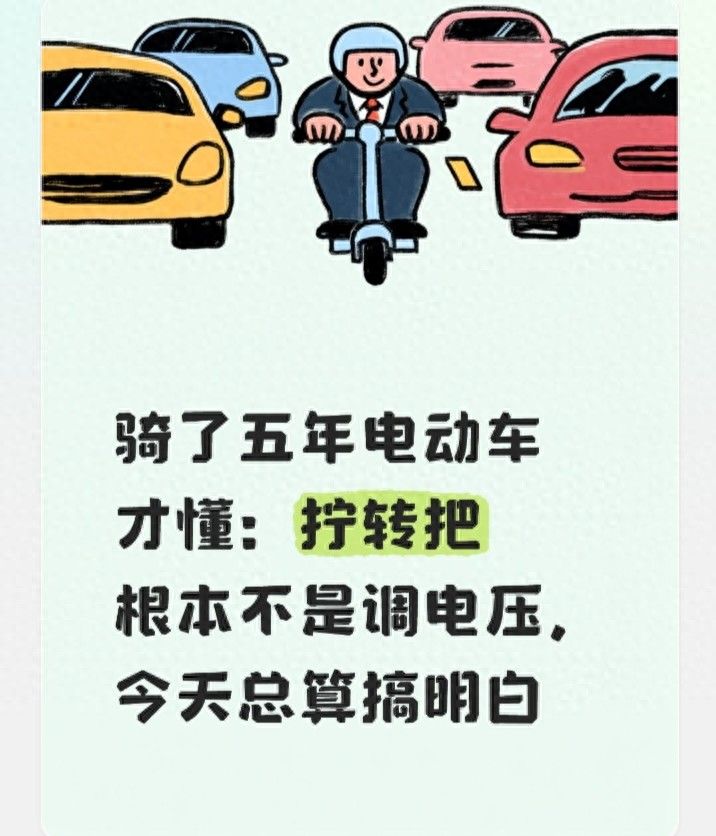
It took me five years to get on the electric car. Turning it wasn't a voltage
Headline for today
A lot of people have been riding electric cars for three, five, seven, eight years, day-to-day twists, speeds, slows, muscular memories, but the vast majority of drivers don't understand a central question: what are we doing with the switch on the door? A lot of old riders think, of course, that the deeper they screw up, the higher the battery, the faster the power, the faster it goes. It's a reasonable perception, and it's all wrong。
I have been riding an electric vehicle for five full years, moving from the base 48v12ah lead-acid walker to the 60v20ah long cruiser model, having experienced various problems such as control damage, lack of start-up capacity, speedcaton and the artificial shrinking of the ship, the mechanic woke me up with a single sentence: turn the pressure off and actually work on the controller. Then i went through the maintenance materials and dismantled the parts with the garage teacher, so i completely sorted out the power logic of the electric car. To understand this principle, not only is it possible to understand vehicle failures, but it also avoids retrofitting traps, prolonged battery and electrical life and saves a lot of maintenance money each year. Today, the power system is dismantled in plain language, without complex formulas, and ordinary car owners are able to understand the relationship between transfer, controller, battery, electric power, and, incidentally, maintenance techniques for daily vehicles, and common failure screening methods。
First, correct the core error: twist the wheel without changing the total battery voltage
First of all, the most critical conclusion: whether you turn the switch half or the end, the total voltage of the battery output remains the same. The 48v batteries, which are static, slow and full-speed, are nominally maintained on or below 48v; the 60v batteries are approximately 60v all the way, and the voltage does not rise empty because you are full of twisters。
A lot of people would argue that a little voltage would drop at the start, and the ramp would be lower. Isn't that a switch? Here, two concepts are to be distinguished: empty labels called voltage and load pressure depression. Larger currents are required for start-up and ramp-up machines, batteries produce large currents instantaneously, and circuits, intra-cell resistance generate small voltage drops, which are physical losses and do not shift the active ups and downs. Unlocking and smoothing, and the voltage slowly bounces back, is a normal fall, and artificial pressure is completely different。
The switch on our hands is essentially just a signal generator, a remote that sends a command to the controller. The vast majority of electric vehicles on the market are retrofitted by hall, with the inner component of the hall and a small piece of magnet, which changes the distance between the magnet and the hor element, and produces a weak telecommunications number that changes continuously between 0. 8 v and 4. 2 v. The deeper it is, the higher the signal voltage of the output, the lower the signal voltage to the initial value。
This weak signal, which can't drive the motor at all, is responsible only for telling the intermediate controller: now how much power does the owner want? A simple analogy: the switch is like a home-based air-conditioning remote, you press high wind speed, the remote sends only one weak signal, and it's the air-conditioning mainframe that really adjusts the volume, controls the compressor, and the remote itself does not power the compressor directly. Put it in an electric car, the controller is the "host", and instead it is the controller who is responsible for the delivery of the message, which really controls the voltage, current and power output。
The role of batteries is simple: the steady output of direct currents of fixed voltage is equivalent to a large power supply for the entire vehicle. As long as the battery is free of power loss and ageing, the base voltage of the entire output is constant. The apparent weakness of old batteries in climbing the slopes is due to greater internal resistance and severe voltage when large currents are discharged, rather than the transfer of the voltage。
The electric power is the final execution component, and it cannot itself adjust the speed, and the type of electrical energy it enters produces the corresponding speed and twist. Direct currents do not have a brusher, and the control must be used to convert the battery's direct currents to a different phase, with different percentages of traffic, in order for the power to start and change at a smooth pace。
Summarizing the three division of labour: transposition of signals, handling of signals by controllers, regulation of electrical output, provision of power by batteries at fixed voltage, and transmission of electrical power by electric machines. The twist changes the output of the controller, which is what we often call the pwm wiring, not the total battery voltage。
It's popularly known that pwm speeds are shifting control over “time of power, not voltage”
I'll use a living example to explain the principle of the width. Assuming the battery voltage is fixed at 48v, we cut it to 100 fractions a second。
When you twist it a little bit, the controller receives a low-speed signal, only 30 of which are connected to the current, leaving 70 to be disconnected. Overall, only 30 per cent of electric power is available on average, which is slow and slow
Half-wielding, controllers connected to 50 segments, 50 disconnected, 50% average power output, medium speed
The wheel is full, the controller is almost fully connected, and 100 sub-sections are essentially continuous, with the electric power running at maximum speed。
In other words, the controller did not change the voltage value of 48v, but only for a very short period of time, to switch the circuits quickly and adjust the ratio of the time to power. The longer the power goes, the higher the average power obtained by the electric power, the faster it turns, which is the speed logic at the core of the electric vehicle。
The advantages of this fast-paced approach are obvious. First, a smoother pace does not result in a hurried drive and a soft start on a day-to-day basis; second, power losses are small, do not increase heat over old-style electrical resistance, and continue more robustly; and third, maximum currents can be precisely limited, batteries and electric appliances protected against overload burning。
The old low-end tricycles used electrical resistance to retort in the early years, and indeed regulated both ends of the electric power plant by changing the electrical resistance subvoltage. The disadvantage is that the electrical resistance continues to heat and consumes electricity, and the two-wheeled motor vehicles have now completely phased out the structure. If you go to the garage, the master says your car's retrenching, probably by faking your fittings。
Many car owners have discovered a phenomenon: it's also full of twisters, new cars are fast and have been riding slowly for two to three years. Mostly not because the battery voltage is insufficient, but because the controller limits the flow and the internal resistance of the battery increases, the controller automatically reduces the average output power for the purpose of protecting the fittings, not diverting the unaltered voltage. There is also the owner's self-loading of the switcher, the “repressor accelerator”, which only increases the signal ceiling for the transfer, frees the controller from the flow limit, which appears to be speed-extension, and sustains large current discharges, significantly reducing the life of the battery。
Here's the difference between two more confusing words: signal voltage and main-line voltage. The output of 0. 8-4. 2 v is used to control signal voltage, which is used only to transmit commands; 48 v, 60 v, 72 v of the battery to the controller is the main main voltage of the main line, which is basically constant throughout the journey. The two are completely different, and are key points where most drivers have been confusing for many years。
Three, you can understand 80% of the common failure of electric cars
It had been impossible to distinguish between the switch and the controller, and the vehicle had to be replaced by the price offered by the mechanic, which cost a lot of money. Once the speed logic is cleared, most of the minor malfunctions can be pre-screened on their own, judging whether the problem is at the end of the signal or the end of the power supply。
The first type of failure: the twister doesn't work, the car doesn't move。
Priority is given to tracking the signal: holding the brakes, releasing the brakes and retrying them. Many models have brakes that cut off the switch, and the brakes are not functioning, cutting off the signal directly; removing the three-wire plugs, using a short-wire signal line and orthodox, if the car runs directly at full speed, which means that the damage will only take a dozen dollars in exchange for a switch. If the short-link remains intact, the problem arises on the controller, the electric power or the main line。
The second failure is to stop while moving, to accelerate intermittently and to drive at short and slow speeds。
The probability is that the signal line will be loosed and plugged into water oxidation, the signal will be intermittent, the controller will receive an unstable command and the output power will be negligible. Dismantling the shell of the handle, cleaning the plug metal contact points and re-fixing the wire beams will basically solve it without changing the controller. If the line is fully tethered, it is the ageing of the hall drive module within the controller, which requires the replacement of the controller。
The third type of failure: a weak start, an inability to roll up the speed and a marked weakness in climbing the slope。
First, the battery state: it's full of electrostatic voltage, with a sudden drop in the start-up voltage, which means that the battery is old and resistant to internal resistance; if the voltage is flat, the controller's limit is too low, or the controller is old to export large currents. Many of the vehicles were mistaken for insufficient voltage, blindly adding lifting modules, forcibly lifting the output current, and finally directly filling the dead batteries。
The fourth type of failure: the switch was released and the car continued to speed up and shut the electrical doors。
A typical turnback spring is disabled or the magnet is deflected, sending a high-rotation signal to the controller. The power will be cut off immediately, no more riding, and the simple replacement of the switch will be repaired without major overhaul of the power system。
Fifth type of failure: quick runs are fine, and the fuse is burned as soon as the wheel turns。
It is not excessive voltage, but the controller's power tubes are punctured and are short-circuited. In this case, no repeated attempts are made to activate, the controllers are replaced directly, and the electric wires are burned down by force riding。
There's also a common error zone: a low turn-down can save electricity. In practice, the switch only sends a signal, and the saving of electricity depends on the control device's restricted flow strategy, cycling habits, tire pressure and load. The smooth twisting, the slow lifting of the controller to the space ratio and the reduction of instant mass discharges are the key to the protection of the battery, the lifting of the continuation of the voyage and the transfer of the pressure itself。
Iv. Retrofitting speed-set dismantling: the so-called “repressurization speed” is all marketing
A number of repair shops, retrofitting network stores sell speed transferers, voltage boosters, altruistic controllers, and promotional techniques are all the same: high output voltage, easy speeds of 10 to 20 yards, and no change in flight. To understand the speed theory, these statements are largely exaggerated。
Quick turn: the plant turns the signal ceiling at 4. 2 v, which simply pulls the highest signal up to 4. 5 v, deceives the controller and allows the controller to break the maximum limit set by the plant. The original plant controller will set a safe current ceiling to avoid start-up, ramp-up large current damage to batteries and generators. The retrofitting controller continues to be full-load output, instantaneous currents are doubled, short-term vehicles are faster, battery circulation life is directly reduced by half over the long term, electrical circuits are overheated and battery replacement is likely to occur within six months。
Turning again to the so-called pressurizer: the business claims to be able to raise 48v to 60v, or to change the output current ceiling of the controller, which is not stable. The batteries, generators and controllers of the electric vehicles are marked in combination, and the resistant pressure of the 48v machines and the thin wires are designed in accordance with 48v to force their power to be high, to be prone to the burning of the wires, to the demagnetic demagnetic of the magnets, and to increase the experience associated with the cost of subsequent maintenance well above the rate of increase。
There is also a one-size-fits-all controller, called "compatible with all voltage " , which seems convenient, and a general controller whose protective logic is crude and does not optimize your battery capacity, and lead-acid and lithium batteries are prone to overloading problems. The original plant controller will match the space-to-space curve with the entire vehicle parameters, and will control currents at the starting, pacing and slowing stages, balancing power with continuity, and modify the controller to maximize speed at the expense of durability。
There are only two safe ways to achieve a truly reasonable acceleration: to replace a compliance controller with a higher power of the same voltage or to replace a larger battery with the same capacity and specification without altering the system voltage. However, when reference is made to the “repression boost” “extension scale”, ordinary scooter owners try not to touch it, and daily commuting is sufficient。
V. Differences in the speed of different vehicle types: lead acid, lithium power, electric mooring, new national car logic
Whether the new national sign 48v lead-acid vehicle or 60v lithium electric molars, the core logic of the speed shift does not differ, it turns to the output of the hole signal, the controller's pwm adjusts to the empty ratio, and the cell's baseline voltage is constant, except for different parameters。
For speed limits, the new state-coded electric vehicle locks up the maximum space ratio and, even if it is full, limits the maximum speed at 25 km/h. Many unlocked the speed limit, except through short-link controller wires, which lifted the ceiling of the space ratio and did not alter the battery voltage, which is why the speed of the release was faster, the slopes were stronger and battery consumption increased significantly。
The difference between lithium battery electric vehicles and lead-acid vehicles is that the lithium battery discharge platform is more stable and the large current is lower, and the same controllers assume that lithium is lighter to start, not that lithium is free to adjust. Lithium has protection panels, which, once the current has exceeded the standard, are cut off directly, which, in turn, limits the output of the controller, which is the reason for the lower tolerance rate of lithium conversion。
The power model of the electric motor vehicle, with the controller having a higher frequency, greater limit flow, faster signal response and more direct power feedback to twist, remains unchanged at the bottom: the signal is transferred and the main-line voltage is not regulated。
In day-to-day maintenance, the life of the whole vehicle can be significantly increased by three points without fixing the voltage values: first, slowly twisting the wheel, avoiding a one-time break to the bottom, and reducing instantaneous large power flows; secondly, periodic inspection of wire plugs to prevent aquatic rust, which can indirectly cause the controller to be activated and aging; and thirdly, not over a long period of time, not to overload the slopes, loads, the controllers have a long-term high-altitude ratio, heat up, and power lines are easily damaged。
Vi. Extension of knowledge points: brakes cut power, cruise speeds set, also through signal control
Many of the owners wonder why the brakes and the screws are not going anywhere, which is also the result of a signal connection. The brake handle has a power cut and the brakes are squeezed, sending a brake signal to the controller, which, regardless of the speed of output, will immediately cut off the power output and give priority to the brake safety. Untie the brakes, lose the telecommunications and re-activate the signal。
The model of a self-paced cruise is also simple: the pacifier holds up a few seconds, the controller records the current signal values, automatically locks the corresponding ratio, the unzipped switch remains at the current speed, turns or brakes again, the cruise signal is cancelled, and the manual speed is restored. The battery voltage has remained unchanged throughout the process。
There are also some high-end models with energy-saving and motor models of the eco, with the two modes switching, except for the control that adjusts the maximum space ratio and current ceiling. In the energy-saving mode, the controller slows the signal response and limits the peak current to a longer duration; the motion mode releases the limit and is more dynamic and still does not change the total battery voltage。
Five years on an electric car, the biggest lesson is that there are many operations that seem simple and that have complete electrical logic behind them. We don't have to learn to break down the controls and calculate the ratio, but we have to distinguish between the signal voltage and the main voltage, and not be misinformed by the misperception of “crew the voltage”. This rationale can be understood both to avoid various types of iq tax conversions and to make simple judgements about the causes of the problem in case of vehicle failure and not to be taken away from maintenance. For the vast majority of day-to-day drivers, maintaining smooth riding, maintaining improved wiring and regular maintenance of batteries is far more effective than the blind pursuit of pressure boost。
Topical discussion