The first financial journalist was informed today by the exclusive of various air travel agents that notifications have been received from some domestic airlines, such as riri air, east air and others, that they will raise the domestic fuel surcharge rates for passenger transportation on domestic routes, starting on 5 september (date of ticketing)。
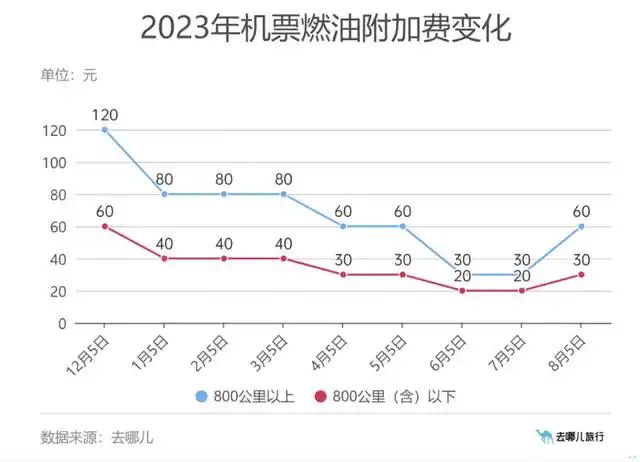
This adjustment is based on an additional charge of $60 per passenger for fuel and $110 per passenger per passenger for more than 800 kilometres。
Following the first increase in fuel surcharges on domestic routes this year, another significant increase was made in september, up $30 and $50, respectively, from the current fuel surcharge rate and close to 60/120 at the beginning of the year。
In accordance with previous practice, other airlines will continue to notify the platform and agents of the same adjustments to fuel surcharges。
This increase in the fuel surcharge is related to the continued recovery in the price of international aviation oil。
Since 2022, international oil prices have risen sharply to close to $140 per barrel at the beginning of last year, and by the end of 2022 they have fallen sharply to close to $70 per barrel, with a consequent downward adjustment in domestic fuel surcharges。
In the first half of the year, fuel surcharges were reduced three times. By the first half of july, however, oil and oil had re-entered the $80/barrel and $75/barrel level. On 27 july, us$ 80 per barrel of oil, the first us$ 80 per barrel since 20 april of this year, was reached by us$ 80 per barrel。
The recovery in international oil prices has also led to higher costs of domestic oil purchases. According to the civil aviation authority, the cost of consolidated procurement of aviation kerosene for the third quarter of inland airline flights has been adjusted from $6267 per ton to $7453 per ton as of 0:00 on 1 september, so that airlines may increase the rate for charging surcharges for fuel, in accordance with the mechanism established by the civil aviation domestic airline fuel transport plus with air kerosene prices。
The increase in fuel surcharges has led to a further increase in the cost of travel taxes just after the summer season. With an increase in fuel surcharges on 5 september, combined with airport construction fees, a maximum of 160 dollars would be required to pay for shipping fees for more than 800 kilometres。
However, as compared to the summer season in july, the current price of the tickets has fallen. According to the flight housekeeper, the average domestic fare (economic class) was $710 on the eve of the mid-autumn national day (1 september-28 september) at the end of the summer, a 22 per cent drop in the ring compared to the summer ticket, which is 41 per cent lower than the mid-autumn national day。
By the end of september, the price of air tickets had again increased significantly. According to the circular on partly holiday arrangements in 2023, issued by the state council office, the 2023 national day took eight days in a row, influenced by news such as the announcement of the mid-autumn national day holiday and the release of the third set of exit destinations, and the number of airline tickets and reservations for the mid-autumn national day on the ota platform increased significantly。
Data on simultaneous travel show that the average domestic air fare on the first day of the mid-autumn national holiday was approximately $1293 (excluding tax and excise prices), an increase of nearly 40 per cent over the summer. From 26 september, domestic airline fares will increase significantly. On the first day of the national holiday (29 september), the average international air fare was approximately $6696 (excluding taxes and fees, the same as the previous), which was about 72 per cent higher than the average summer. Starting on 25 september, international airline fares will increase significantly。