Fault 1: the wheel rotates in only one direction when washing (no change)
1. Fault phenomena
In the washing process, the wheel is continuously rotated in the same direction (e. G., by clockwise only) and cannot be trans-shipped at normal rhythms, resulting in clothing entanglement, uneven washing and even damage to the electric power。
2. Causes of failure and maintenance steps
First check -- the timer's wrong
The machine uses a mechanical scrubber timer, and its internal cavity handler is being reversed and rotated。
When a timer is installed or replaced, any two lines in the public end, the right turner, or the reverse turner are reversed or mislocated, resulting in the electric power being continuously charged to the same transfer。
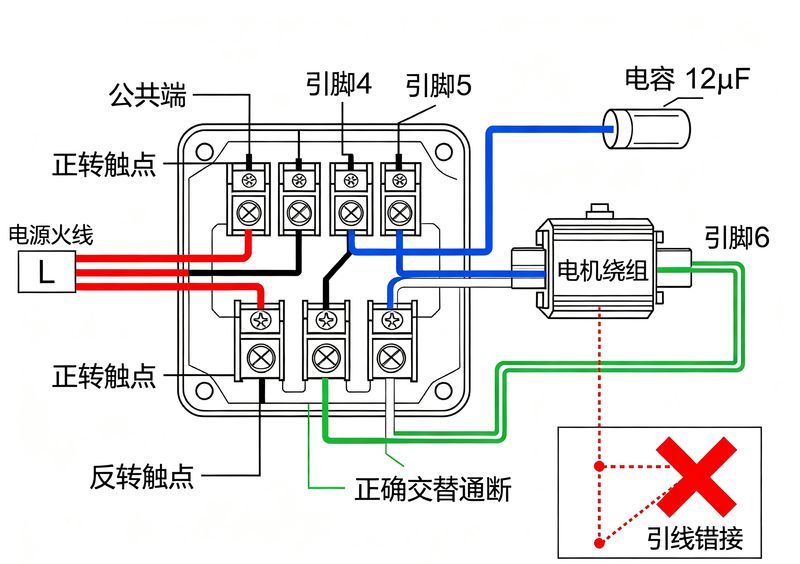
Operation: disconnect the power source, turn on the control disk, re-check the timer's leg definition against the internal wall of the fuselage or the wiring principles attached to the instructions (see the annotated below). Usually, the timers have a total of 6 to 8 endpoints, of which the “public end” connects the power-fire line and the “turning” connects the end of the capacitors (or the sub-engineer convection pump) respectively。
Measurements are carried out in the form of a single timer, which rotates to the detergent slot, with the public end being cut off from the reverse and the reverse end, and, if a fault is detected, re-pressed or welded, as defined correctly, and covered with a nudity tape。
Minor possibility - mechanical damage to the scrubber interior
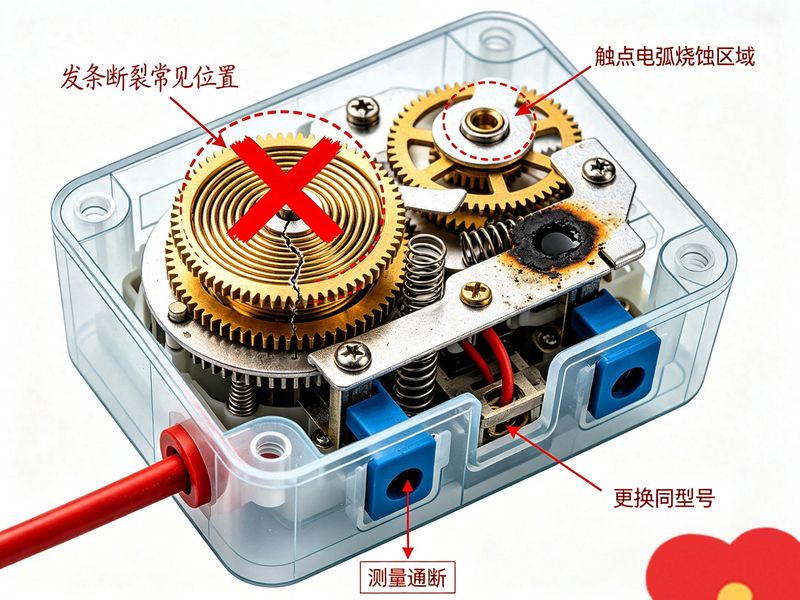
If the connection is correct, but the failure remains, the cogs or contact springs inside the timer may be worn and fractured so that the reverse contact point remains closed。
Operating: the swing timer switcher, feeling the balance of the blocker, measuring the break in the stairwells with a mass-use table if it is slow or lax, and replacing the same type of timer if a road is always broken (recommended to select the original plant or a quality-reliable alternative, rated current zero 6a)。
Additional check-starting capacitor capacity decay
In a few cases, the capacity of the capacitors (usually 10-12 μf/450v) has been severely reduced, resulting in a failure of the engine to activate the rectangular rectangulars and to overcome resistance in reverse, leading to a “perfect one-way” rotation. The capacitors can be removed and the new capacitor should be replaced if the deviation exceeds 10% by a digital capacitor table。
Security: all power plugs must be removed prior to operation and the capacitor must be discharged (with a resistance or a screwdriver short of two feet)。
The typical wiring principle of the machine is "the power l zero timer public end zero timer timer zero timer zero zero zero zero zone" if the timer itself is damaged, each line colour (e. G., straight turn of the blue line, back turn of the white line, yellow green line) must be recorded in the replacement to avoid confusion。
Battery ii: high noise during dehydration (beep or sharp noise)
1. Fault phenomena
During the dehydration start-up or high-speed operation phase, periodic “twilight” impactes, sharp frictions or continuous soundings are heard in the aircraft, which are well beyond normal operation and even accompanied by a violent shaking of the body。
2. Causes of failure and maintenance steps
Core cause - loose or partial dehydrated components
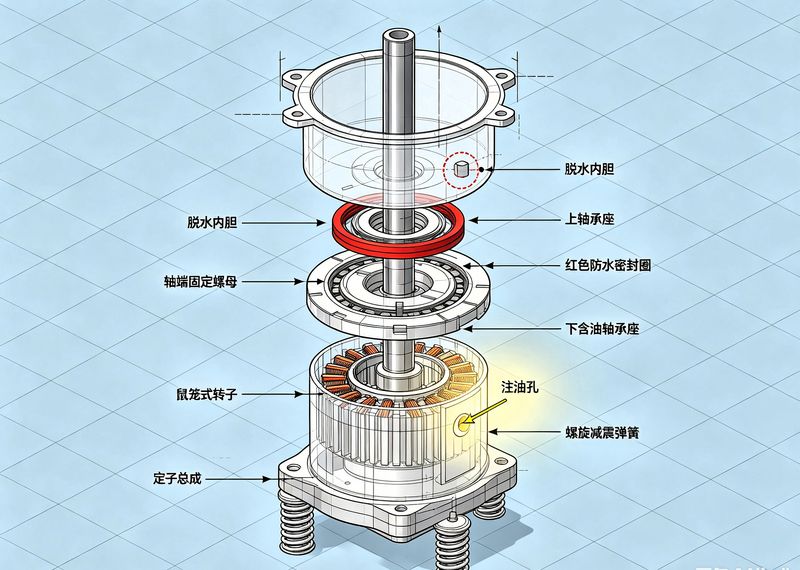
The dehydrator (inner urchin) is connected to the electric motor axis through the central axle and, after long-term use, the fixed nut may be loose, or the shock-reducing spring, rubber-beded coils below the tube are aged and deformed, resulting in the internal urchin swinging, scratching the outer barrel wall or touching the safety switch at high speed rotation。
Operation:
1 opens the dewatering barrel cap, removes the decorative cap in the center of the urchin, re-concentrates the axis nut with a special drum wrench (usually 10 mm or 12 mm), and the twisting is controlled at 15-20n. M. It is not appropriate to overwhelm to prevent slips。
2 checks whether the three suspension-defunct springs below the cartridge are fractured or inelastic, and if so, the replacement set。
3 checks whether the gap between the dehydrator and the jacket drum is even and, if the inner is timid, the base support bolt can be adjusted appropriately。
Lubrication — shortage of oil in power-driven axes or bearings
Most of the engine's motor bearings are oily powdered metallurgy bearings, which, after several years of operation, dry up the lubricant oil and produce high frequency whizzing through the bearings and dry frictions on the neck of the axis。
Operations: under power outages, remove the rear lids, find the aqueous holes (or small rubber plugs) on the electric motor axle end and bearings, drop three to five drops of sewing oil or special high-temperature lubricant oil (do not use edible oil or ordinary oil to avoid high-temperature carbonization). At the same time, hand-turned axes are held up and, if still nuanced, can be injected and re-engineered several times, pending infiltration of the fluid。
Deep faults — motor bearing wear or rotor scanning
If the noise remains after the hardening and lubrication, the probability is that the inner or outer bearings of the bearings are migraine, that the gap is too wide, leading to a rotor eccentricity, and that at high speed the twirl and the rotor (cleaning). At this time, the electric power plant will be removed, the bearings will be pulled out by the rama and replaced with seal bearings of the 6,200 or 6201 type, of the same size (depending on the particular axis path), and the contour surface will be cleaned。
The typical construction of the heil xpb60-187s dehydrator - top-down: dehydrated urchins, axles, waterproof seals, upper axle bearings, electric motor rotors, lower axle bearings, draining leaf wheels. Of these, if the seal is leaking, the leaking of the water into the bearing will accelerate the damage, so the oil seals should be replaced simultaneously。
Battery iii: no dehydration at all (barrel does not turn or is weak)
1. Fault phenomena
After setting dehydration time and covering safety, the dewatering drums do not react or “muck” but cannot be activated, and the timer eventually remains inactive。
2. Causes of failure and maintenance steps
Most common cause - dehydrator timer damage
The dehydrator timer is mechanical and contains multiple sets of contact points. Long-term and repeated tightening, release, exhaustion, break-ups or contact burns, preventing the power from being imported。
Operation:
1 turn down the timer button, remove the control panel and remove the timer from the panel。
2 the manual rotation of the timer axis, if it is able to rotate indefinitely without resistance, indicates that the hairline has broken; if it returns immediately after the stroke, it is not tightened or the internal gear is jammed。
3. Measuring the break between a timer's inbound and outgoing lines in 10,000 meters: when it rotates to a "0 " position, it should be channeled to any dehydration slot. In case of persistent failure, the contact point is damaged。
4. Replacement of dehydrators with specifications (commonly 15-minute and 18-minute specifications, rated current thallium 3a) and maintenance of the original chromatography (usually red power, blue power, black switch)。
Conjunctive phenomena - dehydration timer lead to fall or oxidation
Frequent dismantling or vibrations may result in a loose, welding of the end of the timer line, or even a break of core within the guidance line. The pressure end of each fuse should be checked for strength, and if oxidation, re-plugged with sandpaper and reinforced with a thermode。
Other associated malfunctions (to be checked in conjunction)
1 poor contact with the security cover switch: a micro-movement switch is placed on the dehydrated barrel lid before the circuit is closed. If the switch reed is deformed or oxidized, even when the timer is intact, the electric power is not powered. The contact point can be repaired or the micro-engineered switch can be replaced directly by a thin blade。
2 the dehydrogenerator initiates the failure of the capacitor (as in the case of the failure one, the process cannot produce a rotating magnetic field, with only a “muding” sound, if the capacitor penetrates or the capacity disappears). It can be followed by a new capacitor test。
3 holders or brakes are stuck (some of the machines have centrifuge brakes): if the brakes are not fully released, they will mechanically lock the electric axes, at which point the brakes will have to be adjusted or the oil on the brakes cleaned。
Maintenance validation: replacement of timers or repair of circuits without clothing, security covers, manual rotation timers, observation of the smooth acceleration of dewatered drums to high speed. If everything is normal, a small amount of wet clothing will be put into a test operation to confirm that there are no abnormal vibrations and noises。
Generic maintenance attention
:: tool preparation: cross/one-word screwdrivers, drum wrenchs, universal meters, capacitating meters, rama (axis removed), lubricating oil, insulation tape, thermal inverts, sandpapers。
:: safety first: the washing machine is a mixed water and electricity plant, which must be unplugged before maintenance is undertaken and the body is tilted so that the water is drained and electrical contact is prevented。
:: purchase of components: timers, capacitors, bearings, etc. Are proposed to be purchased through hale after sale or through the regular electronic parts dealer to avoid secondary malfunctions due to mismatching of parameters。
:: test inspection: after repair, the test aircraft will be empty and then progressively loaded to see if the conversions are normal and if the noise is within reasonable limits。