Every year, when you talk about literature, the most worrying question for parents is: is it that students are getting farther away from technology? Computers, artificial intelligence, semiconductors, the high-paying tracks, the professional threshold is kept in the sciences, and students cannot pass the curriculum vitae。
This anxiety is justified, with the exception of one humanities profession — intellectual property. It's the few ways in which humanities can deal directly with technology companies. Patent agents, trademark registration, copyright protection, and a large number of clients of these services come from science and technology enterprises and research and development institutions. You don't have to write code, but you need to understand what is at the heart of a technological innovation and how to protect it in legal language。
I. Patent agent qualification has a threshold for science and technology, but arts students have their own battlegrounds
The most robust qualification in the field of intellectual property is that of a patent agent. The conditions for admission to this examination do require scientific and technical background, which requires more than a degree in science and technology. This means that students with a purely humanistic background cannot become patent agents and cannot directly represent the writing of patent applications。
This does not mean that there is no space for students in the field of intellectual property. Patent agents are only a branch of the intellectual property industry, and there are two large plates of copyright and trademarks, which are fully open to the literary background. Trademark registration, brand protection, copyright transactions, ip authorization, intellectual property administration, which do not require a scientific or technical background, require legal, managerial and text analysis capabilities, which are the strengths of humanities training。
When a scientific and technical company introduces a new product, the patent agent is responsible for writing patent applications, the trademark agent is responsible for the registration of brand names and logo, and the copyright lawyer is responsible for registration of software copyrights and compliance with open-source agreements. Within an intellectual property team, there is a division of labour between the scientific and technical background and the literary background, not between whom。
Ii. Courses and employment directions for intellectual property professions
The course for the intellectual property profession at this stage includes copyright law, trademark law, patent law, intellectual property administration, licensing and transfer of intellectual property. Compared to the legal profession, intellectual property rights are more focused and vertical, not about general studies of civil law and criminal law, but about the line of “how intellectual achievements are protected”。
Employment exports are concentrated in several types of institutions. The intellectual property agency and the intellectual property department of the institute, which acts as trademark agents, copyright registers and ip litigation support. The intellectual property department of the scientific and technological company or the ministry of justice are responsible for patent trademark management and tort risk screening within the company. Copyright trading platforms and ip operators perform copyright trading and ip incubators in film, games, publishing. The national intellectual property authority and the local intellectual property protection centre are administrative and review bodies for intellectual property and are part of the institutional direction。
Iii. Which schools deserve attention
There are few schools specialized in intellectual property, and they are concentrated in institutions of political law and general education. The institute of intellectual property of the university of east china law is one of the country's earlier independent intellectual property teaching institutions with a relatively solid accumulation in the direction of copyright and trademark law. The intellectual property rights of the university of economics and economics of sino-south china are in the brand direction within the system of legal disciplines, depending on the dual advantages of the school in financial affairs and law, with a preference for intellectual property administration and operation. There is also a degree of accumulation of intellectual property at universities, particularly in courses on patent retrieval and the practical orientation of intellectual property。
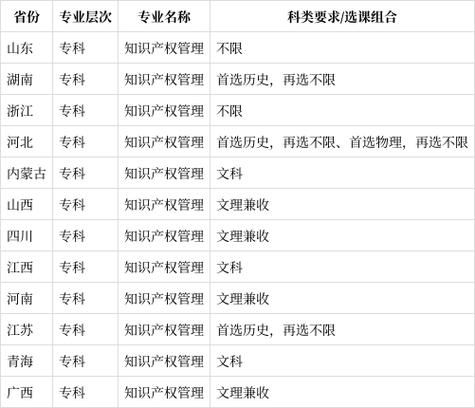
In terms of scores, intellectual property rights are admitted to most schools on lower admission lines than the law of the same school. According to the results of the admissions in 2025, chinese government intellectual property rights in shanghai are between 1,200 and 1800 lower than law. Using a slightly lower score to move into a subdivision with direct dialogue with the science and technology industry, the value of the product is good for students。
The limitations of this subdivision also need to be seen objectively, as the total number of ip counterparts in the country per year is less than in finance and the internet, and is concentrated in front-line cities and headline enterprises. If you want to stay and work in small cities in your hometown, this profession may have limited space. But if you're willing to go north to a city with a large number of big technology companies, intellectual property is one of the directions in which the arts and technology industry can be associated. In 2026, some political and legal institutions may adjust their professional set-up and recommend that candidates pay attention to the latest regulations for admission。
The admission figures are used here for 2025 and 2026 for admission are based on the admission plan for that year and a one-part table。