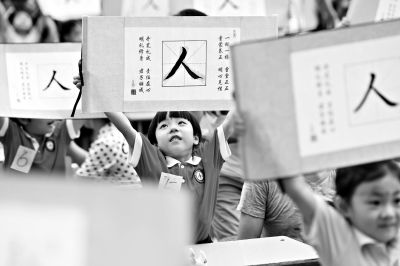
First-grade freshmen present their own writings of the word “human” during the opening ceremony of the new semester. The xinhua society provides maps
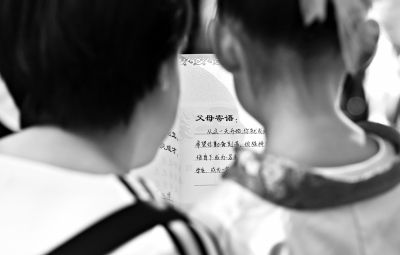
The first grade parents send messages to the children. The xinhua society provides maps
The month of august is approaching, with a long summer coming to an end. The rest of the time is filled with anticipation and uncertainty for the “peas pack” and parents who are about to enter first grade. How, then, can we help “kids” transition to “pupils”? What should parents be prepared for? Journalists interviewed experts from the parties concerned。
Listen to the weather
It helps to get kids focused
“when a child enters the first grade of primary school, he or she is particularly vulnerable to incompatibilities in four areas, namely, time spent, attention, ability to take care of himself or herself, life habits, etc.”. At the 48th public service lecture of the family education hall of the haidian region, the head of the primary school attached to the beijing petroleum institute, xiao ying, shared his experiences with parents in developing young connections。
According to xiaoying, in terms of time spent, kindergarten is dominated by activities and games, with few teaching activities. The three-tier curriculum of the primary school system, on the other hand, does not have a special nap time, which is completely different from kindergarten. As a result, children are prone to early morning and afternoon napping after school. In that regard, she suggested that parents should make reasonable arrangements to sleep at around 8:30 p. M. In addition to early evenings, parents may, as of august, be consciously trained not to take a nap or to take a purposeful trip to make the child become accustomed to not taking a nap。
Shao ying also found that there are problems in primary school children who are just entering grade 1 who do not dress themselves, tie their shoes, pack their school bags and do not care for their own learning tools and drink their own water. She suggested that parents could help their children to develop their proper self-care skills through teaching methods, intensive practice and supervision. At the same time, children should be given the opportunity to develop health, ritual and other practices appropriate to primary school studies。
Lack of focus is also a major challenge. According to xiaoying, the focus of primary school students is between 20 and 25 minutes, because the child's nervous system is still developing. As age increases, the lack of focus gradually improves. Parents can help their children raise their attention in advance through a range of methods. For example, focus is exercised by hearing weather forecasts on the temperature of cities; the breadth of attention is trained by listening to prolonged sentences and repeating them. “these methods are mainly through language communication, allowing children to capture words and keywords, thereby increasing attention. In addition, we can play catch-and-show games with our kids, so we can get more attention.”
Don't go blind in preschool
It's easy to lose focus
With the start of school approaching, the beijing primary and secondary school psychosocial counselling centre received a large number of parents with anxiety and confusion. One of the most important topics of concern to parents is the need to “fly birds first” and to use the summer break before entering primary school to find one-on-one tutors or enroll in pre-school classes。
In beijing, the head of the centre for psychological counselling of primary and secondary schools gave his advice from the point of view of psychological development. The most immediate consequence of the “first fly” during the holidays was that the children went to the classroom and lost their patience to listen. In the long run, children are reluctant to listen to the in-depth, hard-to-reach part of the past that tends to create a bad habit of being distracted.”
On the other hand, the chinese institute of education and science researcher tsai tsai said that parents had to look long-term at the growth and development of their children. He said to journalists that there was a famous “twin-kid climbing” experiment in psychology: one pair of identical twins had to practice climbing the stairs, one of which had begun practiced 10 minutes a day in the 48th week after birth; the other had begun the same training in the 53rd week after birth. By 54 weeks, one child had practiced seven weeks and the other only two weeks. So, which one of these two kids is higher up the stairs? The results of the experiment are unexpectedly high, with only two weeks of training for children climbing the stairs at a faster pace. “so, some training institutions claim that, after training, the children are more focused and have greater memory than untrained children. In fact, such comparisons are of no value to the child's growth and development, since some abilities can be developed naturally after a certain period of time.”
The honorary principal of the beijing shilling primary school, djoley, specifically designed a parent's handbook " welcome to the first year " for parents facing young connections. He described a number of countries in east asia and europe where children start their first grade at the age of five. What's the point of a five-year-old trying to study in class? It is to understand the rules of the classroom and to sit in it. From this perspective, there is value in getting into the preschool as a practice area. However, it should be noted that pre-school classes are intended to anticipate the way in which the upcoming classroom is taught, rather than to receive early indoctrination in the first and second grades of primary school. In addition, another important role of pre-schools is to enable children to advance some of the problems that may arise in the coming primary school life. In this way, parents can be given a timely reminder to find a response earlier。
I'm looking forward to it
School attitudes reflect family problems
Soon after he had received the notice, he had organized school education to help them understand the new environment in which they were going to study and to know their future classmates. It was not surprising that, after schooling, a new habit had been added to the holiday: to grind grandpa around his new school every day. If the school didn't open during the holidays, he was lying at the door for half a day. The heat of the sun is often sweaty, but his grandfather could not persuade him to go to the shade. Grandpa was so upset and desperate that he found the beijing primary and secondary school counselling center
Contrary to the rhetoric, there is another extreme that comes to beijing city's primary and secondary school counselling centre: in remote homes, “schooling” is almost taboo at home. As long as someone mentioned going to primary school, they turned their faces and were crying and screaming. Mom and dad were so sad, "this is not school, it's not school, what's next?"
According to the director, both extreme states of mind require parental attention. Generally speaking, the high expectations of schooling are indicative of the emotional deficit that children feel in the family, “the adult population in the family is less concerned about, and has to look for attention outside the new environment”. He reminded that children in such situations were easily “bad friends” and were eager to find avenues for emotional communication and disclosure, so that “bad friends” had an opportunity。
The child's attitude towards school avoidance reflects the opposite: “the child's tendency to become over-dependent on family relationships is detrimental to the child's transition from natural to social”. In such cases, it is suggested that efforts should be made to bring the family environment, standards of conduct, etc. Into line with schools, parents are unable to do anything, and children are encouraged to take the first step towards independence。
Who's running the kids' school
Family education is important
In recent days, the beijing primary and secondary school psychological counselling centre has also received counselling from a number of family groups. The children are not in school yet, and the battles within the family have begun. In the case of the nono family, where parents were in conflict with their school hours and could not deliver them, they had to ask their grandparents for this difficult task. I didn't think grandma and grandpa would insist on the view that, “if the children leave us here, everything has to be done, and the parents have to do it”. When the parties did not agree, they came to the counselling centre for expert assistance。
The director said that one of the important principles in family education was “consistency”. He referred to several four-word principles: the division of labour and cooperation; close liaison to enhance trust; active demonstration, compliance; and ownership of the principle as a first step。
In fact, parents who cannot afford to bring their children on a full-time basis need not feel guilty and be too worried. An earlier study by the professional committee for family education of the chinese institute of education revealed that the involvement of grandparents in child-rearing does not have a negative impact on the parent-child relationship; it does not have a negative impact on the child's ability to adapt if the ancestors are only partially involved in the upbringing of the child and not playing a leading role in the upbringing。
In the handbook for parents, principal drenley also analyses the question of “who will take care of the child”, and most of the younger parents now work full-time. At the start of the school, most parents will discuss who is more flexible in working hours and who is more energetic in working time, and who is primarily responsible for managing the children's studies. “it is important to have the time and energy available, but i think the best choice for this matter over the years, after dealing with parents of many different personalities and modes of communication, is who is more willing to take care of the children。
Zoro indicated that it was easier to find management because of the will to do so, to spend more time watching children, to have more patience and communication with children, to help children to sum up their routine skills, etc. If, unfortunately, the party more willing to do so is busy, then the parties can negotiate a division of labour after full discussion. For example, when a plan is developed, it will be implemented by a better-timed party and will be adjusted by feedback from each other during the child's learning process until the pace and form of learning for the family that is best suited to the child is found。