

Following the evolution from traditional media to the whole of media to the integration of media, the criteria for the selection of news by audiences have become more demanding today, when there is a growing need for personalization. In this environment, the importance of news titles has become more prominent — they play an important role in creating news outlets and attracting audience hits. Journalists' editors see the title as a key factor in determining the number of hits on their work, including financial media and financial journalism。
From “three sets” to “crossing standards”
In traditional journalism, newspaper editorials, a norm, complete news titles include shoulder, theme and subtopics. They are like “three sets” of division of labour, and together they pull up the text of the news. With the reform of the press that began in the 1980s and the rise of the urban newspaper in the mid-1990s, the three lines were completely broken and replaced by a simple one。
When the style of a line is established, the length of the title becomes the focus of the debate between the “old editor” and the “master”. Around 2000, the title was short. At one time, there was a consensus among industry that the “crossing standard” — an important print and feature press release with no more than 10 titles. On july 13, 2001, beijing was successful when the headlines of numerous newspapers, along with extra-headings, used only four words, “we won”, and even two words, “we won”, and what was the word “short”。
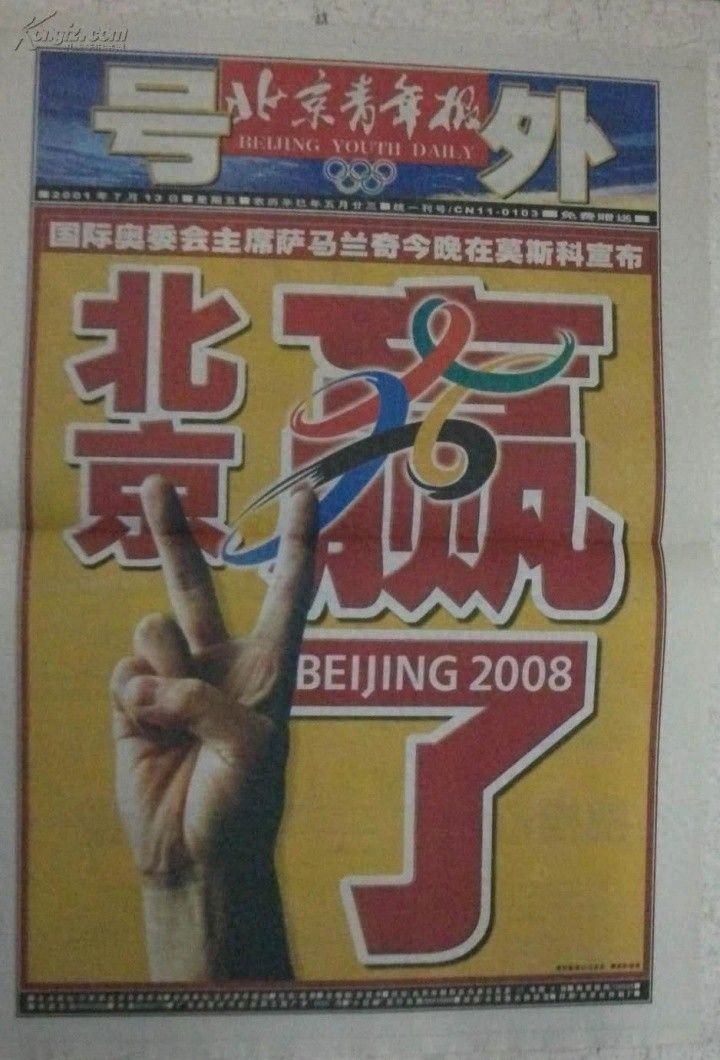
The title of the beijing youth journal, no。
From the “three cars” in boots and hats to a simple line, the headline of the news is a rigid mindset that highlights the inner core of news messages and the distinct character of the media. Essentially, it is a return to its essential features。
Pluralistic style of news titles
At the beginning of the twenty-first century, the rapid development of communication technology led to the advent of an era of information retrieval, with the rise of the internet as a “fourth-media” alien force with unprecedented impact on traditional media, particularly paper-based media. The online media is not only time-bound, but it has dozens of, if not hundreds of, channels and sub-channels that can cover all of the content of the paper-based media, while the web-media editors simply have to focus on the front pages of each channel。
With the rise of online media, the “cross-the-cross standard” is invisible and the title can be squandered at will. A strong intuitive, popular, individualized title has begun to fill large paper-based pages, such as "standing up to double-done national production at one foot" and "x-x-standing off the restricted area" and the sec pulls out red cards, making it unclear whether it's reading the financial news or watching a game。
Under this influence, the news titles have rapidly evolved towards simplicity, pragmatism and subjectivity, with the inherent written language style becoming blurred. There is also a cross-section of headline styles between different news features, such as the informationalization of communication titles and the speech of news titles。
The diversity of the style of the headline of the news is essentially a response of the media to the changing needs of the vector and audience. This change not only reflects the era of socio-economic and cultural development, but also the growing audience of mainstream media。
The title of financial news is confused
Financial and economic news, unlike news in the current and life categories, is more specialized in terms such as savings reserve rates, the procurement manager index and first-time public equity of non-listed companies, which always constrains the role of the headlines。
In order for readers to read the financial news, editors tend to pour their pens over the title. For example, in a single issue of the economic journal in 2003, the second edition of the front page, 37 words, 14 words on the subject, 162 words on the subheading and 213 words on the whole, almost all the news facts are shown in the title。The media ageThis has been repeated, leading to confusion over the title of the financial news。
The title is confusing
—long or short? The headline display of the dissemination platform generally has 20 to 30 words (including the same lines), i. E., two to three lines, and the extra parts need to be opened to see. What is the length of the title
—face or point? Financial and economic news, particularly important policy information, mostly relates to a particular industry or whole market, covering one or more aspects, with more news points, more attention or more? What if the title is general and the weight is too small
• peace or sharpness? The financial news of communications, which involves deep excavation and interpretation, often reveals deep-seated problems. In order to facilitate the resolution of the problem, should the titles of such articles be more balanced or sharper
– steady or fast? Should the mainstream media be “leading first” in the face of a large number of demands for “self-media” and mass media? How to balance stability with speed
The advantages of short titles and the disadvantages of long titles
Statistics on the integration of media matrices (news, webs, end, micro, nodes) into mainstream media (mainly financial and economic media) show that short titles are now used more prominently. In the front page of the newspaper, the leading titles, which represent the whole period of fineness, dominate the indigence, and “short” is the best option for reading titles; in the new media platform, short titles have remained strong, and those that are the same as the newspaper's contents have mostly been changed by editors to short titles。
For example, it takes 100,000 + copies of the micro-literate “confidence of the economy”. Morning! News is here, 11,643 million dollars! 0. 5 percentage points! Central bank is down! Short titles like this are everywhere. There is no shortage of information in the press, such as the “public news-people's daily” “economic monitor”, on the major media and financial media outlets。

In an era of media integration, short titles have taken their course because they have the capacity to create news suspense and excitement and to create an audience's desire to read, thus bringing greater traffic to the articles. At the same time, the short and profound language glamour is sufficient to attract a wider audience。
However, the treatment of the title “a short one” is not without regret: on the one hand, short titles do not fully express the content of the news, resulting in a lack of balance and information; on the other hand, short titles have a high repetition rate and a low level of scarcity, which tends to lead to a decrease in freshness, causing “aesthetic fatigue” to the audience and, when style is solidified, they are “depletion”。
Along with short titles, the mainstream financial and economic media can also choose long titles and can also gain significant traffic. The daily economic news (eds) micro-news, which received more than 70 per cent of the financial flows in 2024, uses long titles. For example, on october 2nd, the hong kong stock race, stock surged by 440%! Inner-house and voucher stock surged! BÉled: the up-to-up rating of chinese stocks, "3300 points! A shares went up on september 30, and "00s later" went on the market. Some people made $520,000 in the morning calling for "money to collect" and "no vacation" for their internet friends. Numerous agencies suggested that the festival should be reopened, entitled 41 words and 55 words, with a reading of 100,000 plus。
The in-depth survey report of the u. S. W. W. W. W. P. Also uses long titles. For example, on 1 september 2024, “the exposure of the “sulphur overstates” was revealed. Journalists hit the scene at night: it was too hard to breathe and tears were running...” with 36 words; on 22 september, “170,000 first payments went down and 20,000 “zero first payments” “super low first payments” were really available?”, entitled 28 words. Both pieces have 100,000 + readings。
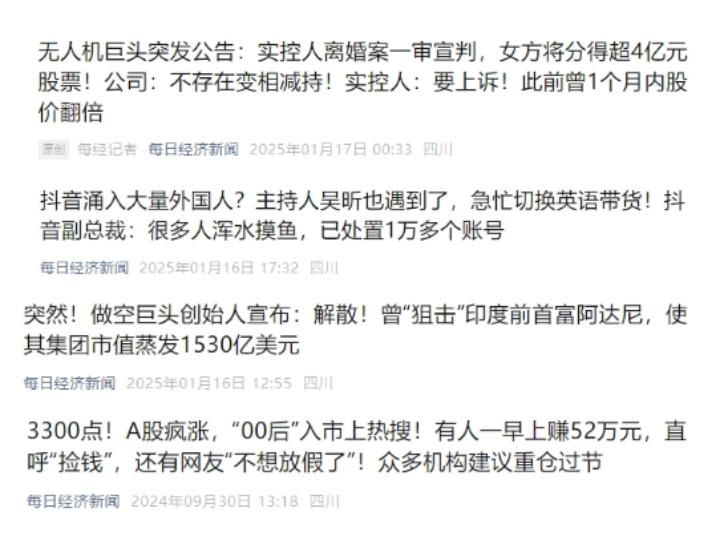
The long title highlights the subject of news facts, singles out key news points, allows for efficient reading and allows the audience to decide whether to continue reading. In particular, financial journalism, where long titles are very helpful in interpreting professional conceptual terms or providing background information, professionals and audiences requiring in-depth knowledge of specific topics tend to prefer long titles containing detailed information。

Again, there are several weaknesses in long titles. One is the ease with which key words can be created, leading to the fragmentation of weights and the separation of themes; the other is the number of words that are subject to the headings of the communication platform, which cannot be presented in their entirety, “the dragon never ends”, which tends to lead to a decrease in audience experience; and the third is the subject of the communication platform's media pool's large data model algorithm, which makes it difficult to quickly identify and lock finalized files, thus affecting the rate of recommendation and ultimately the flow of communication and user retention。
How to select the length of the title
The length of the title is a dialectic and is not appropriate for blindness and solidification. But the choice is still a test of the business credentials of a new media editor, with certain principles and techniques。
Taking as an example the 2024 mainstream media micro-inform public-flowed works, short titles can be selected in the face of press releases and works featuring the following features: quick news, such as the “new deal for house acquisition” in beijing on 30 september in people's daily; news spots focused or involved in a single event, such as the “economic monitor” on 15 august, the hot search first, all over the internet!; news spots averaged and involved, such as the “sinhua” photo coverage of the achievements of the 75th anniversary of the establishment of the new china, “these are not easy to achieve”; more professional and focused audiences, such as the “economic monitor” on 22 august, “both of market a”!; and those wishing to leave their audience with the “sinceration of the nation” film, “see cry。

For press releases and works featuring in-depth coverage, person interviews, and professional focus, such as the city, fire, 5 october, "observe the economy, fire! The mood is high! The tourists are up! They're spending billions of dollars. What's that? America's share of panic is on the rise! The situation in the middle east is escalating! The market is “shocked”; there are different situations or views to be displayed, such as the daily economic news, “forty-five houses a day” on 6 october! Four major cities with long-term false buildings are hot in the city, and some people are busy until early morning, talking about “smoking throats”, but others say “pre-high and low”。

(by the director of the new media department of the economics monitor)
