Four methods for fast memory of english words
I. Composite memory approach
That is, in the course of memory words, as many sensory organs as possible are mobilized to participate in memory activities. In other words, we try to read words with our eyes, with our ears, with our mouths and words, with our hands。
Ii. The limited member methodology
That is, in the process of remembering words, care should be taken to observe the interrelationships between words in form, tone, meaning, etc., and to revisit old words on the basis of the rapid recollection of new words and, through analytical thinking, to translate limited knowledge of words into an unlimited ability to understand new words, thereby familiarizing themselves with their changing patterns, making them more systematic and comprehensive。
(i) the new words of memory
1. Phrase: old mushroom, new root quite (very, very, very) old quiet (silent, quiet) new thirsty
2. Terminology: synonym memory:
Newseat old sit newartive old reach
New fast, quick -- old quickly, soon, new high -- old tall,
New say, tell, old speak, talk,
New form of, a great deal of old, a lot of
Counterword memory:
New heavy-old light,
New tall - old short,
New fast-old slow,
New come-old go
New buy - old soll
New small - old big new fat - old thin,
Newlend – old borrow,
New hungry – old thirsty
3. Voice: the new flour old blower the new write oldright
Terminology: lift (noun, elevator)-lift (verb, lift, lift)
Quiet -quiet
Green - greens
Bear - bear
Book (nouns, books) - book (verbs, reservations)
Note (noun, bulletin, notice)—notice (verb, notice, note)
Bear - bear
4. Physics: new happiness old happiness, happily
5. Usage: new water put on, have on, dress
(ii) recollection
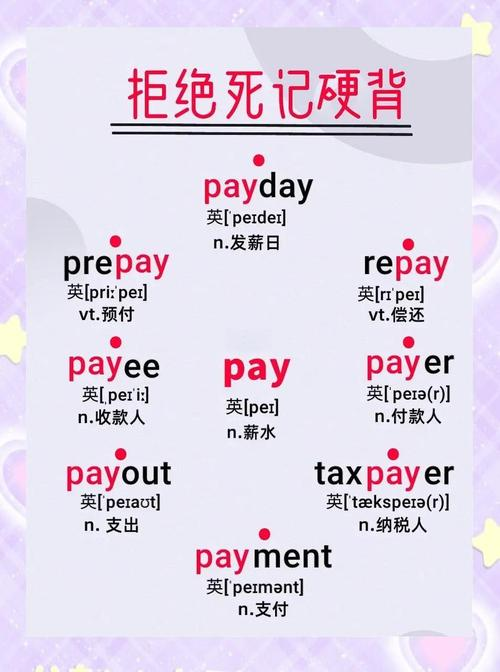
The new term: unusual remembers and joins: happy (adj. Happy), unhappy (vi. Unhappy), usually (adv. Often) usual (adj. Normal) reasoned and concluded: unusual (adj. Unusual) in english, in fact, the term is called birthright, which is the method by which a prefix or postfix is added to the root of a word to form a new word. And it's 70% important in english, so learning the root words not only can be a valid memory word, but can also inadvertently find the intrinsic link between words. There are many prefixes and suffixes in english, and the main ones that appear in english in junior high school are:
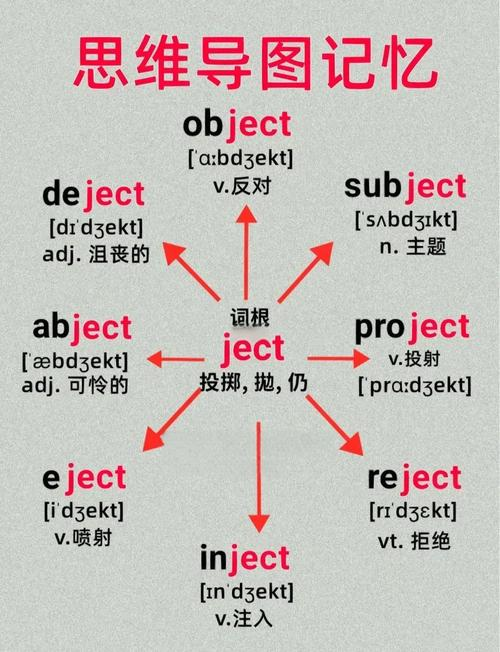
Noun suffix:;
Adjective suffixed with:-ful,-less,-able,-ed,-nt,
Several words followed by:-teen,-ty,-th,
Prefixes: negative prefix; un-, im-, dis-,
Other prefixes are:re-bi-mis-
(iii) new words
In english at the beginning, there's a common phenomenon among students, which is to remember english spelling, but not to remember the chinese meaning of words. The method is to break separate words into pieces and add to one's imagination so that the complex chinese meaning is firmly remembered。
Example 1: scarà s + car a snake was crushed by a car with a scar
Example 2: cold without sweater, criticized
Example 3: familyà fa(other) + m (other) + i + l (ove) + y (ou)
Example 4: dessert and desert are often unable to distinguish between desserts and deserts. We can think of sweet, anddessert has two, so be sweet, so it's dessert。
Iii. Methodology
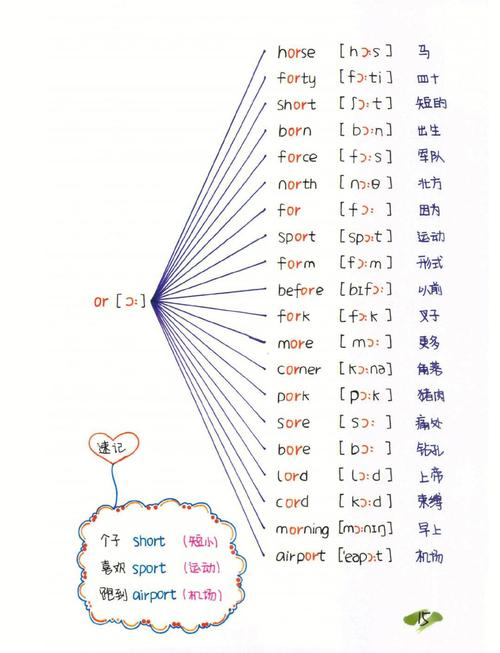
Even in the process of remembering words, words that appear to be unconnected or less connected are collated, summarized and, according to their preferences, made up of easy-to-mouth, broad-based mouths. It also makes the memory of words interesting。
In the case of example 1, the word memory machine of negro, hero, tomato, potato, the four words ending in o need to be added to the --es, which we can put together: black heroes love tomatoes。
Example two, the verb becomes a three-person odd plus es. The verb ends in a three-person singular. According to chinese spelling common sense, we can find sh(e) snakes, c(i) eat, x, o, s(i) die. They were linked together into a mouthpiece: the snake ate a bottle of wine and died。
Example 3: sensory verb memory machine 1 "sense" 2 "listen" 3 "let" 4 "look" 1 "feel" 1 "sense" means "hear, liechtenstein to" 2 "hear" i. E., make", have, let; 4 "see" means "see", watch, notice, look at。
For example 4, the term "f" or "fe" is used to change when a complex number ends:
Thief's wife picks leaves, meets a life wolf, and he cuts his own knife in half and throws it on the shelf
Example 5, similar to a word memory device
Ten ten-net web portal: ten webs。
Pot pot, pot -- top
Not, no-- ton mouth: i'm more than a ton。
Step step-pets pets (complex number) mouth: pets go step by step。
Tops (complex) - spot locations。
Dog-god god mouth: dog god。
Rats rats (complex) --star stars mouth: rats count stars。
Iv. Gap repeater memory
Many students reflect that the words written on the first day are forgotten on the second day and are usually dedicated to a period of time. In fact, mechanical memory has not only failed, but has also wasted a lot of time. Here, students are advised to write on a note the day before, either in the classroom or in the canteen or on their way home, using the gap to take out the note for a review. The effective use of sporadic time and the constant repetition of incentives make the memory of words easy and simple。
In short, english learning methods are diverse and there are many effective word memory methods. It was to be hoped that the students would succeed in these methods while making innovations and breakthroughs, and that the memory of words would not be the work of the hour and the year would continue. In future english learning, care should be taken to break traditional mindsets and develop an innovative english learning capability. Try!