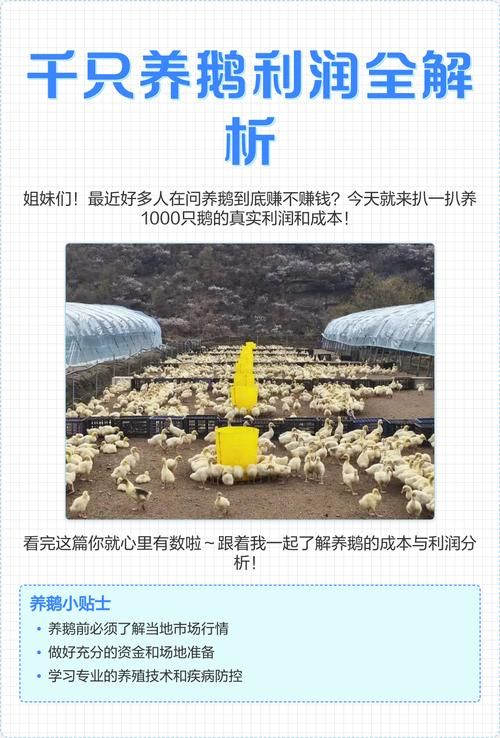
1. The analysis of the cost of rearing geese the cost of raising a goose becomes a popular “hotspot development project” because it is a herbivorous waterfowl, dominated by herbivores and a short, flat and fast project to develop the pastoral economy. Here's an analysis of the cost of raising a goose that the wtt has prepared for you. An analysis of the cost of feeding a goose. First, there should be a hot and warm nursery and facilities, such as a fuel tank, a drinking tank, a shredder, a slurry. After 20 days, the geese press 8 square metres to prepare the geese. The geese have to choose to be built in a place that is easy to transport, slightly high ground, dry and far from other livestock farms. To keep warm and weatherproof, there should be a sports field in front of the house, and if there are bars to build a pool in front of the stadium. Second, for every 100 geese, there's 0. 67 hectares of arable land for grazing. In addition, there is a need for clean water sources and adequate quality feed. Here's some forage
Source 1, quality pasture. The geese are herbivorous waterfowl, feed-resisting, fully utilised with green grass, geese's cysts, large amounts of feed, digestive power, and grass-breeding geese can save good feed and reduce production costs. The weeds to be grown by geese are ryegrass, french bittersweeds, daisies, goose heads, purple flowers and blue corn. If we grow 667 square metres of pasture, we can feed about 100 geese. The cost of land rental, seeds, machine farming is about $150. 2. Stitching micro-storage. When straws are formed as fresh corn straw or dry corn straw shredded, they are added to the material on the lower surface and are added to micro-storages (fermentants or em troughs) and then fermented into the fermenting pond or plastic bag. In general, fermentation can be completed for feed feeding on 5-7 days of winter spring and 1-2 days of summer fall. The degradation of coarse fibres, after micro-storage, increases the concentration and digestion of coarse proteins and promotes the growth of geese

3. The costs of corn trim storage are as follows: crushed corn straw: 100 kg - 0. 02 usd/kg . 22. 00, corn paste: 15 kg - 0. 9 usd/kg = 13. 50, bean cake: 7 kg - 2. 60 yuan/kg = 18. 20 yuan, and wheat: 2 kg - 1. 00 yuan/kg 20. 00 yuan. Red sugar: $us 1. 00-$ 24. 00, salt: $0. 3-$1. 00-$20. 30, micro-storage: $5. 00, electricity at an hourly rate of $0. 50. Total 45. 50 yuan. Iii. The economic benefits analysis is based on the example of 100 meat geese raised by goose farmers. 1. Expenditure. Goose fees: $5. 50 for each goose, and $550 for 100 chicks; feed costs: 0. 75 for each goose
4 kg for feed, calculated at $2. 00/kg for feed, and $150. 00 for feed during childbearing: 0. 3 kg for feed per day at 95% fertility rate, and 235. 95 for feed per 60 day feed; $0. 67 ha for pastures; $0. 67 for medicine for disease prevention, disinfection and prevention: $ 1. 00 per goose, calculated at $100; and $0. 50 for water, heating: $0. 50 per goose, $50. 00 for 100 geese and above: a total of 1235. 98. 2匚o2 for revenue. The lowest purchase price for meat geese on the market in the calendar year was $6. 80/kg, with an average survival rate of 95 per cent per kilogram and a sales income of $2261. 00. Finally, 100 meat geese are raised, earning more than 1000. 00. If it's growing, growing, alive to pull a feather, or if it's done to a goose, slaughter
The benefits will be even more. 100 meat geese still benefit 700. 00 on a minimum weight increase of 3. 25 kg for 90-100 days of rearing cycle, as a result of exposure to goose varieties and herbs. Goose farming methods, not too distant, are herbivorous waterfowls, and have the habit of returning to the nest to produce eggs, so don't go too far. She does not eat grass, stretches her neck, chirps, etc., and she acts as a ovary, so she must be driven back to the shed in time to produce eggs. 2. Adequate feed should be fed to grains of 25 per cent, mixed feed of 30 per cent for grass or vegetable leaves, 250 g/day, 300 g/day, starting four weeks before the mother's egg is produced, and a full supply of good quality g/g/day forage such as autumn valleys, dry grass dust, etc. Where there are grazing strips, it shall be primarily for grazing purposes, with an appropriate level of precision. 3. Feeding at night and at night is an important measure to increase the mother's rate of egg production, especially in the pre- and mid-term stages of egg production, which is fed twice a night, making it possible to produce 40 eggs per female year. Four, keep the male geese fighting, and the herds are better made in front of her eggs, so that the herds don't cause confusion and affect the fertilization of the egg geese. The male-mother ratio of the geese is 1:605. Artificially assisted mating holds hands on the legs and wings of the female geese and lures the male to approach, and when the male steps on her back, one hand holds the female geese and the other hands the female-tails up the wings in order to mate. After several sessions of training, male geese when they see a man catch a female, they move towards mating, and when the female produces an egg, they mate artificially to raise the fertilisation rate of the eggs. Analysis of the cost of rearing geese