I. Central axis (1):
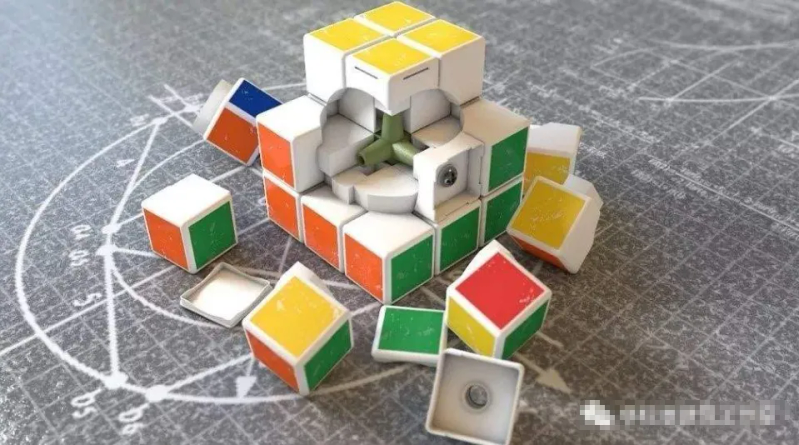
The supporting axes that are needed to support the diamonds and to rotate them。
Ii. Central blocks (6):
The centre block is connected to the centre axis, but it is free to move along the axis. The surface of the center block is square and the structure is slightly rectangular, but the side of the rectangular is not flat, and there is a cylinder connected to the center axis。
On the side side, the inner side of the center block will have a circular arc dent, which, when combined, can form a circle. When you rotate, the edges and horns slide along the groove。
Iii. Prism (12):
The surface of the prism is two squares, with a structure similar to that of a rectangular condensed from one side of a cube, which allows the elasticity to be embedded between two central blocks。
The radians on the surface of the rectangular are the same as the radians on the center block and can slide along. The inner side of a cube has a missing angle and, when combined, the centre block and the groove on the prism form a circle. When rotated, the prisms and horns slide along the groove. In addition, the missing corner was used as a fixed corner。
Angular blocks (8):
Angular blocks have three squares on their surface, with a structure similar to that of a small cube that emerges from one of the sides of a cube, so that they are embedded between the three prisms. As with the prism, the surface of a small cube has the same radians that allow the corner blocks to rotate along the dent。
Extension:
The form of the original cube
Second tier cube: also known as pocket cube, mini cube, little cube, ice cube, 2x2x2 cube structure. There are only eight horns per se, there are no other structures, and the structure is similar to the three-stage cube。
The three-stage cube: consisting of a central axis with six central blocks and eight horns, 12 prisms, forming a whole when connected together, and capable of moving horizontally on either side without affecting the other squares。
Four-stage cubes: the formation is divided into two groups, one of which is a sphere, each of which is connected by a small piece of the outer edge to the slide of the central ball, which slides in a strong direction during the exercise. The second is the four-stage cube, which is central to the axis, where the four-stage cube is the five-stage cube that hides the middle layer, where the small parts of the inner part are the five-order side-cardium and the mid-axis, with a lock-down trigger。
Five-stage cubes: a total of 8 horns, 72 blocks (two types) and 54 central blocks (48 moving, 6 fixed). The core of the five-stage cube is a 3x3 structure, so there are four central blocks for each colour。